1 – 2 s
Temperature = calibration. A color change occurring between 1 and 2 seconds indicates that the surface is exactly at the crayon's calibration temperature.
A wax crayon with heat-sensitive pigment that undergoes an irreversible, permanent color change once it reaches its calibration temperature. A single stroke verifies whether a part has reached the required temperature in welding, vulcanization or heat treatments.
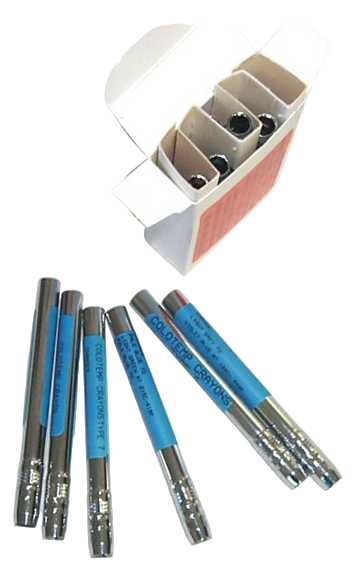
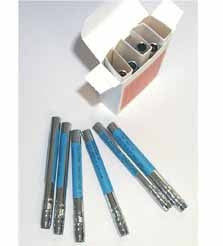
The temperature indicating crayon —also called a heat-sensitive crayon or thermal crayon— is a wax crayon with thermochromic pigment that changes color permanently once it reaches the temperature it is calibrated for. It is applied just like chalk on a chalkboard: a stroke on the critical point before the thermal process lets you check afterward, with the part already cold, whether the target temperature was reached.
Because it is irreversible, the change is recorded permanently even if the part cools down afterward, which lets you document the outcome of the process. Unlike electronic sensors or infrared thermometers, it does not depend on emissivity or surface finish, requires no calibration or batteries, and gives a direct reading at the exact point of contact. Its wax texture lets it mark any surface, smooth or rough.
Once the calibration temperature is exceeded, the stroke changes color permanently; it does not revert even if the part cools down.
A distinctive feature of these crayons is that it is not only temperature that acts, but also the exposure time at that temperature. The behavior of the color change shows where the actual temperature stands relative to the calibration temperature:
Temperature = calibration. A color change occurring between 1 and 2 seconds indicates that the surface is exactly at the crayon's calibration temperature.
Higher temperature. An immediate color change indicates that the part's temperature exceeds the calibration temperature.
Lower temperature. If the color change takes more than 2 seconds, the actual temperature is below the calibration temperature.
Temperature indicating crayons are available in three reference ranges. Some perform a single color change and others several successive changes at different temperatures, which makes it possible to cover several thresholds with a single crayon.
| Reference | Temperature | Color change |
|---|---|---|
| Ref. 120 | 120 °C (248 °F) | Light gray → Violet |
| Ref. 245 | 245 °C (473 °F) | Orange → Black |
| · | 335 °C (635 °F) | Black → Light gray |
| · | 505 °C (941 °F) | Light gray → White |
| Ref. 600 | 600 °C (1112 °F) | Light green → White |
With a reference 245 crayon you can bracket three thresholds of a single process: orange→black (245 °C), black→gray (335 °C) and gray→white (505 °C).
Choose the calibration temperature you need to mark and buy the right reference online.
In stock · The price is for the supply format shown
It is simple to use, but there are conditions that must be respected to get a reliable reading:
The crayon is made from waxes: on a cold surface it does not lay down the stroke well. A slight preheat ensures a uniform, legible mark.
You do not mark the work area itself. In welding, the temperature is checked at some distance from the joint (usually from 75 mm out from the bead), not on its face.
Reach the calibration temperature in under 10 minutes and hold it close to that value for about 10 minutes. From that point on, the crayon begins its color changes.
The temperature is checked at some distance from the bead —usually from 75 mm out— not on its face.
The crayons work optimally in fast heating processes (under 10 minutes). For long processes or continuous monitoring, irreversible adhesive labels within their temperature range are more suitable.
Tell us the process, the target temperature and the surface to be monitored, and our team of engineers will advise you on choosing the optimal range and reference.
| Parameter | Value |
|---|---|
| Accuracy | ±5 °C |
| Available ranges | 120 °C · 245/335/505 °C · 600 °C |
| Type of change | Irreversible, single or multiple depending on range |
| Crayon length | 7.5 cm |
| Supply | Box of 10 units |
| Application surface | Any material, preheated to 30–50 °C |
Manufactured to ISO 9001. They comply with RoHS 3 (EU 2015/863), WEEE and REACH regarding effects on the environment and public health. Their components do not appear on the California Proposition 65 or SVHC lists.
The temperature indicating crayon and irreversible heat-sensitive labels solve similar problems, but they cover different ranges. The practical boundary lies at 290 °C: above it the crayon works; below it, and in long processes, the labels.
It is the right option, since conventional adhesive labels do not withstand those temperatures well. It excels at unattended monitoring of high temperatures: the part is marked before the process and the permanent color change is read afterward, with no need to be present during the thermal cycle.
Especially in long processes, transport or storage, they offer a convenient, permanent record on the part or packaging itself, with no need to preheat the surface or apply a stroke.
The temperature indicating crayon has been established in industry for decades thanks to its simplicity and its ability to monitor higher temperatures than adhesive labels. The more critical the control point, the more useful a method that measures the actual temperature of the part at the exact spot.
Monitoring of preheat (preheat) and interpass (interpass) temperatures on pipes, piping and metal structures. A stroke confirms whether the area has reached the minimum temperature before welding; failing to reach it produces joints without the necessary soundness, and exceeding it can degrade the material. It is a method accepted in welding codes and procedures (WPS).
Verification that the 120 °C required for the seal to achieve the necessary hardness and sealing capability is reached. By marking the part directly, you ensure that the heat arrives uniformly, something the oven's own sensor does not always confirm.
Checking of process temperatures in ovens and on mechanical parts, with a direct reading at the exact point of contact.
Verification of surface thermal thresholds before subsequent operations, leaving a permanent record of the result.
It is a wax crayon with heat-sensitive pigment that is applied to the surface to be monitored. Once the calibration temperature is reached, the stroke changes color irreversibly and permanently. The change is recorded even if the part cools down, which lets you verify afterward whether the thermal process reached the required temperature. It does not depend on batteries, calibration or the surface's emissivity.
They are available in three references: 120 °C (change from light gray to violet), 600 °C (light green to white), and a 245 °C reference that performs multiple color changes at 245 °C (orange to black), 335 °C (black to light gray) and 505 °C (light gray to white). The accuracy is ±5 °C. They are supplied in boxes of 10 units.
The crayon is the best option when the temperature to be monitored exceeds 290 °C, the limit above which conventional adhesive labels do not work well. It is also ideal in fast heating processes (under 10 minutes) and in unattended monitoring of high temperatures. For long processes, transport or storage below that threshold, irreversible adhesive labels are usually more practical.
A stroke is applied at the control point (usually from 75 mm out from the joint, not on the bead) before or during heating. When the area reaches the calibration temperature, the stroke changes color, confirming that the minimum preheat or interpass temperature required by the welding procedure has been reached. It is a recognized method for verifying preheat and interpass.
Because in these crayons it is not only temperature that acts, but also the time the surface stays at that temperature. If the stroke changes between 1 and 2 seconds, the temperature matches the calibration temperature; if it changes instantly, it is higher; and if it takes more than 2 seconds, it is lower. That is why it is advisable to hold the temperature for about 10 minutes and adjust procedures according to the exposure times of each process.
Tell us the process, the target temperature and the surface — we'll select the optimal range and reference, and get back to you with the right solution. Free engineering support, supply from stock.