


— Type
Helical spring with close-wound coils that resists being stretched.
Helical springs with close-wound coils that store force as they extend: they resist being stretched and exert a pulling force.
They start from an initial tension and, once it is overcome, respond linearly (Hooke's law).
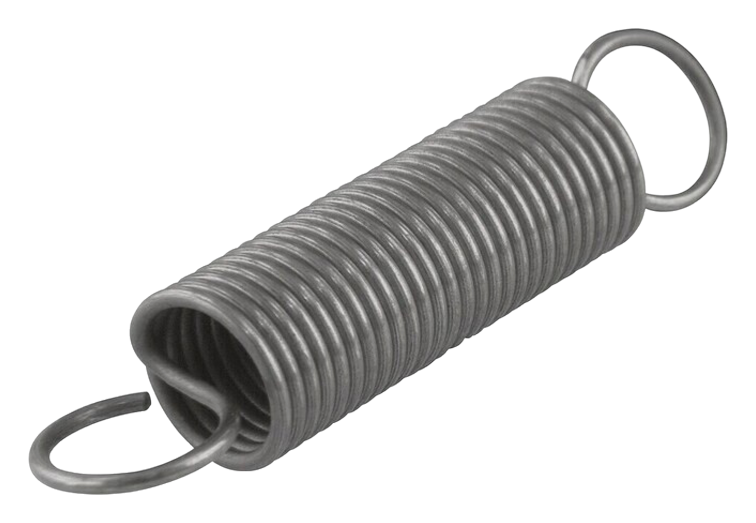
Helical springs with close-wound coils designed to store force as they stretch. Unlike a compression spring —which resists being shortened—, the extension spring resists being stretched and exerts a pulling force that tends to return it to its original length.
Their coils are made in contact with one another, with an initial tension built in during winding. That is why a minimum force is required to overcome this tension and start separating the coils; from there, the force grows linearly with the extension. A correctly sized spring offers a long service life with minimal maintenance.
After forming, extension springs usually undergo a stress-relief treatment to stabilize the initial tension and improve fatigue resistance.
Helical spring with close-wound coils that resists being stretched.
Round (other sections custom).
Linear from the initial tension onward: F = Fi + k · x.
Fi · force that keeps the coils tight at rest.
Machine · German · extended · loop · custom hook.
The hook — wire torsion plus bending at the transition.
Music wire · stainless 302/304/316 · electrogalvanized.
Custom-made to drawing, with subsequent stress relief.
The initial tension (Fi) is the force that keeps the coils pressed together at rest. It is the force that must be overcome before the spring begins to stretch.
Unlike a compression spring, whose curve starts at zero, the extension spring's curve starts at the initial tension value. The tension is "used up" as soon as a gap appears between the coils: it is not part of the spring rate, but adds to the load calculated with it.
The initial tension is tied to the spring index (C = Dm/d): high indices —large coils relative to the wire— give low tensions, and vice versa. That is why it must be specified when sizing the spring.
F = Fi + k · x
total forceC = Dm / d
spring indexThe basic dimensions of an extension spring: wire diameter (Ø d), outer (De) and mean (Dm) diameter, body length with the coils in contact (Lc) and total length between the insides of the hooks (LK).
The extension spring's line does not start at zero, but at the initial tension Fi. Once the coils have separated, the force grows linearly with the extension.
The ends are formed into different geometries to suit the anchoring system of each application. The hook type determines both the mounting and the strength of the end.
Economical and straightforward to manufacture; the first choice in most applications.
Closed loop, more resistant to unhooking; requires an extra forming operation.
Greater reach for anchor points away from the spring body.
For a pin or bolt; distributes the load better at anchor points with a shaft.
Beyond the four usual types, the end can be formed into special geometries —side hooks, double loops, threaded studs or connections to another part— depending on the anchoring of each application.
The stresses in the hook are higher than in the body of the spring: a bending stress at the transition between the last coil and the hook adds to the wire's torsional stress. That is why an overloaded extension spring fails at the hook first.
The allowable stress in the hook is limited more than in the body, and it is advisable to design generous transition radii.
Transition radius r > 2 · wire Ø to spread the bending and extend the fatigue life of the end.
At the hook, torsion and bending add together. A transition radius greater than twice the wire diameter spreads the stress better and improves fatigue life.
Tell us the pull force, travel, initial tension, available space, hook type and environment — and our engineering team will help you size the optimal extension spring. Manufacturer since 1975.
The choice of material depends on the working environment: in dry conditions, mechanical strength comes first; with moisture or chemical agents, corrosion resistance.
| Environment | Recommended material | Note |
|---|---|---|
| Dry | Music wire | Maximum mechanical strength; best cost-performance ratio. |
| Moist | Stainless steel AISI 302 / 304 | Strength ~10% lower than music wire. |
| Aggressive chemical / salt water | Stainless steel AISI 316 | Maximum corrosion resistance. |
| Semi-moist · treated surface | Music wire electrogalvanized | Added surface protection on top of the music wire. |
In dry conditions, music wire for its higher strength. With moisture, move to stainless 302/304; with chemicals or salinity, to AISI 316. Electrogalvanizing covers the intermediate semi-moist case.
After forming, the springs undergo a stress-relief treatment that stabilizes the initial tension and improves fatigue resistance.
Extension springs are used wherever a pull or return force through stretching is needed. They appear in return mechanisms, drive tensioning and high-volume assemblies. To size the initial tension, the spring rate, the hook type and the material, Surisa's technical team, a specialized manufacturer since 1975, offers free engineering support.
Return and tensioning mechanisms in production lines, drives and agricultural equipment subjected to repetitive cycles.
They return an element to its rest position: doors, flaps, pedals and levers that must come back after being actuated.
They keep belts, chains and drives under tension, compensating for clearances and wear throughout the system's life.
Suspension and return in washing machines, latching mechanisms and high-volume consumer assemblies that demand a repeatable pulling force.
Control returns, brake assemblies and engine components where a reliable pulling force and long fatigue life are required.
When no standard spring covers the tension–load–travel–space combination, a specific part is sized to drawing.
An extension spring is a helical spring that stores force as it stretches: the more it elongates, the greater the force it stores and releases as it returns to its length. It resists being stretched and exerts a pulling force. Its coils are wound in contact with an initial tension, so a minimum force must be overcome before it begins to extend; from there, the force grows linearly with the extension.
It is the force that keeps the coils pressed together when the spring is at rest, built in during winding. It must be overcome for the coils to start separating, so the force-extension curve does not start at zero but at the initial tension value. It is not part of the spring rate: it is an additional force that adds to the one calculated with it. Its value depends on the spring index, so it must be specified when sizing.
In the direction of the work and in where the curve starts. The compression spring resists being shortened and its force-deflection curve starts at zero; the extension spring resists being stretched and its curve starts at the initial tension. In addition, the extension spring has hooks at the ends (its weakest point), whereas the compression spring bears on its ends. If you need to push, compression; if you need to pull, extension.
The main ones are the machine hook (the most common and economical), the German hook, the extended hook and the loop or eye, plus custom geometries. The hook type is chosen according to the anchoring system. It matters a great deal because the hook is the critical point of the spring: it withstands a higher stress than the body (torsion plus bending) and is where an overloaded spring fails first. That is why generous transition radii are advisable.
In dry environments, music wire for its higher mechanical strength and better cost. In moist environments, AISI 302/304 stainless steel (with a strength roughly 10% lower). In the presence of aggressive chemical agents or salt water, AISI 316 stainless steel. For semi-moist environments requiring a treated surface, electrogalvanized music wire. The choice depends on the balance between mechanical strength and corrosion resistance.
Tell us the pull force, travel, initial tension, available space, hook type and environment — we'll select the material, wire diameter and end, and get back to you with the optimal solution. Free engineering support, manufacturer since 1975. Always custom.