


01Battery contacts · low profile
Minimal compressed height
Low-profile assemblies where the axial space at the end of travel is minimal but a long travel is required: battery contacts, push buttons.
Helical springs whose diameter tapers progressively from the base to the tip. They deliver maximum lateral stability, a minimal solid height through telescoping, and a progressive spring rate.
The ideal choice when stability and compressed length are critical: long travel with a minimal solid height, resisting buckling thanks to their wide base.
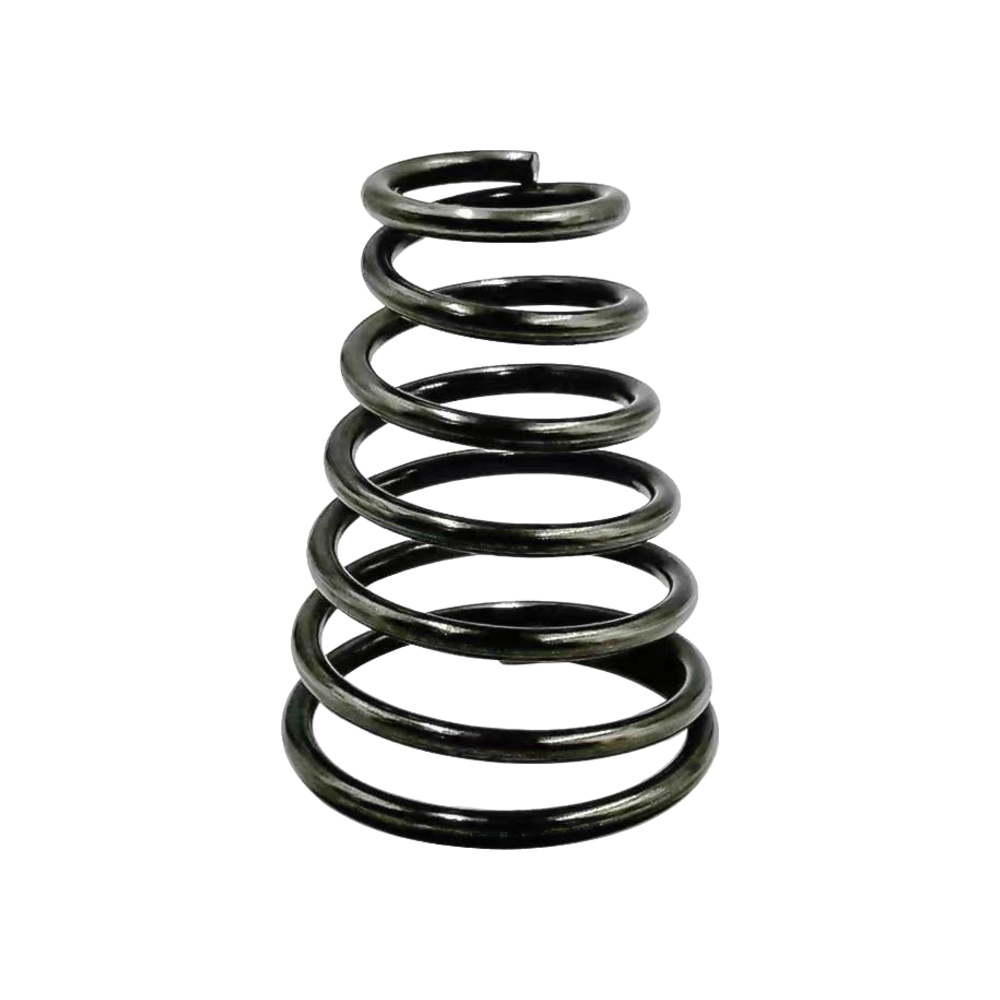
Conical compression springs, known internationally as conical springs, tapered compression springs or cone springs, are helical springs in which the coil diameter tapers progressively from a wide base to a narrower tip. Like any compression spring, they work by opposing an axial load, but their conical geometry gives them properties a cylindrical spring does not have.
They are the ideal choice when stability and compressed length are critical: they deliver long travel with a minimal solid height and resist buckling thanks to their wide base, in many cases eliminating the need for a guide rod or tube.
This page is a specialised variant of compression springs: it focuses on what is unique to the conical profile —telescoping, stability by geometry and a progressive spring rate—.
The most distinctive advantage of the conical spring is its reduced solid height.
Since each coil has a slightly smaller diameter than the next, when compressed the coils nest inside one another (telescoping) instead of stacking up. The result is a compressed height of approximately 1 to 2 wire diameters, versus the sum of all the coils in an equivalent cylindrical spring.
This is decisive in applications where the available axial space at the end of travel is minimal but a long travel or high loads are required. To achieve full telescoping, the coil diameters must be sized so that no coil binds against the adjacent one before nesting.
Versus the solid height of a cylindrical spring (sum of coils · n · d), the conical spring compresses down to almost the thickness of a single coil.
The conical spring in the free and compressed positions: the smaller-diameter coils nest inside the larger-diameter ones down to a solid height of ~1–2 wire diameters.
At the same free height, the slender cylindrical spring buckles sideways under load; the conical spring stays stable, seated on its wide base.
A cylindrical compression spring tends to buckle (deflect sideways) when its free length exceeds about 4 times its diameter (high slenderness ratio). The conical spring solves this problem through its geometry:
In addition, the conical spring reduces resonance and vibration (surge): with its variable pitch, the natural period of vibration changes as the coils bottom out, instead of staying constant as in a cylindrical spring.
Tell us the load, stroke, target solid height and degree of taper — and we'll return the optimal conical compression spring. Free engineering support, manufacturer since 1975.
Unlike the cylindrical spring —with a practically constant spring rate—, the conical spring has a progressive (non-linear) spring rate. The reason is geometric: a smaller-diameter coil generates more force than a larger-diameter one, and since the conical spring combines different diameters along its body, the load-deflection curve is not a straight line.
The typical behaviour is: as it compresses, the larger-diameter coils (softer) bottom out first, leaving only the smaller-diameter ones (stiffer) active. The spring becomes stiffer as it compresses —soft at the start of travel, firm at the end—. By adjusting the degree of taper and the pitch this progression can be tuned, and even variable-pitch variants can be designed that maintain an almost constant spring rate despite the conical shape.
Because the spring rate is variable, the spring rate value shown in the catalogue for a conical spring is an estimated average, not a constant. For a specific working point it is best to calculate the force at that particular deflection with the engineering team.
The cylindrical spring follows a straight line (constant spring rate); the conical one describes a progressive curve: soft at the start of travel and firm at the end.
The coiling direction of standard conical compression springs is generally right-hand, but no specific direction is defined: the force and the operation are not affected by the direction of coiling.
Depending on production, the parts can be made with right-hand or left-hand coiling interchangeably. The direction is only specified when the application requires it —for example, springs that work nested one inside another or threaded onto a component—.
Conical compression springs are manufactured in the same range of materials as cylindrical ones, selected according to load, environment and cycles.
| Material | Designation | Application |
|---|---|---|
| Music wire | ASTM A228 | High strength · dry environments |
| Oil-tempered steel | ASTM A229 | Medium and dynamic loads |
| Chrome-silicon steel | ASTM A401 | High stress, temperature and shock |
| Stainless steel 302 / 316 / 17-7 PH | — | Corrosion · marine environments · food |
| Phosphor bronze / beryllium copper | — | Electrical conductivity |
For high temperature, stainless steels (302 / 316 / 17-7 PH) and special alloys are selected on request. The engineering team recommends the material according to the specification.
Conical springs are chosen whenever stability, low solid height or a progressive load response is the priority.
Low-profile assemblies where the axial space at the end of travel is minimal but a long travel is required: battery contacts, push buttons.
Replaces slender cylindrical springs that would buckle and eliminates the guide rod or tube, simplifying the assembly.
The wide base provides a stable seat and the progression cushions the impact: soft at the start, firm at the end.
Lateral stability under high, repeated loads. The variable pitch reduces resonance (surge).
Mechanisms with a soft feel at the start and firm at the end: the large coils bottom out first and leave the stiff ones active.
Sizing of load, stroke, solid height, taper and material. Specialized manufacturer since 1975.
Three main ones: greater lateral stability (it resists buckling thanks to its wide base, often without the need for a guide rod), a much lower solid height (the coils nest or telescope, compressing down to 1-2 wire diameters) and a progressive, non-linear spring rate (soft at the start, firm at the end). It is chosen when stability and a short compressed length are critical, or when a progressive load response is needed.
It is the ability of the smaller-diameter coils to nest inside the larger-diameter ones when compressed, instead of stacking one on top of another. Thanks to this, the solid height can be reduced to approximately 1 or 2 times the wire diameter, versus the sum of all the coils in a cylindrical spring. To achieve it, the diameters must be sized so that the coils do not bind against each other before nesting. It is the key advantage in applications with very limited axial space.
Because its force depends on the coil diameter: a smaller-diameter coil generates more force than a larger-diameter one. Since the conical spring combines different diameters along its body, the load-deflection curve is not linear. As it compresses, the large coils (softer) bottom out first and the small ones (stiffer) remain active, so the spring becomes progressively stiffer. The catalogue spring rate is therefore an estimated average, not a constant.
In many cases no. Its wide base gives it lateral stability far superior to that of a slender cylindrical spring, reducing or eliminating the tendency to buckle without the need to guide it on a rod or inside a tube. This simplifies the assembly. In a cylindrical spring, by contrast, buckling appears when the free length exceeds about 4 times the diameter and usually requires a guide.
No, except in specific cases. The standard direction is usually right-hand, but the force and the operation do not depend on the direction of coiling, so standard conical springs are not defined with a specific direction and are made right-hand or left-hand depending on production. It is only specified when the application demands it, for example in springs that work nested one inside another.
Send us the load, stroke, target solid height, degree of taper and service environment — and we'll get back to you with the optimal conical compression spring, standard or custom. Free engineering support, manufacturer since 1975.