


2D shapes (flat)
The part is developed in a single plane.
Elastic parts made from wire bent and formed in two or three dimensions — able to take on virtually any geometry, custom-made to drawing.
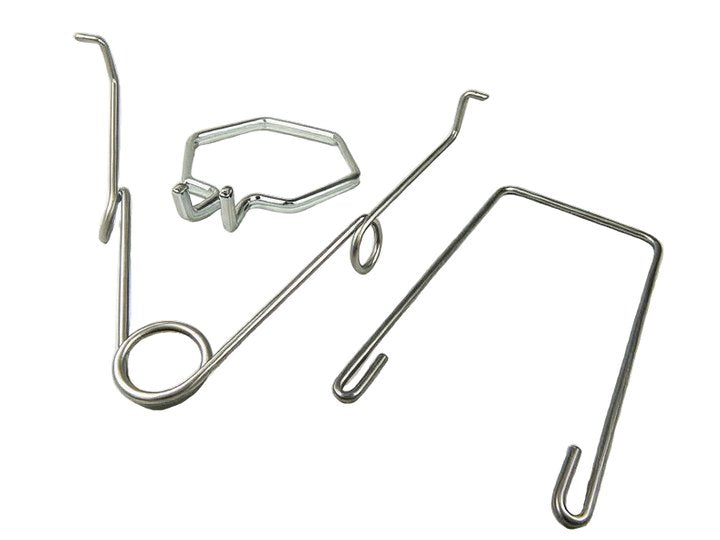
Wire forms —known internationally as wire forms or special-shaped springs— are elastic parts made from wire bent and formed in two or three dimensions. Unlike a catalogue spring, they do not follow a standard geometry: each part is designed and made to measure according to the functional and space requirements of the assembly.
They are the ideal solution when no standard spring fits the application: they combine a specific geometry with elastic properties, integrating fastening, retention, positioning or connection functions into a single part that would otherwise require several components.
The starting wire is transformed by bending, curving and cutting until the final shape is obtained, which can be developed in a single plane (2D) or bent across all three axes of space (3D).
Wire forms are produced by bending, curving and cutting wire on CNC forming machines, which deliver high precision and repeatability even on complex geometries. Cold forming allows typical wire diameters from ~0.25 mm up to ~12 mm, depending on material and geometry.
The part is developed in a single plane.
The part is bent across all three axes of space.
Additional operations such as end flattening, piercing or butt welding extend the possibilities of the part beyond simple bending.
After cold forming, all wire forms undergo a stabilizing heat treatment. Its purpose is to remove the internal stresses generated during bending and to restore the elastic properties of the material.
It ensures that the part keeps its shape and elastic behaviour stable throughout its service life. Without this treatment, the part could deform or lose force with use.
The material is chosen according to the load, the environment and the electrical or corrosion requirements. The surface finish suited to the required level of protection is then applied to it.
General-purpose, low-cost option for most parts (hard drawn, oil tempered).
High-strength music wire for heavily stressed parts.
AISI 302 / 304 / 316 / 17-7 PH. Corrosion resistance and demanding environments.
Inconel, Hastelloy, copper-beryllium: high temperature, aggressive chemistry or conductivity.
Light protection and a uniform aesthetic finish.
Anti-corrosion protection according to the level required by the environment.
Reinforces the natural passive layer of stainless steel.
Tell us your use case —function, geometry, material and environment— and our engineering team will help you choose the optimal solution. Free support, manufacturer since 1975.
Wire forms cover any component that requires a specific geometry combined with elastic properties.
Clips, staples, forks and elastic clamps that fix, retain or release parts with a defined return force.
S-hooks, C-hooks, loops and eyelets for hooking, suspension and connection between components.
Ratchets, rods, pins and elastic levers integrated into actuation mechanisms.
Retention and detent springs that hold the part in place between discrete positions.
Battery springs and elastic connections that ensure continuous, reliable electrical contact.
When no standard spring fits, a single part integrates specific geometry and elastic properties.
Wraps around a shaft and retains the part with elastic force.
Hooking and suspension between two components.
Cone of coils that maintains continuous electrical contact.
Positions, indexes or secures a part in place.
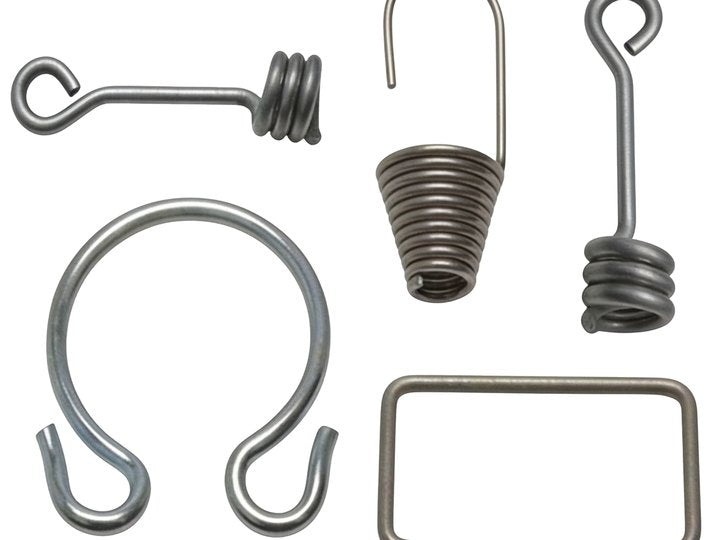
Various hooks formed from wire.
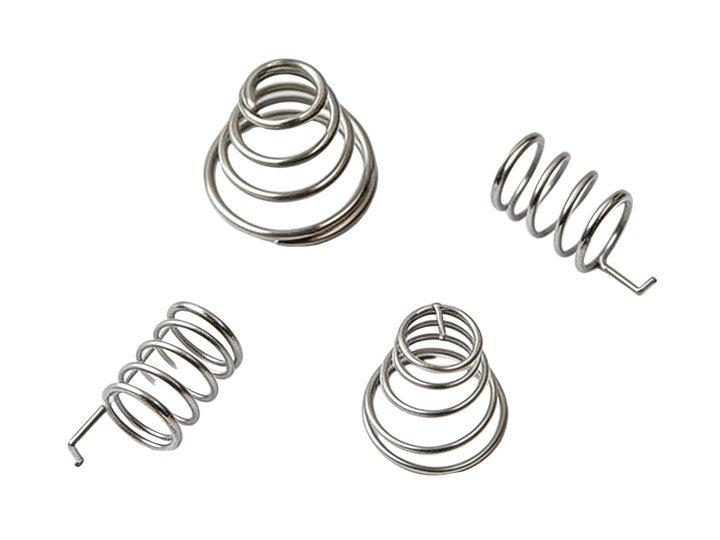
Technical springs for continuous electrical contacts.
Clips, clamps and forks for fastening and retention.
To manufacture a wire form it is essential to have a drawing or 3D model of the part, since each geometry is unique and is made strictly to specification.
From it, Surisa's technical team —a specialized manufacturer since 1975— selects the material, wire diameter and surface treatment, and offers free engineering support. Both prototypes and production runs are manufactured.
A wire form is an elastic part made from wire bent and formed in two or three dimensions, able to take on virtually any geometry. It does not follow a standard catalogue shape: each part is made to measure to a drawing. It is the solution when no standard spring fits the functional or space requirements of the assembly, combining specific geometry and elastic properties.
A wire form is made from wire bent and formed in 2D or 3D (hooks, clips, forks, pins), where the function can be fastening, retention or connection as well as elastic. A flat-strip spring is made from sheet or flat strip that works specifically by bending (spring contacts, tabs, elastic guides). If the part starts from wire and takes on a three-dimensional geometry, it is a wire form; if it starts from flat strip and works by bending, it is a flat-strip spring.
Because cold bending generates internal stresses in the material. The stabilizing treatment (stress relief) removes those stresses and restores the elastic properties of the wire, ensuring that the part keeps its shape and elastic behaviour stable throughout its service life. Without this treatment, the part could deform or lose force with use.
In cold-drawn steel wire (hard drawn, oil tempered), music wire for heavily stressed parts, stainless steel (302, 304, 316, 17-7 PH) and special alloys such as Inconel or copper-beryllium. For corrosion resistance, finishes such as bluing (black oxide), electrolytic treatments (zinc plating, nickel plating, phosphating) or passivation on stainless steel are applied, according to the level of protection required by the environment.
A drawing or 3D model of the part is essential, since each geometry is unique and is made strictly to specification. With that drawing, the Surisa engineering team selects the most suitable material, wire diameter and surface treatment for the application, and offers free engineering support. Both prototypes and production runs are manufactured.
Send us your drawing or 3D model — we'll select the material, wire diameter and surface treatment, and get back to you with the optimal solution. Free engineering support, manufacturer since 1975. Prototypes and production runs.