Automotive and commercial vehicles
Safety fasteners subject to continuous vibration. The 6796 replaces the flat washer + split lock washer combination with a far higher residual force and without damaging the contact surface.
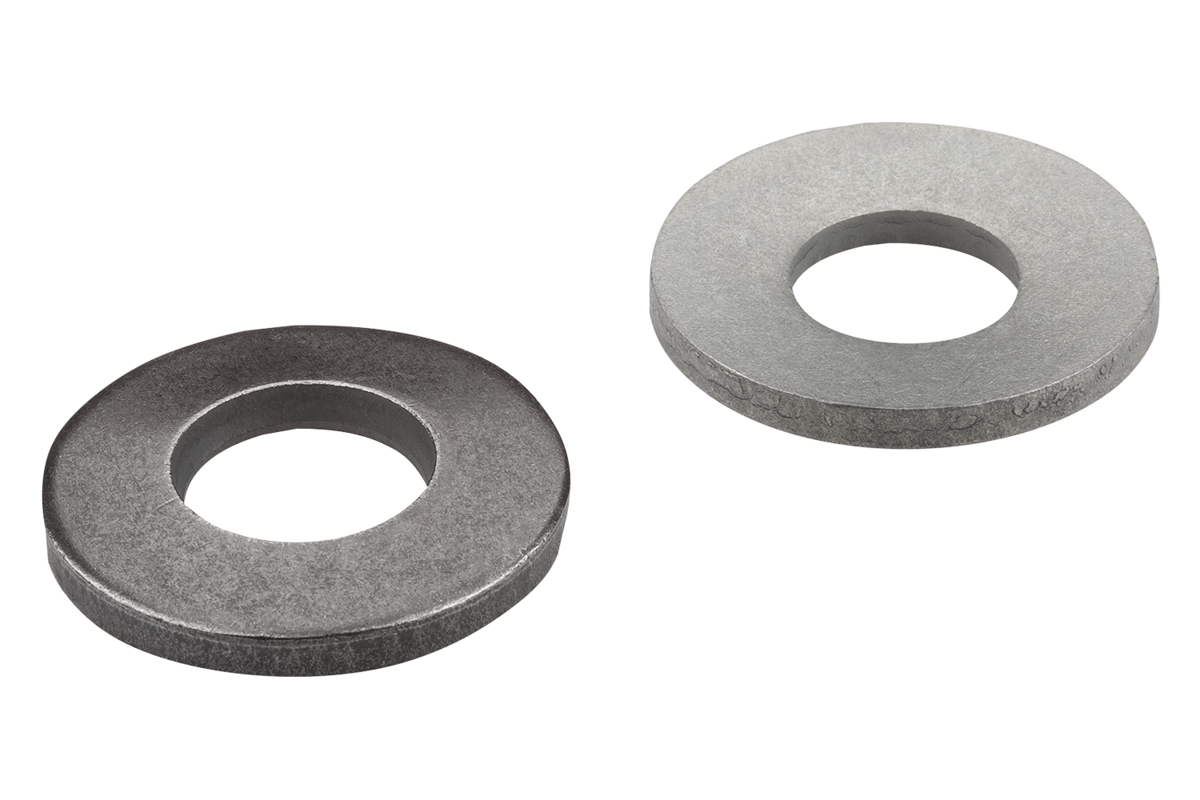
Conical spring washers in hardened C60 steel · a single piece per joint replaces the flat washer + split lock washer with several times the residual force.

DIN 6796 washers —also called Belleville washers or conical spring washers— are fastening elements with a frustoconical geometry, manufactured to the German standard DIN 6796 “Conical spring washers for bolted connections”.
Their specific job is to secure bolted joints. Once the joint is tightened, the washer is almost fully compressed and permanently exerts a residual axial force that compensates for bolt elongation, thermal expansion and the micro-settling of the mating parts.
It is important to distinguish them from the DIN 2093 / EN 16983 disc spring. Although they share the conical geometry, they are not interchangeable: the 6796 is a fastening element with very short travel; the 2093 is an elastic spring with long travel. Using one where the other belongs is a common application error — see §02.
They share the conical geometry, but their function is the opposite. Confusing them is one of the most common application errors in technical fasteners. This table sums up the difference, column by column:
| Criterion | DIN 6796 · Belleville | DIN 2093 · disc spring |
|---|---|---|
| Function | Fastening element · permanent elastic locking | Elastic spring · load spring |
| Elastic travel | Very short · nearly flattened when tightened | Long · designed for controlled deflection |
| Configuration | A single piece per bolted joint | Stackable in series · parallel · mixed |
| Force precision | Reference (not exact) · works at very high stress | F/s curve calculable with precision |
| Typical location | Under the bolt head or nut | Inside the housing as a mechanical element |
| Replaces | Flat washer + DIN 127 split lock washer | Helical springs in tight spaces |
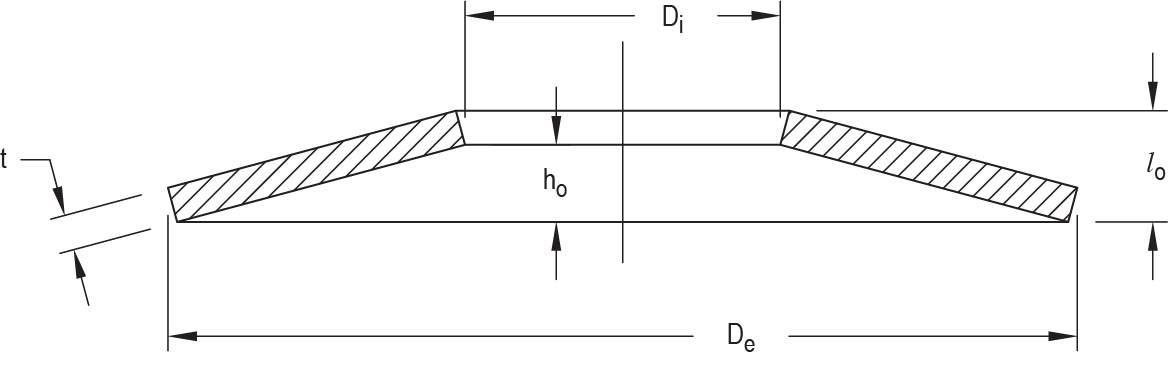
Standard catalogue DIN 6796 washers cover nominal bolt sizes from M3 to M30. The standard defines the geometry (diameters, thickness, height), the mechanical behaviour (flattening and residual force) and the applicable tolerances.
| Parameter | Meaning |
|---|---|
| d₁ | Internal diameter · H14 tolerance. Matches the bolt Ø (M3 — M30) |
| d₂ | External diameter · h14 tolerance |
| s | Material thickness |
| h max | Maximum initial height · before the first compression |
| h min | Minimum height after compression · after the first compression |
| F flat | Flattening force (N) · load needed to fully flatten the washer |
| F res | Residual spring force (N) · minimum guaranteed load in the tightened joint |
The F flat and F res values in catalogues are reference values, not individually guaranteed.
The actual force depends on the batch hardness, the geometric precision and the friction coefficient at the contact surface. The force tolerances are wide by design: the 6796 works in a very high stress range (420–510 HV) and the effective residual force comfortably exceeds the range of a conventional split lock washer at any point in the band.

The DIN 6796 sits between the bolt head (or nut) and the surface of the part. As the joint is tightened, the washer becomes almost fully compressed. Its outer rim (d₂) bears on the part; its inner edge (d₁) contacts the flat face of the head or nut. The cone flattens towards the centre of the joint, exerting the residual force permanently.
Tell us about your use case and our engineering team will help you choose the optimal solution.
The DIN 6796 standard is manufactured in standard carbon steel for most applications. When the environment demands it — corrosion, extreme temperature — stainless steel and nickel alloys are available.
Hardened and tempered to 420–510 HV. Covers virtually all applications when combined with the right coating.
For environments with condensation, sheltered outdoor exposure or industrial settings with high relative humidity.
Saline environments, offshore, chemical plants. Resistance to pitting and crevice corrosion.
High temperatures and highly corrosive environments where stainless steel is not enough.
The modulus of elasticity of A2/A4 stainless steel and Inconel is lower than that of standard C60. For the same geometry, the residual force in stainless or Inconel is somewhat lower than in carbon steel. Where the environment allows, compensating with a coating is the technically and economically optimal solution.
The base material (C60, A2/A4 stainless, Inconel) determines the intrinsic corrosion resistance. For carbon steel — the most common — the coating is the main protective barrier. These are the ones available at Surisa:
| Coating | Protection | NSS · ISO 9227 | Cr (VI) | Typical application |
|---|---|---|---|---|
| Manganese phosphate | Low–medium | — | Free | Storage · pre-lubrication · assembly |
| Electrolytic zinc plating (Zn) | Medium | ~120 h | Free | Indoor · dry environments |
| Zinc-nickel | High | 500 — 720 h | Free | Automotive · general industrial |
| Geomet 321 / 500 | Very high | 720 — 1,000 h | Free · RoHS / ELV | Automotive · wind · outdoor |
| Delta Protekt | Very high | 720 — 1,000 h | Free · cadmium replacement | Cadmium replacement · critical joints |
| Dacromet | High | 500 — 720 h | Free | Long-service-life applications |
The DIN 6796 washer appears in any bolted joint that needs to maintain clamping tension against vibration, thermal cycling or micro-settling of the parts. These are the sectors where Surisa supplies it most often:
Safety fasteners subject to continuous vibration. The 6796 replaces the flat washer + split lock washer combination with a far higher residual force and without damaging the contact surface.
Joints subject to dynamic loads and critical vibration. Vibration loosening is one of the main risks: the constant residual force of the 6796 prevents it throughout the turbine's service life.
Equipment with dynamic loads that affect static joints. It maintains bolt tension against the progressive micro-settling of the mating parts.
Fastenings exposed to wide thermal cycling, continuous vibration and infrequent maintenance. The 6796 maintains clamping force between interventions.
Joints subject to daily thermal cycling and traffic-induced vibration. It compensates for bolt elongation caused by the expansion of the structural parts.
When combined with A4 stainless or high salt-resistance coatings, it maintains the elastic locking function in saline environments and continuous marine spray.
With material suited to the fluid and process temperature (A4, Inconel). It secures the seal against thermal expansion of the piping and pressure cycling.
Where the conventional split lock washer has proven insufficient, the 6796 is the direct upgrade: same location, several times the residual force, no surface damage.
They share the conical geometry, but their function is the opposite. The DIN 6796 is a rigid washer with very short travel, intended to secure a bolted joint with a single piece per bolt. The DIN 2093 is an elastic spring with long travel, designed to be stacked in series or parallel and to work as a load spring. They are not interchangeable: using a DIN 6796 as a spring, or a DIN 2093 as a fastening element, are application errors.
No. The DIN 6796 standard is intended for use with a single washer per bolted joint, placed between the bolt head (or nut) and the surface. If the application requires elastic stacking —for example to achieve greater travel or to tune stiffness— the correct element is the DIN 2093 disc spring, which is indeed designed for series, parallel or mixed configurations.
Yes, and with advantages. A DIN 6796 exerts a residual force several times higher than that of a split lock washer (DIN 127) of the same nominal size. It also does not damage the contact surface the way toothed lock washers do, and it maintains tension throughout the service life of the joint, not just at the moment of initial tightening. That is why it is the preferred element in critical and vibration-prone joints.
For dry indoor use, electrolytic zinc plating is enough. For automotive and general industrial applications, zinc-nickel offers a good cost/protection ratio. In demanding environments, outdoor automotive, wind or applications with RoHS / ELV requirements (free of hexavalent chromium), Geomet 321/500 and Delta Protekt coatings are the current standard, reaching between 500 and 1,000 hours in the ISO 9227 salt spray chamber. For severe marine or chemical environments, it usually pays to use A4 stainless directly.
Yes. Beyond the standard M3 to M30 catalogue in C60 steel, we manufacture DIN 6796 washers in non-standard sizes, in stainless steels (A2, A4), in Inconel-type nickel alloys for high temperature, and with any technical coating the customer requires. Ask our engineering team about lead times for special manufacturing.
The DIN 6796 standard specifies hardened and tempered C60 carbon steel (or equivalent C67S), with a final hardness range of 420 to 510 HV (Vickers). This hardness level is needed so that the washer can withstand the high stress its function demands without permanent relaxation under prolonged static load.
The modulus of elasticity of A2/A4 stainless steel and Inconel-type nickel alloys is lower than that of standard C60 steel. This means that, for the same geometry, a 6796 washer in stainless or Inconel exerts a somewhat lower residual force than the carbon steel version. This should be taken into account when sizing the joint: if the environment allows C60 + coating, that is usually the technically and economically optimal solution.
Tell us about your use case and our engineering team will help you choose the optimal solution.