


Die-making and stamping
Pressing · deep drawing · ejection
Pressing, deep drawing, sheet-metal holding and ejection in dies and moulds — high forces in the scarce space of the die. It is the sector standard.
Sealed cylinders charged with high-pressure nitrogen that deliver force through a piston rod. They don't store energy through elastic deformation: the force comes from gas pressure — F = P × A.
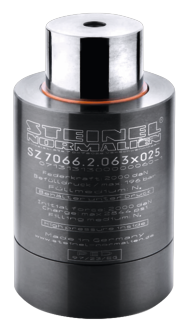
Nitrogen gas springs —known internationally as nitrogen gas springs, gas cylinders or die springs— are a robust alternative to mechanical springs. They consist of a sealed cylinder charged with high-pressure nitrogen and a piston rod.
Unlike a helical spring, they don't work through elastic deformation of the material, but through the pressure of a confined gas. They are a self-contained unit: once charged with (inert) nitrogen during assembly, they need no further input. As the rod is pushed inward, the gas is compressed and reacts by exerting an opposing force.
The force is given by the relationship F = P × A, where P is the internal nitrogen pressure (typically around 150 bar / ~2,000–3,000 psi) and A is the cross-section of the rod. They are used as standardized spring elements where high forces are needed in tight spaces.
Schematic section: the piston rod compresses the nitrogen; the force is the product of the pressure and the rod's cross-section (F = P × A).
The big advantage is force density: a gas spring delivers far higher tonnage than a mechanical spring of the same size. That's why it is the standard in stamping die-making, where space in the die is scarce and forces are enormous.
| Feature | Gas spring | Mechanical |
|---|---|---|
| Force per unit volume | Very high | Limited |
| Force at the start of travel | Immediate, high | Builds from zero |
| Force curve | Very flat | Linearly increasing |
| Force adjustment | Yes — gas charge | No |
| Installation space | Compact | Larger |
| Synchronization of several elements | Yes — linked systems | No |
Swipe to see more →
The gas spring starts from a high immediate force and stays almost flat; the mechanical one starts at zero and grows linearly with travel.
The gas spring is a simple self-contained unit but demanding to manufacture: the quality of the sealing determines service life, especially in die-making environments contaminated with oil and grinding dust.
Longitudinal section: steel cylinder, pressurized nitrogen (≈ 150 bar), piston rod, elastomer seals and G 1/8 charge port on an ISO mounting plate.
Standard construction; the sealing acts on the rod. A good balance of force, stroke and service life for most applications.
The sealing acts on the internal diameter of the cylinder, which allows the maximum force per diameter in the same housing.
Gas springs are manufactured to ISO standards and standardized mounting patterns, which makes them interchangeable between manufacturers. The range of forces and strokes is very wide, from elements of a few newtons (ejector pins) to cylinders of several tens of tonnes for stamping presses.
Several cylinders are connected by hose to a single gas charge, so they act in a synchronized way and share the same pressure. This is the solution for distributing a uniform force across several points of a large die.
Tell us the required force, stroke, available space and format — and our engineering team will help you choose the optimal gas spring and, if you need it, the right linked system. Specialized manufacturer since 1975.
Gas springs are the standard wherever high force in little space with immediate force is needed. Their natural territory is die-making and stamping, but they appear in any high-tonnage tooling.
Pressing, deep drawing, sheet-metal holding and ejection in dies and moulds — high forces in the scarce space of the die. It is the sector standard.
They hold the sheet metal firmly in place during forming, ensuring uniform holding with force available from first contact.
Ejection and lifting of parts and panels by means of ejector pins whose force can be adjusted with the gas charge.
High-temperature versions that maintain the force inside the mould throughout prolonged cycles.
Any tooling or automation assembly that requires a high, compact and adjustable force in minimal space.
We select the model, force, stroke and mounting or linking system for your tooling. Surisa's technical team, specialized since 1975, offers free engineering support.
It is a sealed cylinder charged with high-pressure nitrogen that delivers force through a piston rod. As the rod is pushed in, it compresses the gas, which reacts with an opposing force given by F = P × A (pressure times the rod's cross-section). Unlike a helical spring, it doesn't work through elastic deformation of the material, but through the pressure of the confined gas, and it is a self-contained unit that needs no further gas after its initial charge.
Four main ones: it delivers far higher forces in the same space (high force density), the force is available immediately from first contact (a mechanical spring needs travel to generate it), the force curve is very flat throughout the stroke, and the force is adjustable by varying the nitrogen charge. In addition, several cylinders can be linked by hose to act in a synchronized way.
Because the force depends on the nitrogen pressure acting on the rod's cross-section, and that cross-section is small relative to the cylinder's gas volume. As the rod is pushed in, the gas volume is reduced only slightly in relative terms, so the pressure —and therefore the force— increases only marginally. The result is a very flat force curve, with a low increase between the start and end of the stroke.
Above all in die-making and stamping: pressing, deep drawing, sheet-metal holding and ejection in dies and moulds, where high forces are needed in the scarce space of a die. Also in pressure pads and blank holders, adjustable ejector pins, injection moulds (high-temperature versions) and automation tooling. They are the standard when a high, compact, immediate and adjustable force is required.
Yes. They are manufactured to ISO standards and standardized mounting patterns, which makes them interchangeable between brands in many formats (full height, compact, super-compact). The force is adjusted by charging or discharging nitrogen through the cylinder's port, and several elements can be connected in a hose-linked system to share a single charge and act in a synchronized way.
Tell us the required force, stroke, available space, format (full-height / compact) and whether you need a linked system — we'll select the ISO model, diameter, seal type and gas charge, and get back to you with the optimal solution. Free engineering support, specialists since 1975.