


Refineries and petrochemical
VOC · hydrocarbons · API 622 / API 624
Control of volatile organic compound emissions on hydrocarbon lines. Compliance with API 622, API 624, ISO 15848-1.
Live loading on the gland packing of the stuffing box: they keep the sealing pressure constant despite packing wear, thermal cycling and relaxation.
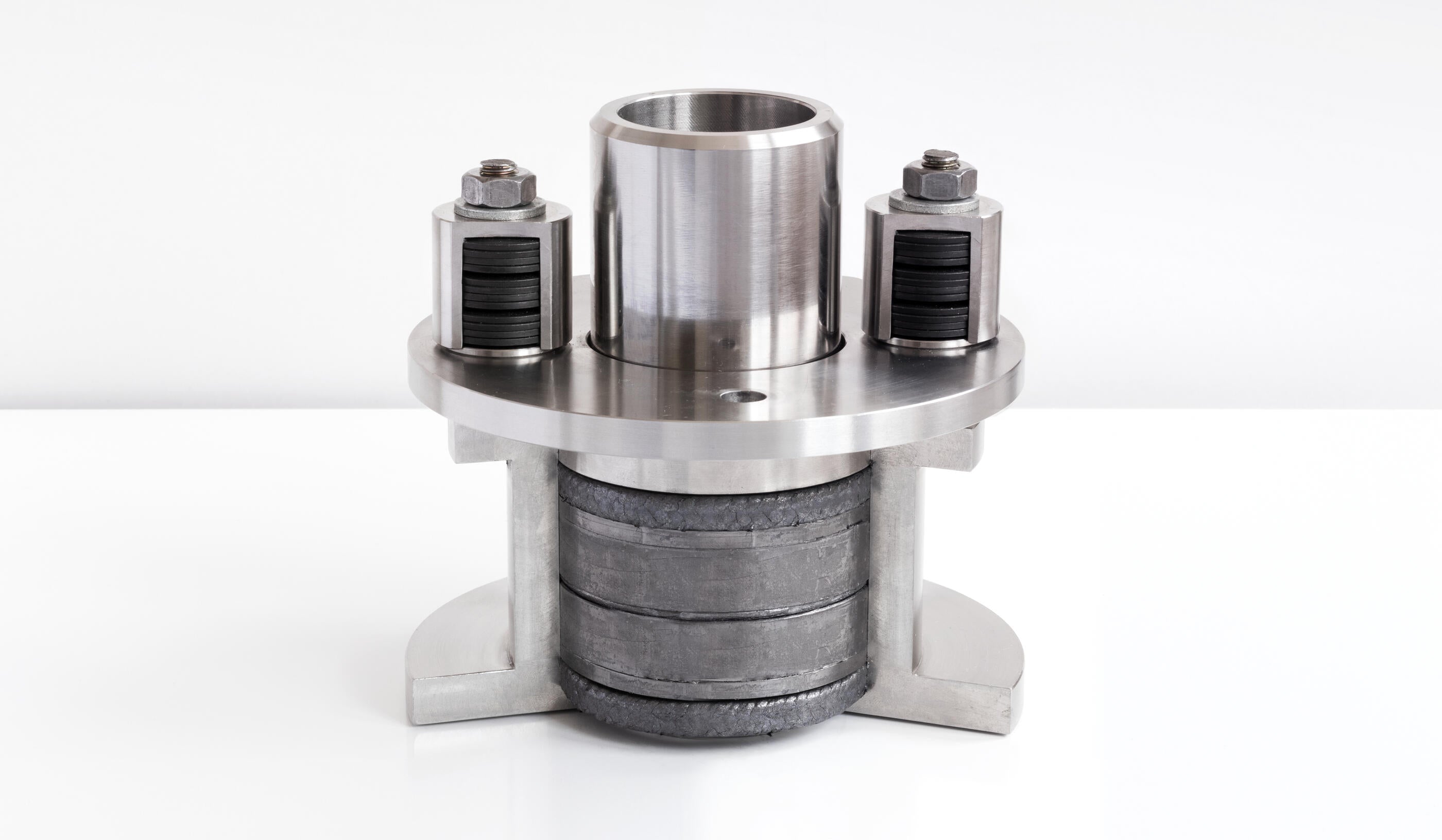
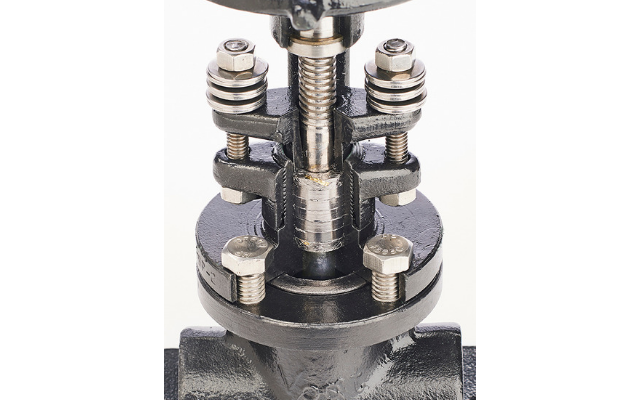
Live loading consists of inserting one or more stacks of Belleville washers between the nut and the gland follower of the valve. As the studs are tightened, the washers are partially compressed and remain in a preloaded elastic state.
While the valve operates, the packing wears, flows or relaxes due to temperature. Without live loading, the sealing force drops until it causes leakage and requires periodic manual retightening. With Belleville washers, the stack releases its stored deflection at the rate of packing wear, keeping the closing force within the useful range for thousands of cycles.
The benefits are measurable: sealing stress stays within the allowable range even as the packing flows or wears, manual retightening is reduced, it helps meet emissions regulations (API 622, API 624, ISO 15848-1, TA-Luft), it absorbs thermal cycling of the stud-body-packing assembly and it damps vibration, preventing the bolting from loosening.
The reference standard for live loading packing systems is MSS SP-143 · Live-Loaded Valve Stem Packing Systems.
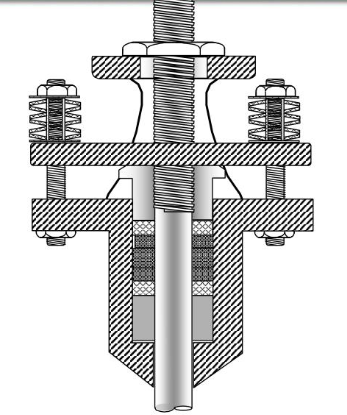
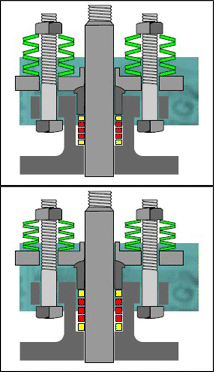
Live loading with Belleville washers is especially recommended when one of the following conditions is met. The more conditions are met, the greater the benefit of live loading.
Industry data indicate that between 50% and 80% of leaks in industrial bolted joints are caused by loss of preload, and a very significant share of VOC emissions at petrochemical plants comes from valves and flanges with poor sealing.
They are not used in valves with a metal bellows seal (bellows-sealed), where there is no packing on the stem. Nor in valves with no load-maintenance requirement (static service without thermal cycling).
Applicable to all valves with packing on the stem. Does not apply to valves with a metal bellows seal.
Control valves with constant modulation or frequent ON/OFF service — where packing wear is accelerated.
Electric or pneumatic actuators where manual stuffing box adjustment is hard to coordinate with operation.
Valves in hard-to-reach areas, insulated lines or cryogenic insulation where each retightening requires a plant shutdown.
Wide thermal cycling between start-up and steady state — the stud-body-packing assembly expands differentially.
Lines critical for process safety, fire control or plant continuity — where a leak means a shutdown or a hazard.
Valves with a history of packing leaks — the first candidate for conversion to live loading.
Applications subject to LDAR, EPA, IED or TA-Luft — where leakage is subject to a measurable legal limit.
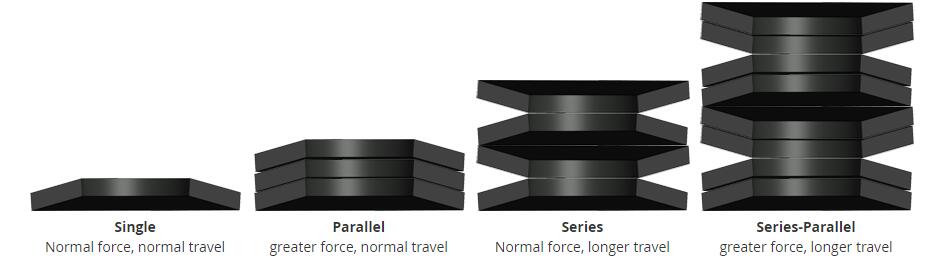
The load capacity and total deflection of the spring are tuned by combining several washers in different orientations. There are four basic configurations — the choice between series, parallel or a mixed configuration is one of the most important design decisions in a live loading system.
The washers are stacked directly in the same orientation. The total travel equals that of a single piece; the force is multiplied by the number of units. There is friction between the discs → curve with hysteresis.
The washers are placed alternating their orientation. The resulting force equals that of a single piece; the travel is multiplied by the number of units. No friction between washers → clean curve.
k groups in parallel stacked in alternating series. Allows fine tuning of the trade-off between load and travel. The most common configuration in medium and large valves.
Tell us about your use case and our engineering team will help you choose the optimal solution.
The material defines the temperature range, the corrosion resistance and the fatigue behavior. Surisa works with three materials that cover virtually every industrial application. The choice depends on the service temperature, the working atmosphere and how often the assembly is thermally cycled.
Chromium-vanadium spring steel. The best-value option for general-service valves with no thermal demands and no corrosive atmosphere.
Not stainless — requires an anti-corrosion coating (zinc phosphate, GEOMET) depending on the service environment.
De facto standard for industrial valves: high mechanical strength, good corrosion resistance and stable fatigue behaviour.
In marine environments or with aggressive chlorides it may require an additional silver-nickel coating.
Cryogenics (LNG, liquid H₂), severe corrosion, continuous high temperature. Replaces 17-7 PH above +300 °C or in aggressive atmospheres.
Reference material for services where the seal allows no retightening: petrochemical, LNG, severe chemical.
17-7 PH is the default material in most industrial valves: it combines high mechanical strength (Rm up to 1,700 N/mm²), good fatigue behaviour and enough corrosion resistance for typical environments.
In marine environments or with aggressive chlorides it may require an additional silver-nickel coating. For cryogenic service (LNG) or steam above 350 °C it is replaced by Inconel 718; in oxidising service at very high temperature, Nimonic 90 retains its properties up to 800 °C.
The ranges are indicative for preliminary design. The admissible service temperature also depends on the load, the frequency of thermal cycling and the atmosphere.
Belleville washers are used in practically any valve with packing subject to cycling. The most common configurations:
Isolation valves with packing on a rising stem. Live loading is common in process lines at temperature.
Regulating valves with a linear stem. Most common application — high cycle frequency and packing wear.
Quarter-turn valves with stem packing. Live loading on the seal of the obturator shaft.
Shaft sealed by packing in large-diameter valves. Common application in water and air treatment lines.
Continuous automatic modulation — the packing works in a permanent cyclic regime and demands live loading.
Motor-operated valves in hard-to-reach installations. Manual retightening is not operationally viable.
They are not used in valves with a metal bellows seal, where there is no packing on the stem. In these cases sealing relies on the welded bellows and the Belleville washers have no function.
Belleville washers for valves are the standard when a packing leak has critical consequences — safety, plant shutdown, environmental penalty — and the environment makes the loss of initial preload inevitable.
Control of volatile organic compound emissions on hydrocarbon lines. Compliance with API 622, API 624, ISO 15848-1.
Valves in wellheads, manifolds and transport lines where prolonged service without accessible maintenance is the norm.
Cryogenic valves where thermal contraction of the assembly compromises the seal. Usually solved in 17-7 PH, with Inconel 718 for the most demanding cases.
Valves in contact with corrosives or in high-purity service, where a leak is unacceptable for safety or cross-contamination reasons.
High-temperature steam valves in thermal and nuclear power plants, within reliability and maintenance-reduction programmes.
Regulating valves with a high number of daily cycles where packing wear is the main cause of leakage.
The most widely used material is 17-7 PH stainless steel (X7CrNiAl17-7 / 1.4568 / AISI 631), which works between −200 °C and +300 °C. It combines high mechanical strength, good corrosion resistance and competitive cost, which makes it the de facto standard for general-service valves in petrochemical, chemical and industrial plants. Above +300 °C it is replaced by Inconel 718, which reaches +600 °C. For general-service valves with no thermal or corrosion demands, 51CrV4 spring steel is used.
It depends on the force and deflection required. As a general rule: parallel multiplies force without increasing travel, series multiplies travel without increasing force, and the parallel/series combination lets you tune both. To define the stack you need the stud diameter, the target preload (calculated by the packing supplier), and the available radial and axial clearances. Our engineering team can size the stack from that data.
Yes. Live loading with Belleville washers is one of the recognized methods for cutting emissions in industrial valves, and it helps meet API 622 (packing qualification testing), API 624 (low-emission rising stem valves), ISO 15848-1/2 and TA-Luft VDI 2440. The specific standard for live-loaded packing systems is MSS SP-143, Live-Loaded Valve Stem Packing Systems.
In a conventional stuffing box the force on the packing depends on the initial tightening torque and is progressively lost through wear, creep and thermal expansion, requiring periodic manual retightening. In a live-loaded system, the Belleville washers store elastic energy on installation and release it progressively at the rate of wear, keeping the sealing force constant for thousands of cycles without intervention.
Yes. The most common material in cryogenic service is 17-7 PH, which keeps its mechanical properties down to −200 °C. Inconel 718 is used only occasionally, when the temperature drops below that limit —down to −250 °C— or the atmosphere is especially aggressive. In LNG/FLNG plants, thermal contraction of the valve-packing assembly is one of the main causes of leakage, and live loading with Belleville washers keeps the seal tight under those thermal gradients.
Four parameters that the process engineer or the packing manufacturer normally provides: (1) the stuffing box stud diameter, (2) the target preload in torque or force calculated by the packing supplier, (3) the radial clearance available around the stud — defines the maximum external diameter of the spring, and (4) the axial clearance between the nut and the gland follower — defines the maximum stack height. With that data we select the material and configuration.
Tell us about your use case and our engineering team will help you choose the optimal solution.