During the plastic bottle production process, one of the most important variables to consider is temperature. When the plastic is molten and the bottles are going to be formed by extrusion, its value is key to obtaining a good product.
Industrially produced plastic bottles are very sensitive to temperature, so some slight changes could lead to the products being discarded, failing to meet the characteristics demanded by buyers.
Why control temperature in a plastic bottle production process?
The process variables that can most affect the viability of plastics are temperature and relative humidity. When these two factors remain within a very specific range, the plastic bottles turn out perfect. Both for high-temperature plastics and other variants, the truth is that the viscosity of the material is very important during the industrial procedure. Normally, it must be above 250ºC so that the viscosity decreases to the appropriate level (in the case of plastics). This viscosity is what will allow the materials to be moulded to taste; hence the importance of keeping this parameter within a very specific range.
How to control this parameter in plastic bottle manufacturing?
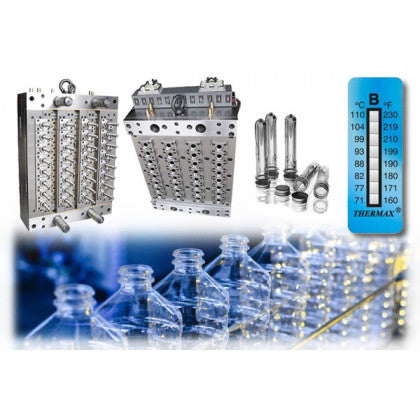
One of the simplest and most economical methods to carry out adequate control is to use temperature labels, something simple that makes it possible to control this variable in the processes. These temperature sensors are adhesive and can be stuck on any surface. Once placed, they will undergo a permanent colour change when the indicated temperature is reached. In this way they make it possible to carry out checks at any point in the production chain and to guarantee that work is being carried out at the desired temperatures. In addition, these temperature sensors have no cables or batteries, so they do not interfere with the other components of the process.
To control the temperature of the plastic bottle manufacturing process, different options can also be used. In fact, there are different procedures such as injection moulding or thermoforming for plastics in general. As for the typical PET bottles, the values are controlled through pyrometers, which are able to give a response every 6 milliseconds, or by a thermographic camera, which has a frequency of 100 Hz. These solutions aim to maintain 250ºC during the process. These two options are used quite frequently. However, there are various sensors and thermometers that can be used in the process. The idea is for the bottle manufacturing process to stop when the temperature is too high or too low. Until the ideal temperature is restored, the process will not be reactivated.
Issues in controlling the temperature to melt the plastic
The main advantage of controlling the values in the process is that the discarding of defective batches is avoided. It is common that when this parameter is not within the desired values, the plastic bottles do not end up with the shape designed at the start, being able to bend or, directly, break.
Sometimes, the probes or pyrometers that control the process can deteriorate and take faulty measurements. It is in these cases where the use of a solution such as irreversible temperature labels can detect the problem in time and correct it, avoiding the production of defective batches. In short, during the plastic bottle production process it is essential to bear in mind the temperature at which the plastic melts. Using appropriate sensors will ensure that plastic bottle manufacturing is optimised at all times.