


Alu-zinc (aluminized steel)
Very good thermal conductivity. It is the standard option for most installations.
U-shaped tubular elements with a helical fin that multiplies the heat-exchange surface to heat moving air inside ducts, ovens and drying chambers.
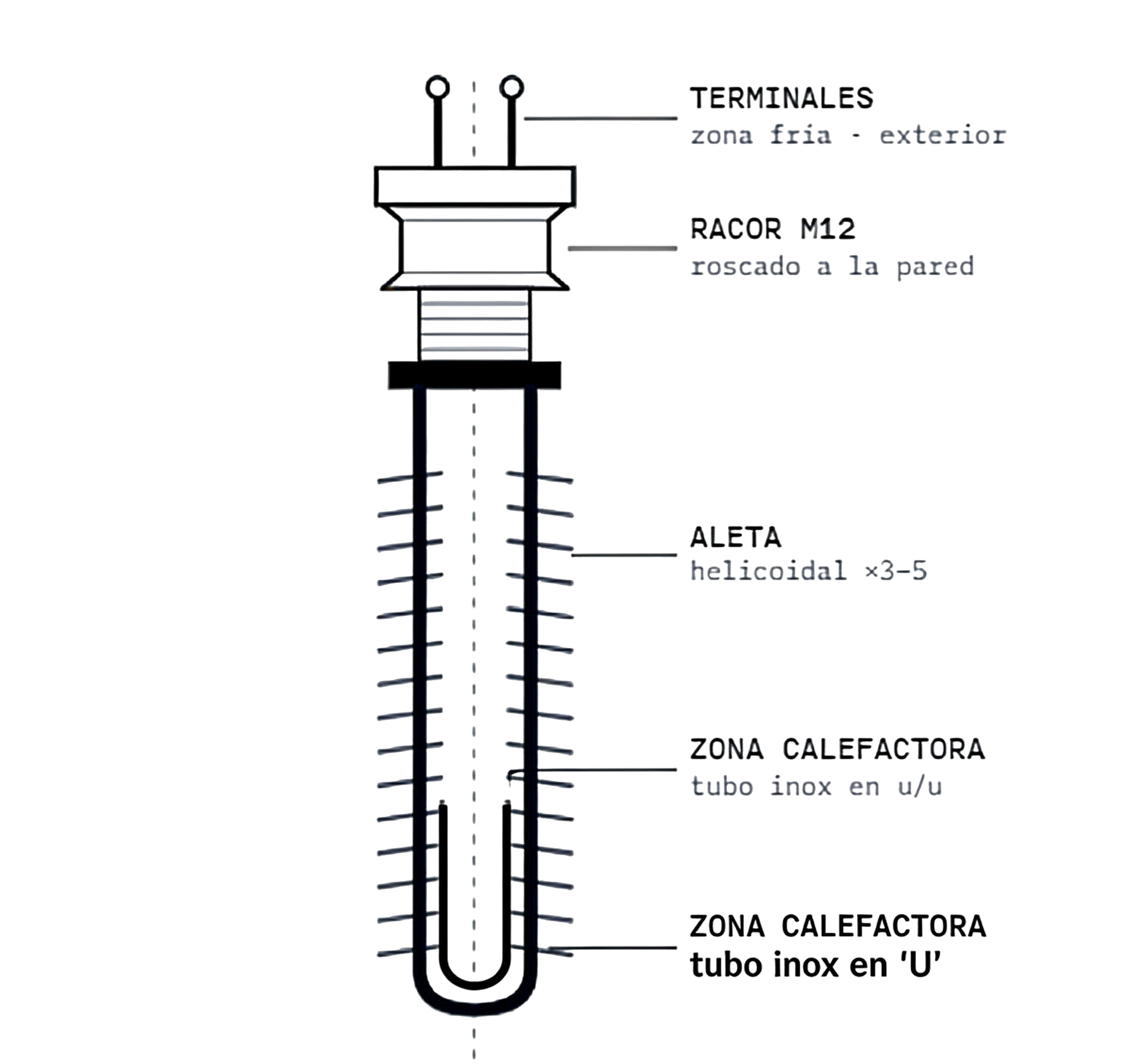
A finned tubular air heater is a sheathed tubular heating element with a metal fin wound helically around the sheath, increasing the dissipation surface by 3 to 5 times compared with a plain tube.
That larger surface lets it transfer heat to the air efficiently without the sheath reaching dangerous temperatures. In international technical terminology they are called finned tubular air heaters or finned duct heaters.
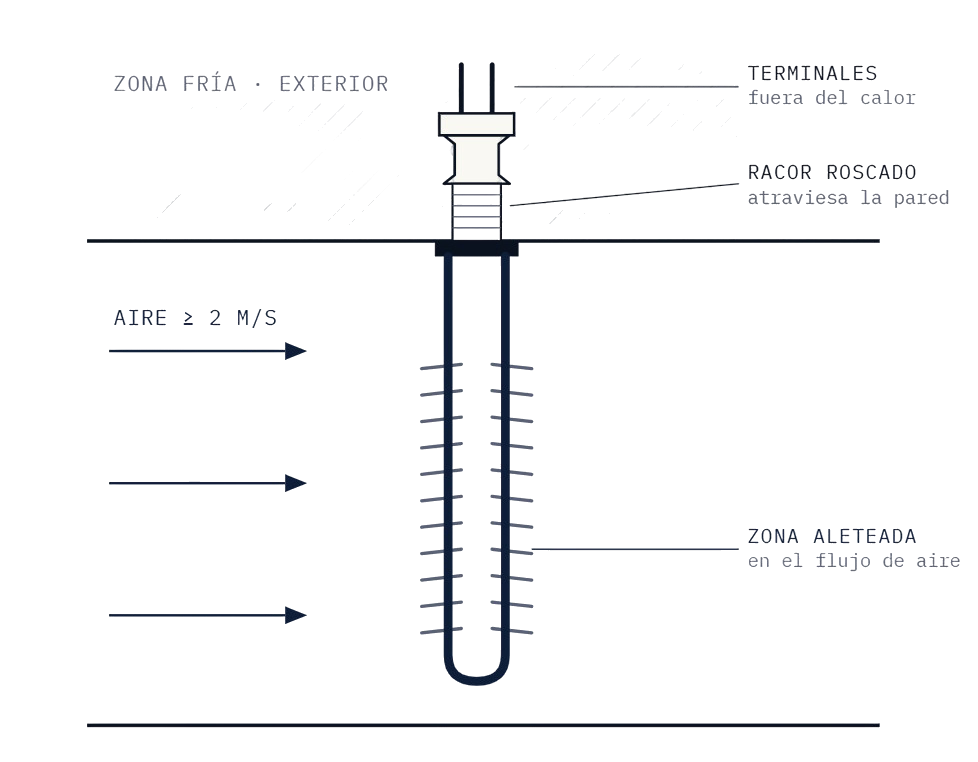
The U shape houses the entire heated length inside the duct while the connection terminals stay outside, in the cold zone, protected from the heat. They are designed specifically to heat circulating air: ventilation ducts, heating batteries, drying ovens and forced-air systems where the medium to be heated is the air itself.
| Element | Material / configuration |
|---|---|
| Sheath | Stainless steel |
| Fins | Alu-zinc or stainless steel · helical |
| Insulation | Magnesium oxide (MgO) |
| Resistance wire | NiCr 80/20 |
| Shape | U-shaped tube |
Air is a poor heat conductor. If a plain tubular heater is placed in an air stream, the heat does not escape the sheath fast enough: the tube's surface temperature soars while the air barely warms up. The fin solves this problem by expanding the surface in contact with the air.
The result is a key functional feature: for the same power, a finned heater runs at a much lower sheath temperature than a plain tube. This translates into faster air heating, higher efficiency, lower surface temperature and longer element life.
For that same reason finned heaters require moving air. The fins need an airflow to sweep them and extract the heat; without enough circulation, the air between fins becomes laminar, is not renewed and the sheath overheats. They must not be used in still air or in liquid immersion applications.
The fundamental design variable is the surface watt density, expressed in W/cm². Air heaters deliberately run at low watt density —max. 3.6 W/cm²— precisely because air removes heat with difficulty. The maximum temperature the air can reach depends directly on the speed at which it flows over the fins:
Tell us your flow rate, speed and temperature. For large-section ducts, humid or aggressive air and powers outside the catalog, Surisa's technical team studies each case and proposes the right series, power and fin pitch.
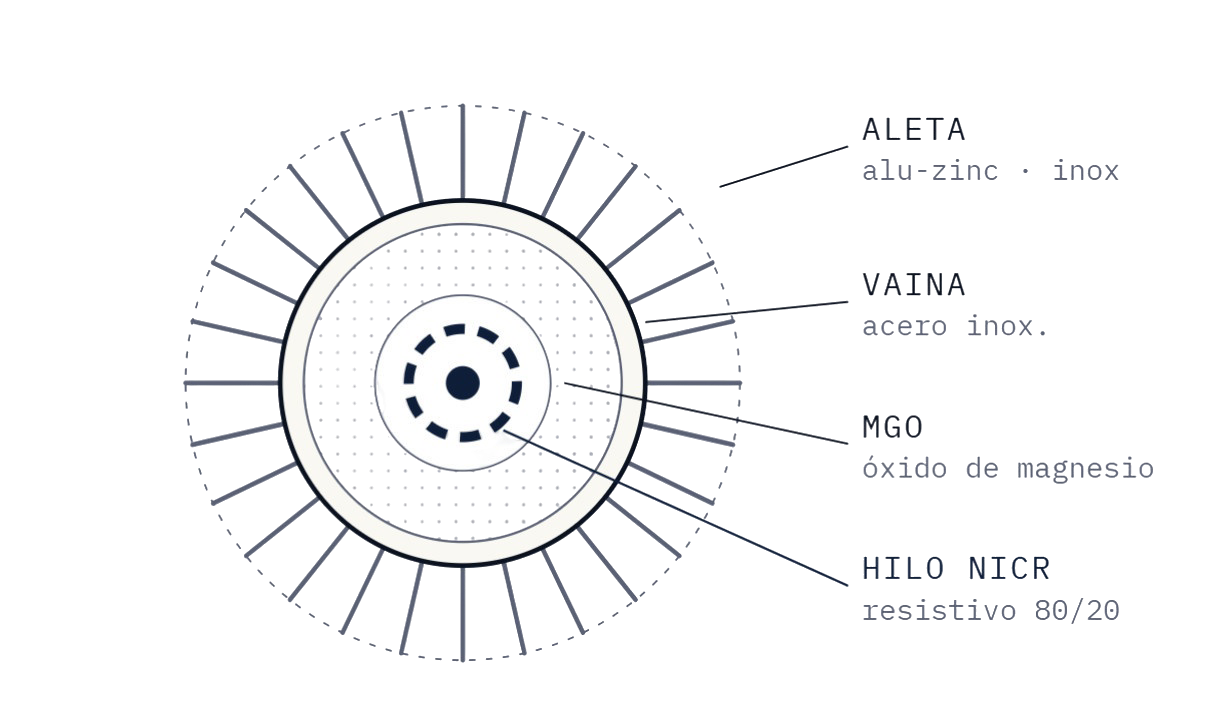
All air heaters share the internal architecture of a sheathed tubular heating element, with the fin added on the outside. The choice of fin material sets the application limit.
| Layer | Material | Function |
|---|---|---|
| Resistance wire | NiCr 80/20 nickel-chromium alloy | Generates the heat as current flows through it |
| Insulation | Compacted magnesium oxide (MgO) | Insulates electrically and transmits heat to the sheath |
| Sheath (tube) | Stainless steel | Protects the wire and resists air corrosion |
| Fins | Alu-zinc or stainless steel · helical | Multiply the dissipation surface ×3–5 |
| Fittings | Threaded M12 · M14 · M22 | Pass through the duct wall · terminals outside |
Very good thermal conductivity. It is the standard option for most installations.
Greater resistance to oxidation and temperature. The tube (sheath) is always stainless steel in both cases.
MgO is an excellent electrical insulator and, at the same time, a good thermal conductor: it insulates the wire electrically while transferring its heat to the sheath.
Air heaters are built in several series according to fin size, tube diameter and fin pitch. The pitch governs both the heat-exchange surface and the resistance to airflow: a tighter pitch provides more surface but introduces more pressure drop in the duct.
| Series | Fin | Tube | Fitting | Fin pitch | Typical application |
|---|---|---|---|---|---|
| Alu-zinc fins 50×25 | Alu-zinc 50 × 25 mm | Stainless steel | M12 | 4.5 mm | Clean air · ducts and ovens at moderate temperature |
| Stainless steel fins 50×25 | Stainless steel 50 × 25 mm | Stainless steel | M12 | 7 mm | Aggressive air · humidity · higher temperature |
| Alu-zinc fins 40×80 (Ø10) | Alu-zinc 40 × 80 mm | Stainless steel Ø10 | M14 | — | Higher power per element · large ducts |
| Alu-zinc fins 40×80 (Ø16) | Alu-zinc 40 × 80 mm | Stainless steel Ø16 | M22×1.5 | — | High power · reinforced tube |
Within each series there are multiple standard lengths and powers (from 200 W up to 3,000 W per element), with lengths from 200 to 970 mm depending on the power. Versions with round fins and special configurations are also made on request. The exact power and length are selected according to the air flow rate, the flow speed and the required outlet temperature.
Finned tubular air heaters are used in any process where moving air must be heated efficiently: HVAC, ovens and drying chambers, process machinery, surface finishing and laboratory equipment.
Heating batteries in ducts, reheating of supply air and hot-air curtains.
Drying and curing ovens, drying tunnels and dehumidification of process air.
Process air heating, hot-air generators and forced-air systems on production lines.
Paint and coating drying booths, and preheating of process air.
Forced-air ovens and shrink-wrapping and heat-sealing equipment.
It depends on the air speed over the heated zone. At a watt density of 3.6 W/cm², the air can be heated up to 90 °C at 1 m/s, 200 °C at 2 m/s, 270 °C at 3 m/s and 325 °C at 4 m/s. They must not be used in still air, because without circulation the sheath overheats. The higher the air speed, the more heat is extracted from the fins and the higher the outlet temperature you can safely achieve.
Air is a poor heat conductor. A plain tubular heater placed in an air stream would reach a very high sheath temperature while the air barely warms up. The fins multiply the dissipation surface by 3 to 5 times, so the element transfers heat to the air efficiently while running at a much lower sheath temperature. This improves efficiency, speeds up heating and extends the heater's service life.
A minimum air speed of 2 m/s over the heated zone is recommended. The fins need a flow to sweep them and extract the heat; below that speed the air between fins becomes laminar, is not renewed and the sheath overheats. For this reason finned heaters must never be used in still air or to heat liquids by immersion.
Alu-zinc (aluminized steel) fins offer very good thermal conductivity and are the standard option for clean air in ducts and ovens at moderate temperature. Stainless steel fins are used when the air is more aggressive, there is humidity or vapors, or higher working temperature and resistance to oxidation are required. The tube (sheath) is stainless steel in both cases.
You start from the air temperature required and the flow speed available. With that speed you determine the admissible watt density (max. 3.6 W/cm²) according to the temperature table; from there you calculate the total power to be installed to heat the airflow to the desired temperature rise. If you need a higher temperature while keeping the speed, the watt density must be reduced by spreading the power over more heating surface. Surisa's technical team helps with this sizing.
Yes. In addition to the standard series (from 200 to 3,000 W per element, with lengths from 200 to 970 mm), air heaters are made in specific lengths, powers, tube diameters and fitting types, as well as versions with round fins or special configurations on request.
Tell us your flow rate, velocity and temperature. We'll come back with the right configuration. Standard and custom air heaters, with in-house engineering support since 1975.