


Easy to interpret
Visual, immediate reading, suitable for non-technical staff.
Adhesive labels that record cumulatively and irreversibly how long a product has been above — or below — a critical temperature, through a progressive color change. A cost-effective complement to dataloggers for verifying the cold chain unit by unit.
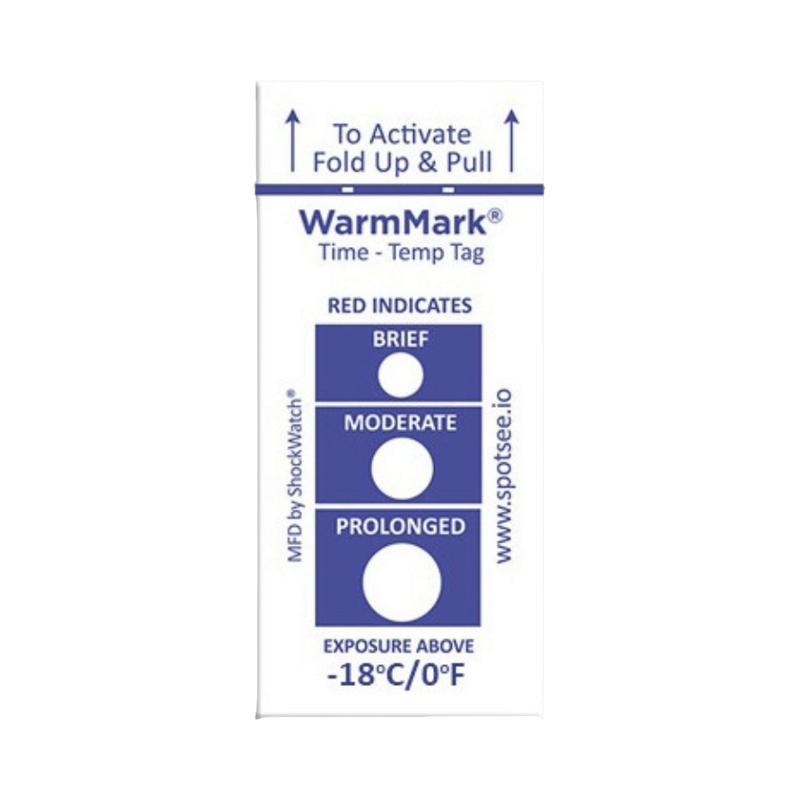
A time and temperature indicator is a cumulative and irreversible monitoring device. Unlike a thermometer or threshold indicator, which only shows whether a given value has been exceeded at some point, the TTI records the total exposure to inadequate temperature by adding up periods, even when they occur intermittently.
This matters because most sensitive products — vaccines, biologics, medicines, fresh food — do not deteriorate from a single moment out of range, but from the cumulative dose of time × temperature. The indicator's response is designed to reflect that effect visually and unambiguously.
There are two main behaviors, depending on the direction of the excursion they monitor:
| Type | What it detects | Typical use |
|---|---|---|
| ↑ Ascending (heat) | Exposure above the threshold | 2–8 °C cold chain, frozen goods, food |
| ↓ Descending (cold/freezing) | Exposure below the threshold | Products that must not freeze (vaccines, biologics, insulin) |
| ↕ Bidirectional | Both directions, high and low | Strict ranges where excessive cold also damages the product |
The most complete indicators, such as those in the Coldchain family, monitor both ends of the range simultaneously; those in the WarmMark family focus on heat exposure with different thresholds and response times.
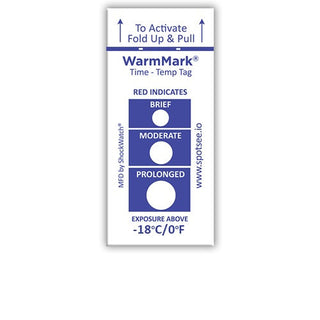
Most of these indicators incorporate several temperature points — usually three, although single-point models exist — that change color in sequence as the product remains above the marked temperature. Each point is calibrated for a specific time period (for example, 2 h, 12 h and 48 h), so the combined reading indicates how long the excursion lasted.
The operating principle is based on the diffusion of a dye at a temperature-dependent rate: above the threshold, the dye advances and activates the points in sequence; below it, the process stops.
The shortest-time point changes color first, then the intermediate one and finally the longest-time one.
If the product returns to the correct temperature, the change stops and only resumes if the threshold is exceeded again. The label adds up intermittent periods of overheating.
Once it occurs, the color change is permanent, making it possible to verify afterward whether the conditions were maintained.
Choose the model by its temperature threshold and its time window, and buy the reference you need online.
In stock · The price is for the supply format shown
To choose the right indicator you need to define three parameters: the temperature threshold, the direction of the excursion to monitor and the response time of the temperature points.
| Parameter | Description | Typical values |
|---|---|---|
| Temperature threshold | Temperature at which the indicator starts reacting | Matched to the product's range (e.g. 2–8 °C cold chain) |
| Direction | Heat (ascending), cold (descending) or both | Depending on the product's risk |
| Number of temperature points | Determines the time resolution | 1 point (threshold) or 3 points (staggered times) |
| Response time | Calibrated periods of each point | From minutes/hours up to several days |
| Activation | Many models require manual arming before use | Pull tab / press, depending on the model |
| Format | Single-use adhesive label | Typically supplied in packs of 100 units |
Being single-use adhesive labels, they use no batteries or environmentally harmful components, and their low cost makes it possible to apply them individually to the product or to small packages within the same shipment.
Tell us about your use case and our engineering team will help you choose the optimal threshold, direction and configuration.
Visual, immediate reading, suitable for non-technical staff.
Enables unit-by-unit control, not just at pallet or cold-room level.
They require no maintenance or periodic calibration.
Not just the momentary fact of exceeding a threshold.
They provide auditable evidence of the conditions during transport and handling.
They verify the individual product that actually experienced the excursion.
Time and temperature indicators are used in any sector where a product degrades through cumulative exposure to critical temperatures:
Monitoring the 2–8 °C cold chain for vaccines, biologics and insulin; verification of temperature-sensitive shipments; pharmacy and hospital refrigerators. Evidence aligned with Good Distribution Practice (GDP) and WHO recommendations.
Transport and storage of perishable, frozen and refrigerated goods; support for HACCP-based self-monitoring plans to document that the temperature was maintained.
International shipments of time- and temperature-sensitive cargo, alongside the IATA Time and Temperature Sensitive label required for air freight.
Reagents, adhesives and formulations that lose their properties outside a controlled range.
Recording time and temperature with adhesive labels is a practical, effective method that complements dataloggers and recorders. Thanks to their low cost and ease of application to the product itself or to individual packages, they reveal the actual temperature each unit has experienced. In the event of a cold-room failure or negligence during transport, they identify which packages were affected and which were not.
A threshold indicator only shows whether a specific temperature has been exceeded, without saying for how long. A time and temperature indicator (TTI) integrates both factors: it cumulatively records how long the product has been out of range, adding up even intermittent excursions. This better reflects the real deterioration of vaccines, medicines and food, whose degradation depends on the combined dose of time and temperature, not on a single instant.
Yes. They are a common solution for verifying that the 2–8 °C range for vaccines, biologics and insulin is maintained during transport and storage. They provide visual, irreversible evidence per unit, useful for demonstrating compliance with Good Distribution Practice (GDP) and WHO recommendations. For products that must not freeze either, bidirectional indicators are available that simultaneously monitor both excess heat and excess cold.
It depends on the model. Many indicators require manual arming — pulling a tab or pressing the activator — right before applying them to the product, at which point tracking begins. Other models come pre-activated. It is important to activate them at the right point in the shipment so that the reading corresponds to the leg you want to monitor.
Ascending indicators only detect heat exposure. To monitor cold or freezing — critical for products that are damaged by freezing, such as certain vaccines and biologics — descending or bidirectional indicators are used, such as those in the Coldchain family, which alert when the product leaves the range either above or below the threshold.
They do not replace it — they complement it. The datalogger records the temperature curve of an entire shipment with date and time; the time and temperature indicator provides a low-cost check on the individual product or package that actually experienced the excursion. Combining both gives batch-level traceability plus unit-by-unit control, especially in split or last-mile shipments.
Tell us the temperature threshold, the direction of the excursion and the product being transported — we will select the optimal model and get back to you with the right solution. Free engineering support, permanent stock.