


Double-loop
Doubles the tube length within the same immersion depth; reaches up to 18,000 W while keeping watt density within safe limits.
Sheathed tubular heating elements that heat water, oils and other fluids by direct contact, with thermal efficiency close to 100%.
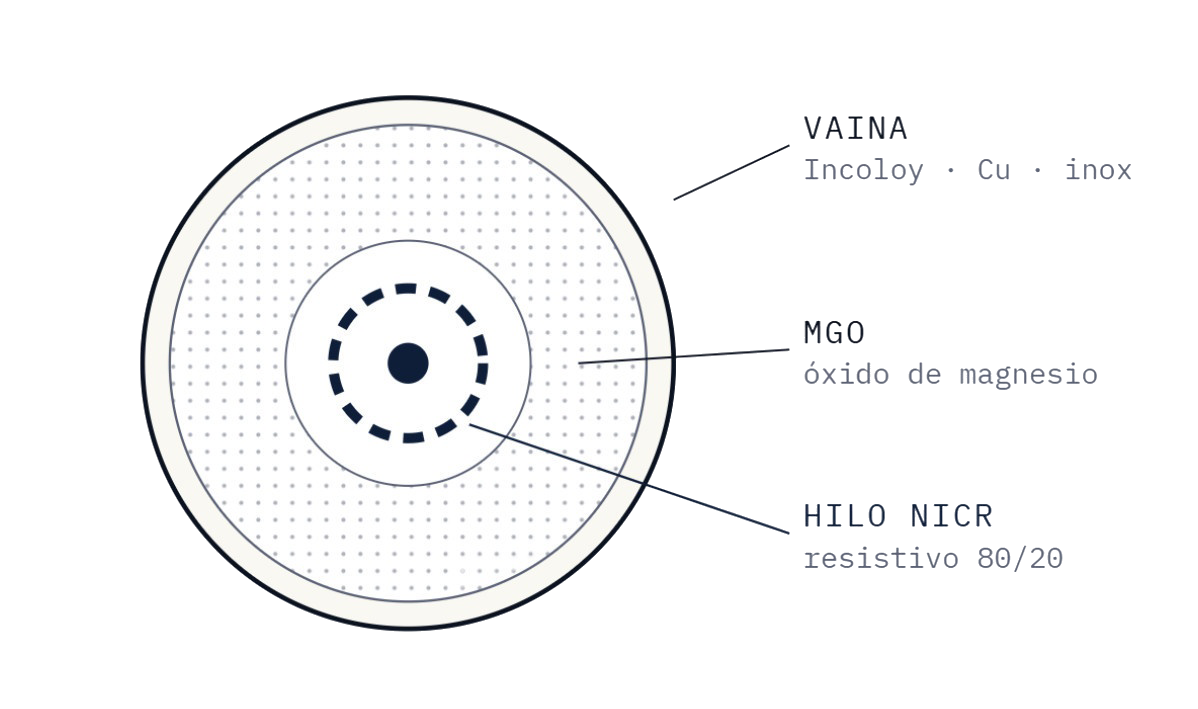
An immersion heater is a sheathed heating element made up of a metal tubular sheath (Incoloy, copper or stainless steel AISI 304/316) that houses a NiCr 8020 resistance wire embedded in highly compacted magnesium oxide (MgO). The MgO electrically insulates the wire from the sheath while transferring heat to the fluid with high efficiency. Manufacturing meets the electrical safety requirements of standard DIN EN 60335-1.
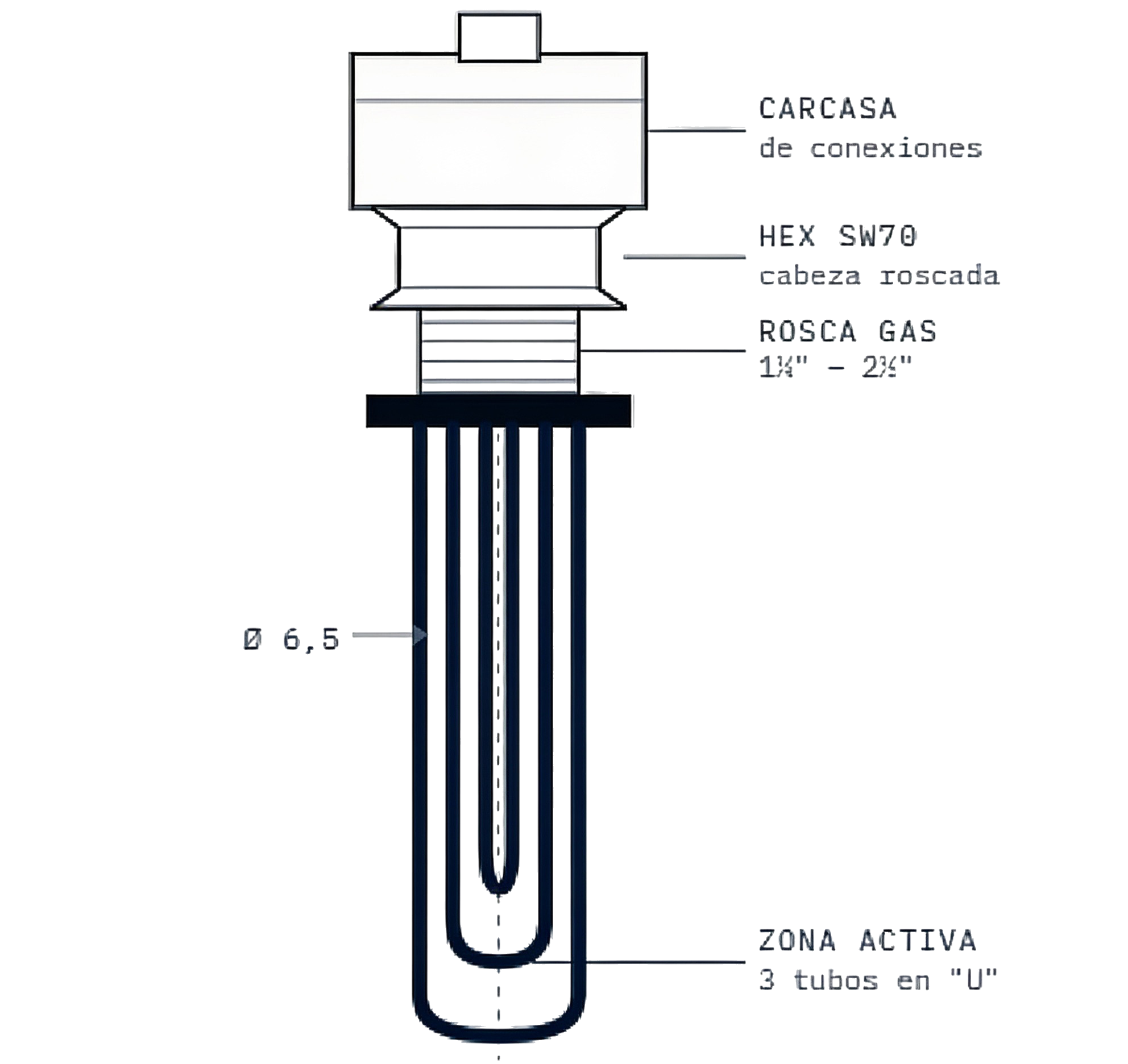
Each heater is made up of one or more sheathed tubular elements (Ø 6.5 mm) bent into a "U" or coil shape, secured to a screw plug or a stainless steel flange. The element must always remain fully submerged in the liquid during operation.
The U-shaped geometry —single, triple ("3U") or double-loop— maximizes the heat exchange surface inside the tank and allows high power ratings to be concentrated in short immersion lengths.
| Component | Material / function |
|---|---|
| Sheath | Incoloy, copper or stainless steel AISI 304/316 |
| Insulation | Highly compacted magnesium oxide (MgO) |
| Resistance wire | NiCr 8020 |
| Electrical safety | DIN EN 60335-1 |
The Surisa catalog covers seven families of tubular immersion heaters, with the following coverage of lengths, power ratings and connection type:
| Type | Sheath material | Connection | Length (mm) | Power (W) |
|---|---|---|---|---|
| 3 "U" shape | Incoloy | 1¼" or 1½" BSP thread | 190 – 1,350 | 1,500 – 9,000 |
| 3 "U" shape double-loop | Incoloy | 2" BSP thread | 200 – 990 | 3,000 – 18,000 |
| 3 "U" shape copper | Copper | 2½" BSP thread | 210 – 680 | 4,500 – 18,000 |
| "U" shape | Incoloy | Direct 220 V connection | 155 – 780 | 500 – 3,000 |
| 3 "U" shape 90° outlet | Incoloy | Direct 220 V connection | 170 – 704 | 500 – 2,400 |
| For mounting onto bars | Copper | Direct 220 V connection | 190 – 255 | 2,000 – 4,000 |
| Single-block with thermowell | Stainless steel | 1¼" BSP thread | 190 – 360 | 500 – 3,000 |
Doubles the tube length within the same immersion depth; reaches up to 18,000 W while keeping watt density within safe limits.
Orients the terminals at a right angle. Useful when space above the tank opening is limited.
Incorporates a thermowell that houses the thermostat bulb without contact with the fluid: it allows the sensor to be replaced without draining the tank.
The choice of sheath material determines chemical compatibility with the fluid and the maximum working temperature:
| Material | Designation | Recommended fluids | Key feature |
|---|---|---|---|
| Incoloy | Ni-Fe-Cr alloy (UNS N08800 type) | Water, demineralized water, mildly chemical solutions, oils | Maximum resistance to aqueous corrosion, even with chlorides |
| Copper | Cu-DHP | Clean and potable water, non-corrosive aqueous solutions | Excellent thermal conductivity; sheath temperature limited to ~180 °C |
| Stainless steel | AISI 304 / AISI 316 | Aqueous solutions, applications with sanitary requirements | Good corrosion-cost trade-off; AISI 316 for media with chlorides |
Incoloy is a family of ternary nickel-iron-chromium alloys. At high temperature, its nickel content outperforms stainless steel in corrosion resistance, especially in the presence of chlorides, and the Ni-Fe-Cr combination provides resistance to creep rupture. That is why it is the reference material for heaters in permanent contact with water.
Tell us the fluid, the volume and the temperature rise and our engineering team will size the right immersion heater for you.
Watt density —the power dissipated per unit of sheath surface, in W/cm²— is the parameter that governs the sheath temperature and the service life of the heater. Each fluid allows a different maximum:
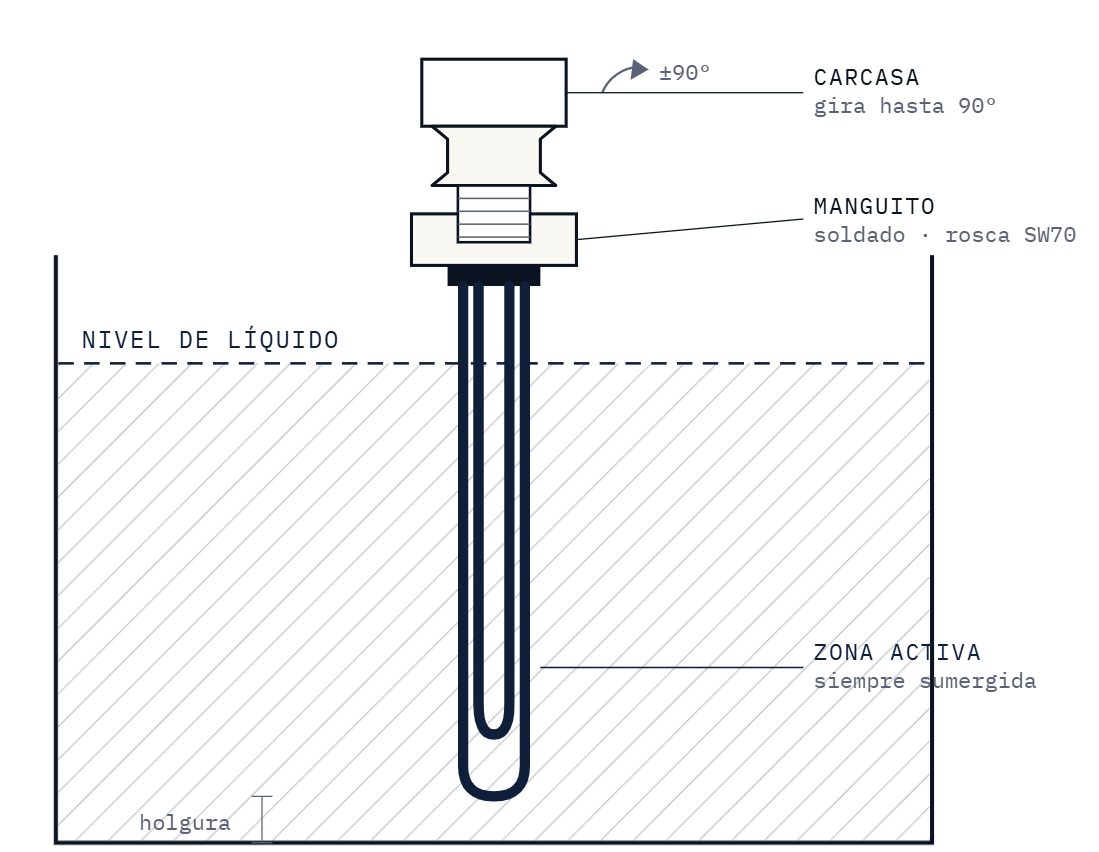
Threaded immersion heaters are installed through a sleeve welded to the tank, using a hexagonal SW70 screw plug (1¼" BSP thread) or the larger threads of each family (1½", 2" or 2½" BSP). Once the heater is tightened, the terminal enclosure can be oriented with a rotation of up to 90°, which eases cable entry according to the panel layout.
| 01 · Full immersion. The active zone must always remain covered by liquid. Dry running, even partial and brief, destroys the element. |
| 02 · Distance from the bottom and walls. Allow free fluid circulation around the tubes to promote natural convection inside the tank. |
| 03 · Temperature control with protection. Combine the control thermostat with a safety limiter, especially in closed tanks or where there is a risk of low level. |
Tubular immersion heaters are used in any process that requires heating a liquid by direct contact. For aggressive fluids, three-phase voltages, power ratings beyond the catalog or special geometries, the Surisa technical team studies each case and proposes the right configuration.
Electric heating boilers, domestic hot water tanks and indirect cylinders, electric backup for solar thermal systems.
Degreasing, phosphating, pickling and rinsing baths in painting and electroplating lines.
Preheating of hydraulic and lubricating oil in oil-hydraulic power units, gearboxes and chillers.
Kettles, cookers, sterilizers, industrial dishwashers and CIP cleaning equipment.
Heating of paraffins, glycols and process solutions in atmospheric tanks and reactors.
For water and aqueous solutions, the standard option is a 3U-shape immersion heater with an Incoloy sheath and a 1¼" or 1½" BSP thread, available from 1,500 to 9,000 W. If more power is needed in the same tank opening, the double-loop version with a 2" thread reaches 18,000 W. The rough power estimate is: P (kW) ≈ liters × temperature rise (°C) / (860 × heating hours), adding a 20% margin for losses.
It is not recommended. Oil dissipates heat much worse than water, so it requires watt densities of 2–3 W/cm² versus the 8–14 W/cm² allowable in water. A heater sized for water, installed in oil, cokes the fluid onto the sheath and ends up failing due to internal overtemperature. For oil you should select a heater with greater tube length and reduced watt density.
Incoloy (a nickel-iron-chromium alloy) offers maximum corrosion resistance in aqueous media, even with chlorides, and withstands much higher sheath temperatures; it is the universal choice for water, mild chemical solutions and oils. Copper has better thermal conductivity and lower cost, but its sheath temperature is limited to about 180 °C and it is only suitable for clean water and solutions that are non-corrosive to copper.
The thermowell is a closed sensing tube, integrated into the heater itself, that houses the thermostat bulb or temperature probe without direct contact with the liquid. It allows the bath temperature to be controlled and the sensor to be replaced without draining the tank or removing the heater. The single-block units in the catalog come with a stainless steel thermowell, a 1¼" BSP thread and power ratings from 500 to 3,000 W.
Failure is almost immediate. With no liquid to dissipate the heat, the sheath temperature spikes within seconds above the material limit and the internal resistance wire melts. That is why the active zone must always remain submerged, and it is recommended to install low-level protection (float or probe) in addition to the control thermostat and the safety limiter.
Yes. In addition to the seven standard catalog families, you can define specific immersion lengths, custom power ratings and voltages (single-phase or three-phase), special threads or flanges, and alternative sheath materials depending on the fluid. It is common to start from a sample or a drawing of the element to be replaced to ensure interchangeability.
It is screwed into the tank sleeve using the hexagonal head (SW70 on the 1¼" threads), applying a sealant suitable for the working temperature. After tightening, the terminal enclosure can be rotated up to 90° to orient the cable entry. Before start-up, verify that the liquid level fully covers the active zone and that the thermostat and limiter are connected.
Tell us about your application —fluid, volume, target temperature— and our engineering team will advise you on choosing the optimal immersion heater.