Formable coil
heaters

Very small-section tubular heaters with high watt density that can be formed —straight, helical or in custom geometries— to the exact part to be heated: injection nozzles, hot runner manifolds, molds, blades and pipes.

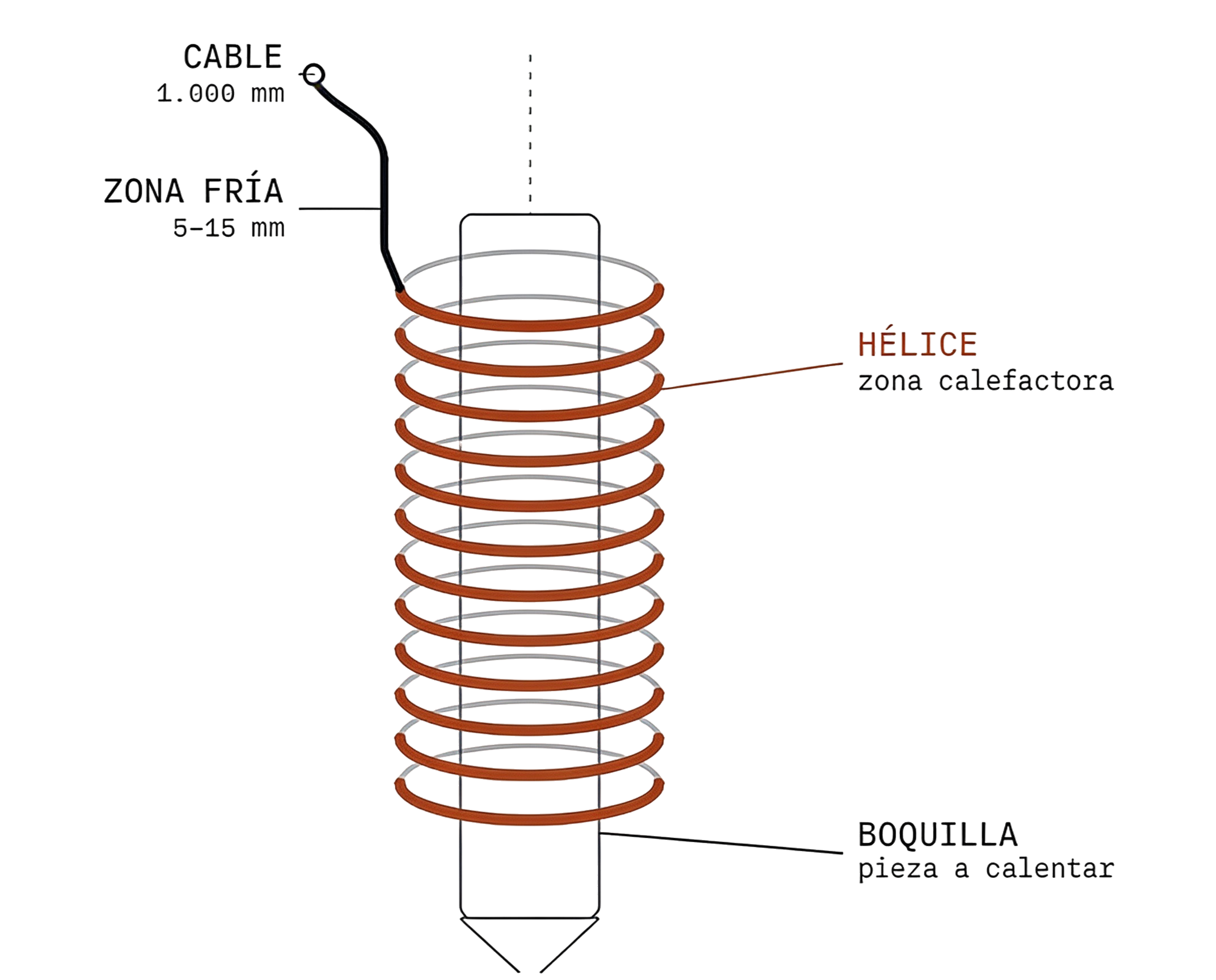
Fig — Helically formed onto a nozzle
Diagram of a formable coil heater wound onto an injection nozzle: 1,000 mm connection lead, 5–15 mm cold zone, helix as the heated zone and the nozzle as the part to be heated
use → concentrated heat in minimal spaces · from Ø 1.8 mm
Max. temp.
750 °C
Sections
Ø 1.8 – 8.5 mm
Watt density
≤ 15 W/cm²
01

What a formable coil heater is

A formable coil heater is a sheathed electric heating element with a circular, square or rectangular section, built from annealed stainless steel tube so it can be cold-bent and adapted to the exact geometry of the part to be heated without losing electrical performance.

In international technical terminology these elements are known as coil heaters, formable tubular heaters or, when mounted on injection nozzles, hot runner nozzle heaters. The smallest-diameter version (1.8 mm) is known as a micro coil heater.

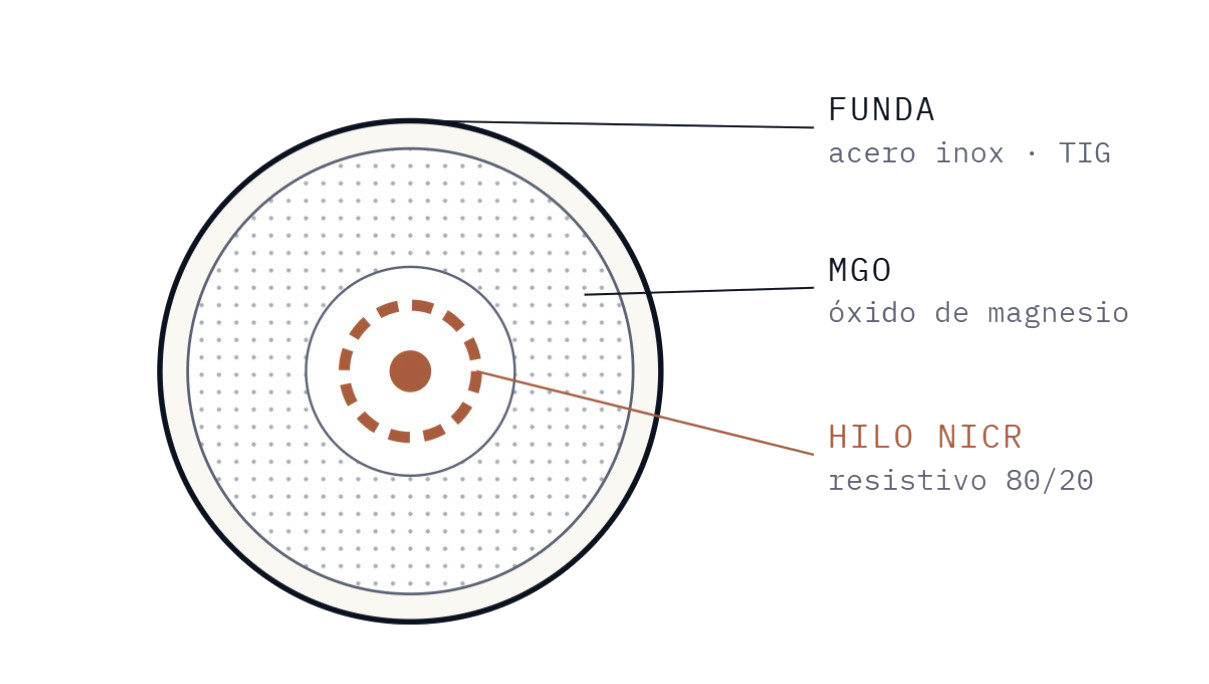
Its construction —NiCr 80/20 resistance wire embedded in compacted magnesium oxide (MgO) inside a TIG-welded stainless steel sheath— improves heat transfer, extends service life and allows working temperatures up to 750 °C.

Terminology by language
Terminology of the formable coil heater in Spanish, English, German and Italian.
SpanishResistencia helicoidal conformable · resistencia conformable · resistencia moldeable
EnglishCoil heater · formable tubular heater · hot runner nozzle heater · micro coil heater (Ø 1.8 mm)
GermanWendel-Rohrheizkörper · Düsenheizkörper · Heißkanal-Düsenheizung
ItalianResistenza a spirale conformabile · riscaldatore per ugelli a canale caldo
Fig · Section of the formable tube
Cross-section of the formable tube: TIG-welded stainless steel sheath, compacted magnesium oxide (MgO) insulation and NiCr 80/20 resistance wire at the core
02

Series and sections of the manufacturing program

The program ranges from micro-sections of 1.8 mm up to sections of 8.5 mm, in rigid versions formed at the factory and flexible versions for on-site forming. Every series can be built to custom length, power, voltage and forming geometry.

Surisa formable coil heater series with their standard sections and distinguishing feature: standard formable, mini formable, formable CL, flexible CL, flexible ML, bronze-encapsulated and zamak nozzle electrification.
SeriesStandard sectionsDistinguishing feature
Standard formable3 Ø · 4 Ø · 3×3 · 6×6 · 2.2×4.2 · 5×7 mmFormed at the factory to drawing; tangential, axial or radial outlet
Mini formable1.8 Ø · 1.8×1.8 mmMicro-section for very small-diameter nozzles
Formable CL5 Ø · 6.4 Ø · 8 Ø · 8.5 Ø · 6×6 mmConnection at each end; annealed tube
Flexible CL6.5 Ø · 8 Ø · 8.5 Ø · 6×6 · 8×8 mmAnnealed corrugated tube, formable on-site; connection at each end; 40 mm inactive per side
Flexible ML6.5 Ø · 8 Ø · 8.5 Ø · 6×6 · 8×8 mmConnection at one end only (1,000 mm); designed to be embedded in molds; lengths from 200 to 3,000 mm (4,000 mm on special order)
Bronze-encapsulatedTo nozzleFormable core with stainless steel sheath encapsulated in bronze: maximum thermal uniformity and corrosion protection
Nozzle electrification (zamak)To customer's nozzleThe customer's own nozzle is electrified directly
Rigid vs flexible

The rigid versions are delivered already formed to drawing (repeatability in series production). The flexible versions, with an annealed corrugated tube, let the customer perform the final bend in-house while respecting the minimum radius of the section — which simplifies inventory when several mold geometries coexist.

— Four levels of lead protection
  • 01 · PFA lead No outer protection · standard connection
  • 02 · Metal braid Stainless steel braid over the lead
  • 03 · Metal tube Galvanized metal protective tube
  • 04 · Fiberglass + silicone sleeve Fiberglass sleeve with silicone
— Cold zones · actual heated length

Each heater includes cold zones (sections with no resistance wire) at the ends, from 5 to 15 mm depending on length and diameter. In the flexible versions the inactive zone is 30 mm on the lead side.

There is also a 35 mm non-formable zone next to the outlet that must not be bent, so as not to damage the electrical transition. The actual heated length is the total length minus the cold zones: accounting for it avoids temperature gradients and errors in the watt density calculation.

Have the part drawing or a sample?

Send us the geometry of your nozzle or mold. We'll come back with section, power and forming. Surisa's technical team defines the element from your drawing or a sample of the part to be heated, and proposes the right series, section and lead outlet.

04

Technical specifications

Technical specifications of the formable coil heaters: NiCr 80/20 wire, compacted MgO insulation, TIG-welded stainless steel sheath, maximum temperature of 750 °C, watt densities, currents, dielectric strength, tolerances and optional integrated thermocouple.
ParameterValue
Resistance wireNiCr 80/20
InsulationCompacted MgO (magnesium oxide)
SheathStainless steel (annealed in on-site formable versions) · TIG welding
Max. working temperature750 °C at the sheath surface
Recommended watt density≤ 4 W/cm² (standard) · up to 10 W/cm² (flexible Ø 6.5) · up to 15 W/cm² (flexible Ø 8–8.5)
Maximum current (flexible)5.45 A (Ø 6.5 and 6×6) · 9.10 A (Ø 8, Ø 8.5 and 8×8)
Dielectric strength1,500 V / 1 s (standard) · 1,000–1,250 V depending on section (flexible)
Cold insulation resistance≥ 5 MΩ at 500 V DC
Cold leakage current≤ 0.1 mA at 242 V
Length tolerance± 2.5 % (standard) · ± 1.5 % (flexible)
Diameter tolerance± 0.1 mm
Power tolerance± 10 %
Integrated thermocoupleOptional · type J (Fe-CuNi) or type K (NiCr-Ni), depending on section
Why compacted MgO

Compacted magnesium oxide is an excellent electrical insulator and, at the same time, a good thermal conductor: it insulates the NiCr wire while transferring its heat to the sheath. Compaction improves transfer, extends service life and allows reaching 750 °C.

Integrated thermocouple

The integrated thermocouple (type J or K) measures the temperature in the body of the heater itself, enabling precise closed-loop control on injection nozzles and hot runner manifolds.

05

Industrial applications

Formable coil heaters are used in any thermal process where electric heating must be concentrated in very tight spaces: plastic injection, molds, non-ferrous metal casting, packaging machinery and fluid processes.

01

Plastic injection

Hot runner · nozzles · manifolds

Heating of injection nozzles and hot runner manifolds (hot runner systems), including very small-diameter nozzles with 1.8 mm micro-sections.

02

Molds and dies

Uniform temperature control · PET

Flexible heaters embedded in machined channels of the mold, for uniform temperature control of injection, blow and PET preform molds.

03

Non-ferrous casting

Zamak · aluminum

Heating of nozzles and feed channels in zamak and aluminum casting, including direct electrification of the nozzle.

04

Packaging

Sealing · cutting · folding

Hot-cutting blades, welding jaws and film folders in packaging machinery.

05

Fluid processes

Heat tracing · distribution

Heat tracing and localized heating of pipes, fittings and distribution blocks.

06

Corrosive environment or maximum uniformity?

Bronze-encapsulated

The bronze-encapsulated version improves the fit on the nozzle and the heat distribution. Get in touch.

06

Frequently asked questions

01 What is the difference between a rigid and a flexible formable coil heater?

The rigid version is formed at the factory to drawing and delivered with its final geometry, guaranteeing dimensional repeatability in series production. The flexible version is made with annealed corrugated stainless steel tube, which lets the customer bend it on-site and adapt it to the mold or nozzle in their own shop, respecting the 35 mm non-formable zone next to the lead outlet. The flexible version simplifies inventory when several mold geometries coexist.

02 What maximum temperature does a formable coil heater reach?

The maximum working temperature is 750 °C at the sheath surface. To operate reliably in that range, good mechanical contact with the part to be heated is essential, along with respecting the recommended watt density: up to 4 W/cm² in the standard series and up to 10–15 W/cm² in the flexible versions, depending on section.

03 What standard sections are available in formable coil heaters?

The standard program covers round sections of 1.8 — 3 — 4 — 5 — 6.4 — 6.5 — 8 and 8.5 mm in diameter, square sections of 1.8×1.8 — 3×3 — 6×6 and 8×8 mm, and rectangular sections of 2.2×4.2 and 5×7 mm. The choice of section depends on the diameter of the nozzle or channel, the power required and the minimum admissible bend radius.

04 Can they include an integrated thermocouple?

Yes. Formable coil heaters can be built with an integrated thermocouple, type J (Fe-CuNi) or type K (NiCr-Ni), depending on the section of the element. The thermocouple measures the temperature directly in the body of the heater, enabling precise closed-loop control on injection nozzles and hot runner manifolds.

05 What is the cold zone of a formable coil heater and why does it matter?

The cold zone is the section at the ends with no resistance wire, from 5 to 15 mm depending on length and diameter (30 mm in flexible versions). It must be taken into account when sizing the heater: the actual heated length is the total length minus the cold zones. Ignoring it causes temperature gradients at the ends of the part and errors in the watt density calculation.

06 Can formable coil heaters be used to heat an injection mold?

Yes. The single-end connection flexible versions are specifically designed to be embedded in machined channels of the mold, with lengths from 200 to 3,000 mm (4,000 mm on special order) and loads up to 15 W/cm². By adapting to the channel routing, the heat is distributed uniformly across the area of the mold that requires it.

07 Can formable coil heaters be made to measure?

Yes. In addition to the standard program, heaters are made to custom length, power, voltage, section and forming geometry, with tangential, axial or radial lead outlets and four types of lead protection. Surisa's technical team advises on defining the element from the drawing or a sample of the part to be heated.

Need to heat a nozzle, a mold or a blade?

Tell us the geometry and the target temperature. We'll come back with the right configuration. Standard and custom formable coil heaters, with in-house engineering support since 1974.