The proliferation of bacteria in food is a serious public health problem. Bacteria and the enterotoxins they produce are the most common cause of food poisoning. Salmonella, as well as verotoxigenic Escherichia coli and Campylobacter, are some of the most frequent.
The food industry establishes protocols for the correct treatment of food in order to ensure its sanitary conditions at the time of consumption. It is essential to control that these processes are carried out correctly to avoid serious health problems. The use of temperature indicators guarantees their correct application in a simple and economical way.
Bacterial reproduction temperatures
Temperature is one of the factors that most affects food preservation, since bacteria develop or not depending on it. We must point out that the presence of bacteria in food can even be beneficial. The main problems arise due to the growth of these bacteria, which means our body is unable to process them. Therefore, the first thing we must look at is at what temperature bacteria multiply most quickly.
The temperatures at which bacteria reproduce are between 5ºC and 60ºC. Within this temperature range, and depending on other parameters such as oxygen and the presence of water, is where the ideal circumstances for their proliferation occur.
It must be borne in mind that bacteria reproduce by binary fission, as the most common method, and that this process can occur every 20 minutes. Therefore, in a short time, the population may have increased exponentially.
Killing bacteria by temperature
One of the most widely used methods in the food industry for food preservation is the elimination of bacteria through a heat process. Most bacteria die from 65ºC. However, depending on the type of food or the way it is going to be preserved, it may be necessary to reach 120ºC.
It is commonly established that if we keep a food at 100ºC for long enough for all its parts to have reached that temperature, we will have eliminated the bacteria it contains.
Heat processes for killing bacteria
Currently, with the increase in packaged food and the need to extend shelf life while trying to maintain the organoleptic characteristics of the food, we find several methods of killing bacteria:
- Pasteurisation: we subject the product to a temperature of 75ºC for 15 seconds. This process partially sterilises the food, which must then be kept refrigerated. It is commonly used in products such as cheese, milk, beer and even orange juice.
- Cooking: it involves keeping the food at 80ºC for 4 minutes. In principle it destroys the bacteria, although some spores may remain. Depending on the specific food and the type of bacteria, times and temperatures may vary.
- Sterilisation: the food is subjected to 120ºC for 4 minutes. This process means the food does not then have to be kept refrigerated. It is usually used in milk and fruit juices.
Temperatures to prevent bacteria from reproducing
Another option used in the food industry is to keep food at a temperature that slows down or even completely stops the proliferation of bacteria. As we have already indicated in this article, one of the main problems is not the presence of bacteria itself, but their exponential increase within the product.
Preserving food below 5ºC greatly reduces bacterial reproduction. In addition, the use of vacuum packaging, causing the absence of oxygen, and keeping food in a dry environment are procedures that help it to be preserved properly, preventing the proliferation of bacteria.
Freezing food at -18ºC completely stops bacterial reproduction and, in some cases, even eliminates it. By using frozen food, the shelf life of food, without risk to health, is much longer.
Temperature labels to control the elimination of bacteria
Temperature procedures to kill bacteria or to prevent them from reproducing are only effective if carried out correctly. In this regard, it is essential to carry out a control that ensures we have achieved the indicated temperatures.
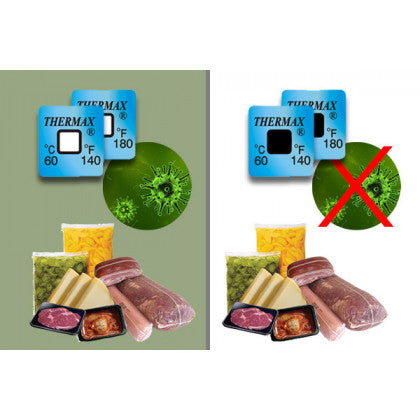
Irreversible temperature labels make a permanent colour change when the appropriate temperature is reached. In this way they make it possible to control heat processes, guaranteeing that the temperature at which bacteria die has been reached and that, therefore, the food complies with preservation standards to be eaten.
Likewise, the use of adhesive temperature indicators is an effective means of controlling the cold chain, both in fresh and frozen food.