The initial goal of this project was to compare how disc springs in different materials degrade. After almost two years of testing, the results are in part self-evident and in part revealing.
The experiment consists of leaving disc springs of different sizes and materials exposed to the elements over a long period — 21 months, to be exact. The setting: an interior courtyard in the city of Barcelona (Spain). They were subjected to nothing beyond ambient conditions: air, rain and the city’s temperature swings. The results are the effects the environment produced on the different parts. Photographs were taken every one to two months to record how corrosion progressed. It is worth noting that the washers carried no load during the test and were always exposed to ambient temperature.
The climatic agents that affect materials most are oxygen and water. The study was carried out at our commercial premises, less than 2 kilometers from the sea, with the humidity levels that implies. Bear in mind that every climate is different, and so is its effect on materials: hotter, damper climates accelerate corrosion.
The springs in the test are made of four different materials: DIN 1.8159 (51CrV4), DIN 1.4310 (AISI 301), DIN 2.4668 (Inconel 718) and DIN 1.4568 (AISI 631, also designated 17-7PH). The 51CrV4 is the least resistant, being a chromium steel alloy made for applications known in advance not to be exposed to corrosive agents. The 1.4310, the 17-7PH and the Inconel, by contrast, are made specifically to withstand external agents. The experiment shows no great difference between them, because the elapsed time was not enough for differences in corrosion resistance to emerge. From experience, however, we can say that the most resistant is Inconel 718, followed by 301, with 17-7PH the least resistant of the three. Even so, 17-7PH is sometimes used instead of 1.4310 because it is a cryogenic material with a wide thermal range (−196 °C to 300 °C). Inconel is more efficient still in thermal resistance (−260 °C to 700 °C). Against the plain effects of the environment, though, all three materials hold up perfectly, as the images show.
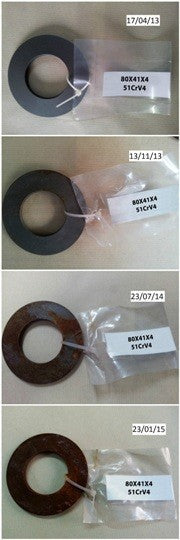
With the 51CrV4, the effects of corrosion over time are clearest in the photographs, above all from eight months of outdoor exposure onward. What shows up mainly is rust staining, spreading across the surface of the washer as the months pass. In some cases the wear deforms the washer, mainly at the edges.
The springs remain unchanged in AISI 301, 17-7PH and Inconel 718 alike. None of the three shows notable corrosion. Some staining can be made out, but in no case does it indicate deterioration that would affect the disc spring’s performance.
We can conclude that, at rest, the only material that suffers from the environment is 51CrV4. The rest hold up perfectly.
Below are the image sequences for the different types of disc spring. In all four cases the photographs were taken on 17 Apr 2013, 13 Nov 2013, 23 Jul 2014 and 23 Jan 2015, in chronological order:
Click any image to enlarge
51CrV4 |
1.4310 |
17-7PH |
Inconel 718 |
|---|---|---|---|
 |
 |
 |
 |