


Petrochemicals and refining
ANSI flanges · process lines
Flanges in high-pressure, high-temperature process lines. Typical combination: spiral-wound gasket + Inconel 718 Belleville on critical bolts.
Leak prevention in flanged joints exposed to thermal cycling, vibration or gasket relaxation.
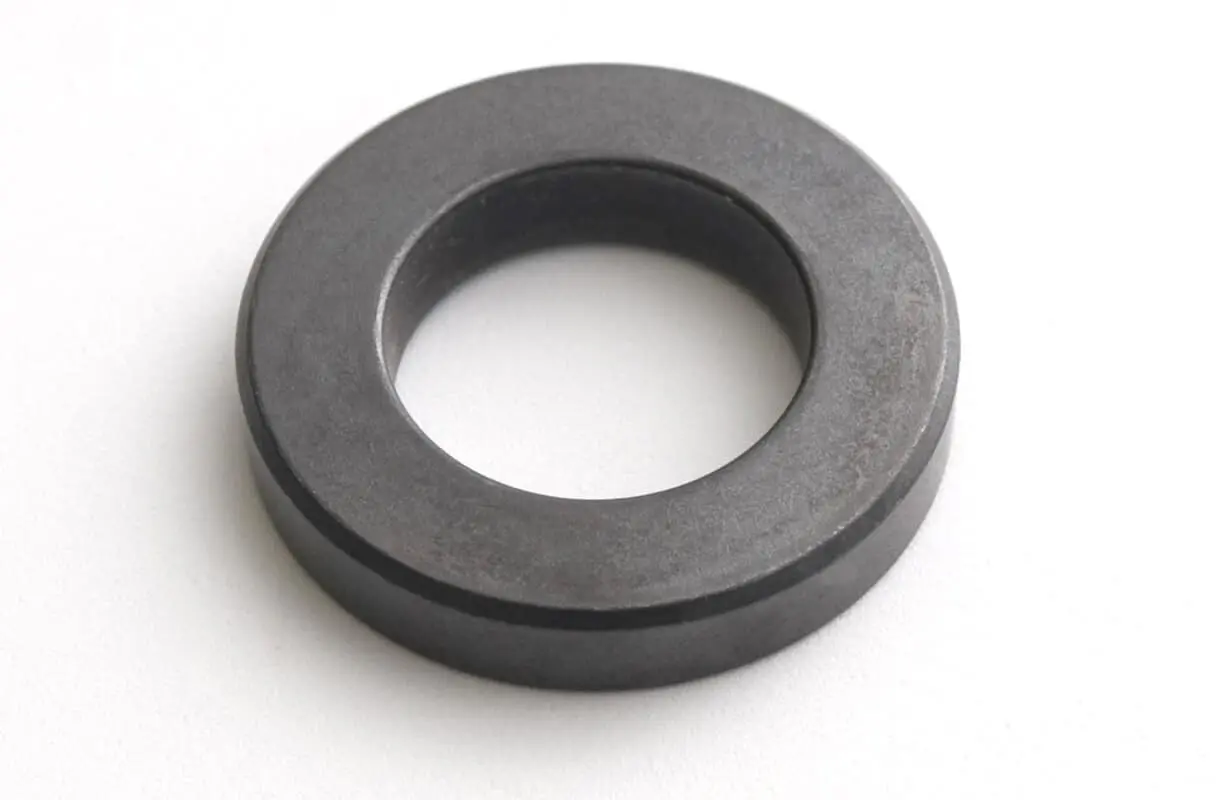
A flange washer —also called a pressure disc spring, disc spring or coned-disc washer— is a conical elastic component fitted under the nut or bolt head in a flanged joint to maintain a constant axial load on the gasket.
Unlike flat washers, its frustoconical geometry stores elastic energy that compensates for the loss of preload caused by:
These washers are referenced by the stud diameter in inches, with three force levels for each. They can also be supplied for stud diameters in the metric system. Contact us about your case.
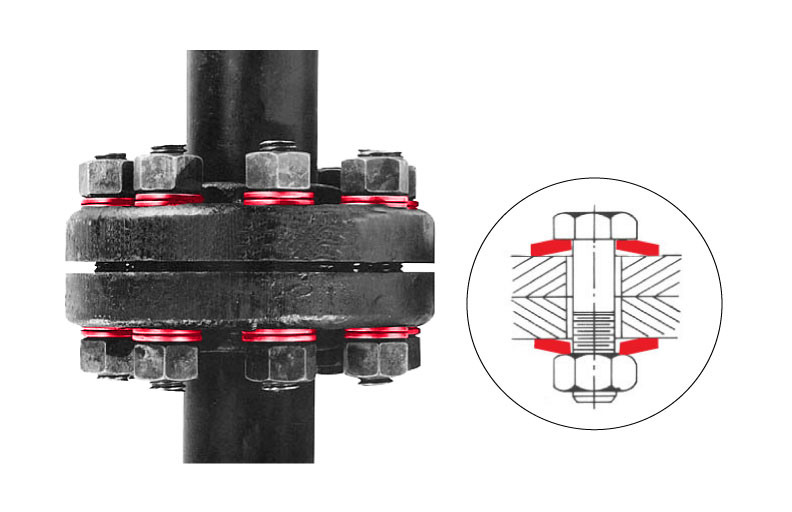
Installing Belleville washers on flanges is justified when the joint is exposed to any of the following scenarios. The washer acts as a load reserve: when the gasket or the bolt loses effective length, the washer expands without recovering its full height, allowing the joint to stay sealed (with a lower force, but enough to prevent leaks).
During a thermal cycle, in a flanged joint, the bolt/stud, the flange body and the gasket change at different rates. Flange washers, pre-compressed to the tightening torque required by the gasket, absorb these changes so that the joint never loses its clamping force, thereby preventing an unwanted leak.
Fully rigid, 100% contact causes two opposite modes: load loss from gasket settling, or excessive values that break bolts or gaskets. The elasticity of the flange washer absorbs these stresses and keeps the force within the operating range.
Over time and at service temperature, the stud tends to deform/elongate because it is under tension. This elongation is absorbed by the flange washers, so that the joint does not lose its contact force, preventing leakage of the fluid running through the pipe. (The elongation of the stud is smaller than the elongation of the flange washer.)
Electrical connections are often made up of materials with different coefficients of thermal expansion. In addition, the joint materials carry more current than the bolts, which causes the joint to heat up more than the bolts do. The resulting differential thermal expansion increases the load on the bolt, which can lead to creep in the joint components. Introducing spring washers reduces this detrimental effect.
↘ Typical configuration: a pair of Belleville washers under each nut of the electrical terminal, usually in 17-7 PH or Inconel 718 depending on the service temperature.
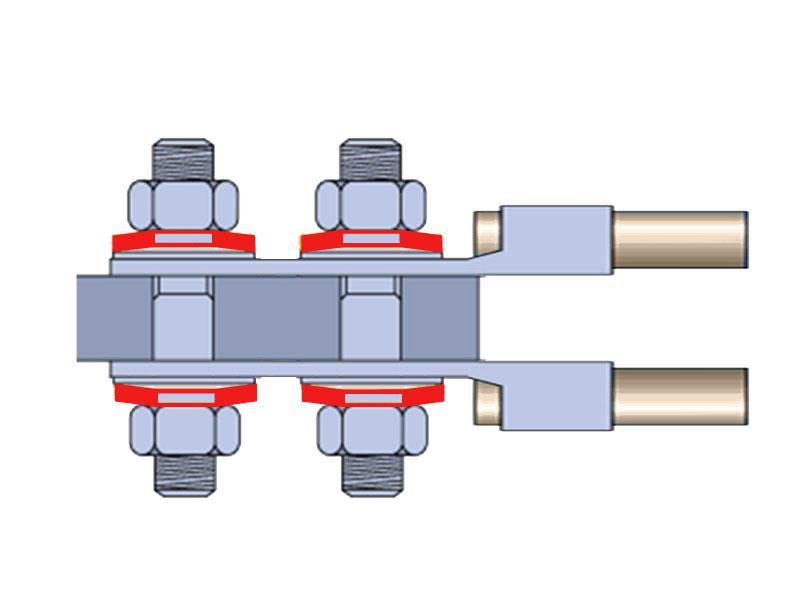
Flange washers protect flanged joints against leaks, giving them the elasticity each case requires.
Surisa manufactures flange washers in three materials that cover virtually every industrial application. The choice depends on the service temperature, the working atmosphere (corrosion) and the frequency of thermal cycling.
The ranges are indicative for preliminary design. The admissible service temperature also depends on the load, the frequency of thermal cycling and the atmosphere.
Tell us about your use case and our engineering team will help you choose the optimal solution.
Inconel 718 is the only material suitable for continuous service above 550 °C, thanks to its γ″ precipitation. 17-7 PH is the default choice when there is moderate corrosion or cryogenic service. H-13 covers the middle ground in non-corrosive applications where thermal cycling is intense.
For the upper limit of the range by material, we recommend validation with a specific relaxation calculation at the actual service temperature.
Flange washers are the standard when a gasket leak has critical consequences (safety, plant shutdown, electrical inefficiency) and the environment makes the loss of initial preload inevitable.
Flanges in high-pressure, high-temperature process lines. Typical combination: spiral-wound gasket + Inconel 718 Belleville on critical bolts.
Heat exchangers, turbines and superheated-steam piping where thermal cycling is continuous and gasket failure has critical impact.
Plants with aggressive fluids where stainless steel or a nickel alloy is mandatory. 17-7 PH for moderate corrosion, Inconel 718 for severe environments.
Flanged connections in industrial switchgear, transformers and substations. The Belleville absorbs the cyclic expansion from the Joule effect and prevents hot spots.
Equipment down to −250 °C where 17-7 PH stainless steel and Inconel 718 maintain stable elastic behavior. Critical in LNG and liquid hydrogen plants.
Flanged closures on valves with a stem, where leakage is a direct function of maintaining the preload on the gasket assembly.
The main factors are: bolt diameter and grade, thread-nut friction coefficient (a function of the lubricant and coating), closing load required by the gasket and the load-deflection curve of the selected washer.
DIN 6796 washers are standardized conical spring lock washers for structural bolting, designed to prevent loosening of bolted joints and to work almost flat, and are single-use. Flange washers are pressure disc springs designed to maintain a significant elastic preload throughout the life of the joint, with a load-deflection curve calculated to compensate for thermal and mechanical relaxation. The former are an anti-loosening safety element; the latter are an active load-maintenance element (live loading).
It depends on the material. 17-7 PH stainless steel maintains stable elastic properties from −200 °C up to about +300 °C. Inconel 718 is the choice for continuous service up to about +600 °C thanks to its creep resistance, and goes down to −250 °C. H-13 covers the intermediate range in non-corrosive applications, from −100 °C up to about +590 °C. For service at the limit of the thermal range we recommend validation with a specific calculation.
No: they are complementary elements, not alternatives. The gasket remains the primary sealing element. Belleville washers are fitted under the bolt nut to maintain the preload on that gasket when the system undergoes thermal cycling, vibration or relaxation. The combined installation (spiral-wound gasket + Belleville washers on the bolts) is common in critical petrochemical and power-generation flanges.
In a flanged joint, the usual practice is to fit two washers, one under each nut; these washers are not stacked in stacks. Surisa's calculation program is exclusive to DIN 2093 disc springs and does not apply to flange washers. To size a specific joint, send us the joint data (flange standard, bolt, temperature and gasket) and our technical team will advise you on the right material and arrangement.
The vast majority of the applications we receive are solved with catalog washers; it is rare to have to manufacture sizes outside the catalog, unlike what happens with DIN 2093 disc springs. Occasionally, special versions can be manufactured on request.
The usual lead time for standard references is 72 to 96 hours: the material is imported from the United States, so transit and customs procedures may extend that time. Confirm your reference and we will indicate the actual lead time in each case.
The DIN 2093 is a general-purpose elastic element: it is designed for a specific force and deflection. The flange washer is a preload-maintenance element: it is designed to compensate for load loss in the flange bolt due to relaxation and temperature.
Dimensionally they are also different, both in the ratio between external diameter and internal diameter and in the ratio between deflection capacity and free height.
Tell us about your use case and our engineering team will help you choose the optimal solution.