


— Elastic behaviour
Progressive non-linearity
The force-deformation curve is non-linear: stiffness increases progressively as the elastomer is compressed, allowing it to absorb overloads without transmitting sharp peaks.
Cylindrical elastomer springs in CR rubber (SZ8500) and Vulkollan polyurethane (SZ8590) for damping and vibration isolation. Available in multiple diameters (Da 16–125 mm) with full technical data, force-deflection charts and chemical compatibility to industrial standards.
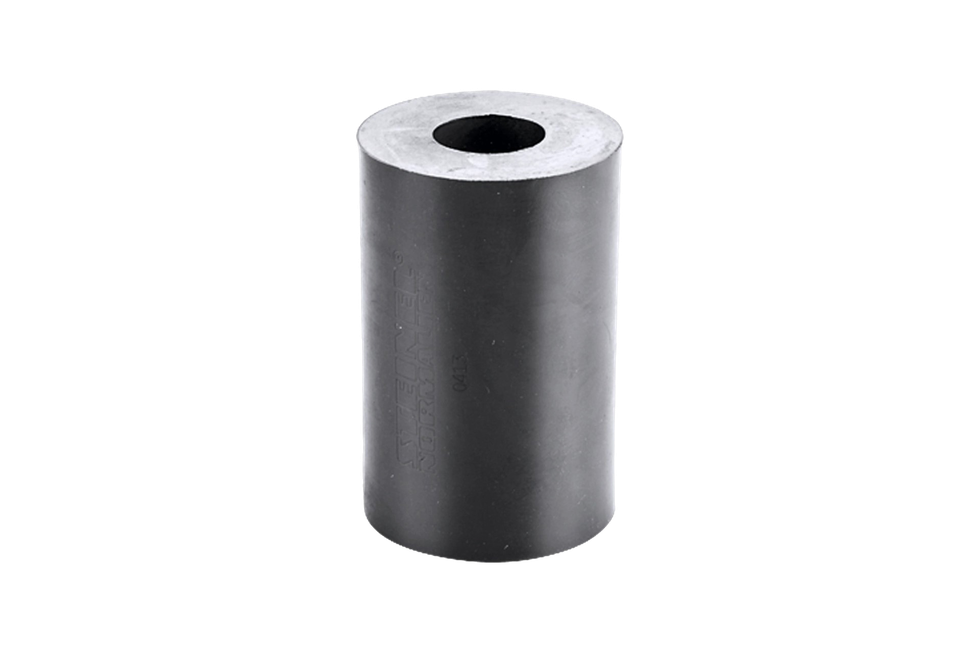
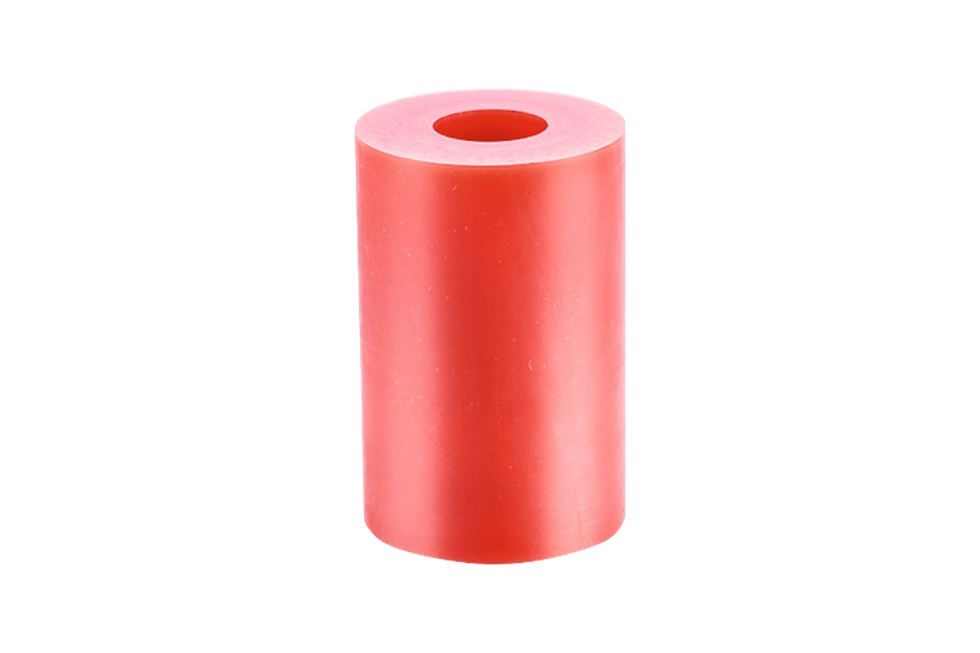
Cylindrical elastomeric compression springs made of chloroprene rubber (CR) or Vulkollan polyurethane (PUR). They are used as an alternative to the steel helical spring in applications where reliability under overload and impact absorption are critical.
The DIN ISO 10069-1 standard — «Springs — Cylindrical helical springs made from round wire and bar — Elastomer springs» defines the standardised geometry, hardness, maximum permissible deflection and elastic behaviour. It is complemented by DIN 9835, specific to elastomer springs in tooling.
In technical terminology they are known as elastomer springs, rubber springs (if made of rubber) or polyurethane springs and Vulkollan springs (if made of polyurethane). They are the reference standard in stamping dies, injection moulds, presses and damping systems requiring progressive elastic force without the risk of catastrophic failure.
The DIN ISO 10069-1 standard defines two standardised series covering the full range of needs in tooling and damping. They are geometrically interchangeable: they share Da, Di and standard lengths, which means you can select the right elastic response without redesigning the housing.
Large deformations, impact absorption
High forces in a small space
| Parameter | SZ8500 (CR) | SZ8590 (PUR) |
|---|---|---|
| Material | Chloroprene (CR) | Vulkollan polyurethane (PUR) |
| Shore A hardness | 70 ±3 | 90 ±5 |
| Identifying colour | Black | Red |
| Maximum deflection (Smax) | 0.35 · L₀ | 0.25 · L₀ |
| Initial setting | 3-5 % | 8-10 % |
| Continuous temperature | +80°C | +80°C |
| Thermal peaks | +120°C | +120°C |
| Best for | Large deformations | High forces |
Each cylindrical elastomer is defined by standardised geometric parameters that determine its elastic behaviour.
| Da | External diameter of the elastomer (mm) | Range: 16 to 125 mm |
| Di | Internal diameter / central bore (mm) | For shaft guiding |
| Db | Intermediate diameter in the deformed zone | Measured under maximum load |
| L₀ | Free height without load (mm) | Initial state |
| Smax | Maximum permissible deflection | SZ8500: 0.35·L₀ · SZ8590: 0.25·L₀ |
| Fn | Nominal force at Smax (N) | Calculated from hardness and geometry |
| c | Spring rate (N/mm) | ±15% (non-linear) |
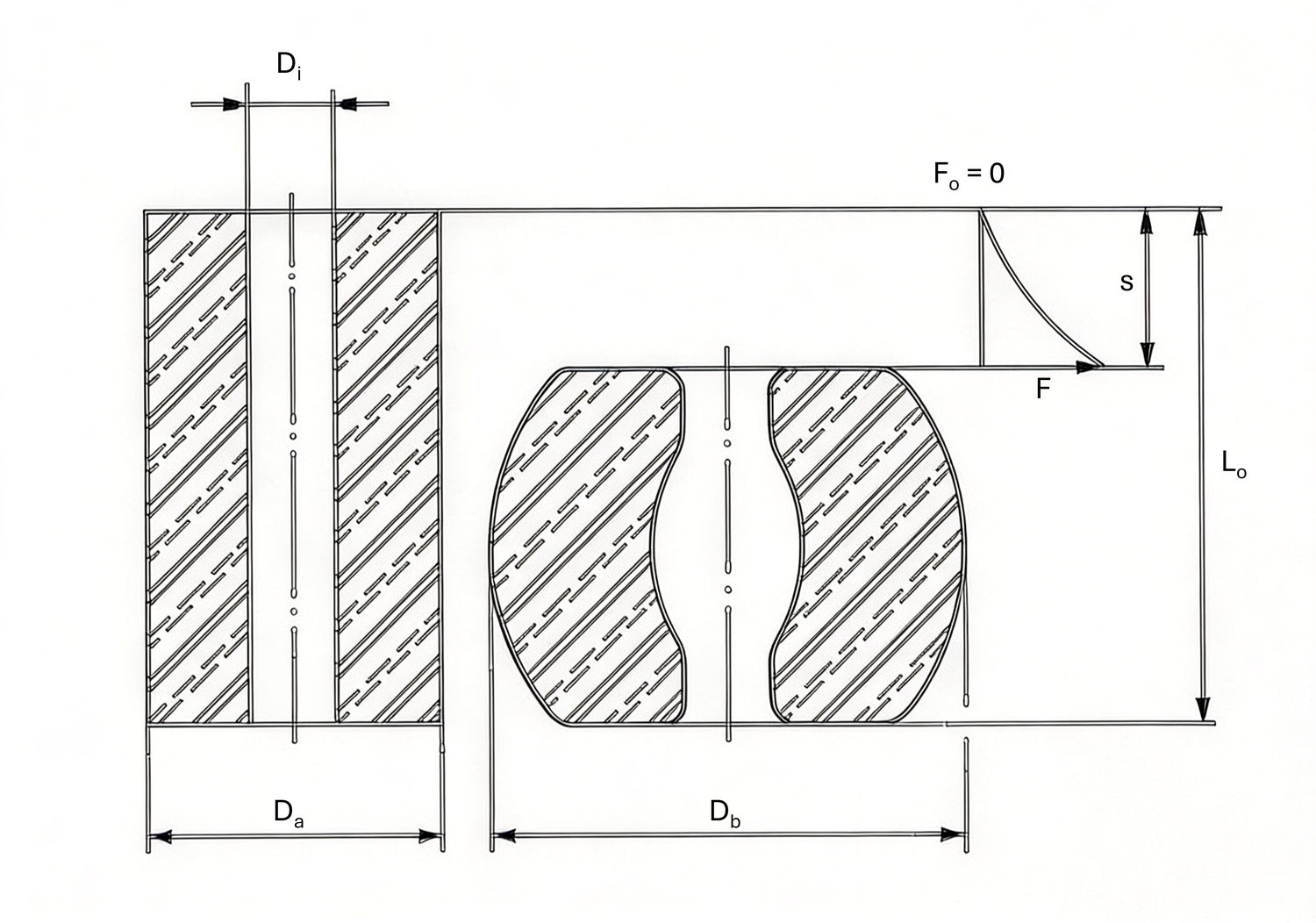
The force-deformation curve is non-linear: stiffness increases progressively as the elastomer is compressed, allowing it to absorb overloads without transmitting sharp peaks.
SZ8500 and SZ8590 share Da, Di and standard L₀ lengths, allowing you to switch series without redesigning the housing.
Both series cover Da = 16 — 125 mm and multiple standard L₀ lengths.
Tell us about your use case and our engineering team will help you choose the optimal solution.
Chloroprene (neoprene) elastomer with a hardness of 70 ±3 Shore A. It is chosen when the application calls for absorbing impacts with long travel rather than applying maximum forces.
Elastic characteristics
When to choose SZ8500: chloroprene accepts large deformations and dissipates energy with very good elastic recovery. It is the right choice when you need to absorb impacts (end stops, limit stops, stripper return) rather than apply maximum forces in a compact space. Its low initial setting (3-5%) makes it especially stable in the long term under continuous operation.
Vulkollan polyurethane elastomer with a hardness of 90 ±5 Shore A. It is chosen when the application calls for high forces in a very small space, with controlled travel.
Elastic characteristics
When to choose SZ8590: polyurethane is built to withstand high forces. With the same geometry as an SZ8500, it develops a significantly higher nominal force Fn. It is the right choice when the design criterion is maximum force in minimum space: heavily loaded press cushions, stripper return under high load, clamping and preload systems. Its initial setting is higher (8-10%) and must be allowed for in the initial sizing.
Both series offer outstanding resistance to the stresses commonly found in industrial environments.
Compatible with hydraulic fluids and industrial lubricants
Withstands repeated cycles without crack propagation
Up to +80°C continuous; +120°C short-duration peaks
Especially CR (SZ8500); PUR less affected
For environments with special chemical compatibility (aggressive solvents, acids, concentrated alkalis) or with continuous temperatures above 80°C, Surisa supplies special elastomers in NBR, HNBR, FKM, EPDM, silicone and high-temperature polyurethanes. Consult our engineering team free of charge.
DIN ISO 10069-1 elastomers are used as a reliable elastic element in a wide variety of applications, especially where the steel helical spring is at risk of failure from fatigue, overload or impact.
Stripper return, ejectors, internal cushions and safety elements in stamping dies. Direct replacement for helical springs at risk of catastrophic failure.
Press cushions, moving plate return, automotive stamping lines. Absorption of high-energy impacts.
End-of-travel stops, impact dampers, industrial bumpers. Fail-safe without breaking the part.
Mould closing, damping of rapid closures, return of moving elements in injection and blow-moulding machines.
Secondary dampers, intermediate stops, end-of-travel stops on carriages and transfers. Resistance to continuous vibration.
Elastic mounts for heavy machinery, anti-vibration systems, dynamic decoupling. Progressive non-linear response.
Actual force and deflection characteristics for each series and external diameter (Da).

Chart not available for this diameter — see the technical catalogue.

Chart not available for this diameter — see the technical catalogue.
Note how the SZ8500 (chloroprene, black edge) accepts larger deflections with progressive force, while the SZ8590 (polyurethane, red edge) develops higher forces at smaller deflections.
Choose SZ8500 (chloroprene, 70 Shore A) when you need to absorb impacts with long travel: end stops, limit stops and stripper return. Its maximum deflection is greater (0.35·L₀) and its initial setting low (3-5%). Choose SZ8590 (Vulkollan polyurethane, 90 Shore A) when the criterion is maximum force in minimum space: with the same geometry it develops a significantly higher nominal force Fn, at the cost of shorter travel (0.25·L₀) and a higher initial setting (8-10%).
The reference standard is DIN ISO 10069-1 («Elastomer springs»), which defines standardised geometry, hardness, maximum permissible deflection and elastic behaviour. It is complemented by DIN 9835, specific to elastomer springs in tooling. Both Surisa series (SZ8500 and SZ8590) meet both standards.
Setting is the permanent loss of height the elastomer undergoes after the first compressions, i.e. an initial loss of free height. In the SZ8500 it is low (3-5%) and in the SZ8590 higher (8-10%). It is compensated for by allowing for it in the initial sizing: you start from a slightly greater free height L₀ so that, after settling, the part works within its nominal range.
Both series work up to +80°C continuous and tolerate +120°C peaks of short duration. For continuous temperatures above 80°C, Surisa supplies special elastomers in HNBR, FKM, silicone or high-temperature polyurethanes.
With identical external geometry (same Da, Di and L₀), the SZ8590 in polyurethane develops a significantly higher nominal force Fn than the SZ8500 in chloroprene, because its hardness is greater (90 vs 70 Shore A). The trade-off is shorter usable travel (0.25·L₀ against 0.35·L₀). The force-deflection charts in section §08 show this difference by diameter.
Yes. In addition to the standard sizes of the SZ8500 and SZ8590 series (Da 16–125 mm), Surisa supplies custom special elastomers: intermediate hardnesses, non-standard geometries and specific compounds (NBR, HNBR, FKM, EPDM, silicone). Consult our engineering team free of charge.
Compared with the steel helical spring, the elastomer offers fail-safe behaviour without catastrophic failure (it does not snap or throw out fragments), a progressive force-deformation characteristic that absorbs overloads and impacts, good damping and vibration isolation capacity, and corrosion resistance without the need for coatings. It is the preferred choice where steel is at risk of fatigue or failure.
Tell us about your use case and our engineering team will help you choose the optimal solution.