


Pharmaceutical and medical industry
Transport and storage of vaccines, refrigerated medicines, blood products and laboratory samples; monitoring in pharmacy and hospital refrigerators.
Adhesive indicators that monitor exposure to out-of-range temperatures during transport and refrigerated storage, with no power supply or on-site calibration. Irreversible, time-temperature or reversible, depending on what you need to monitor.
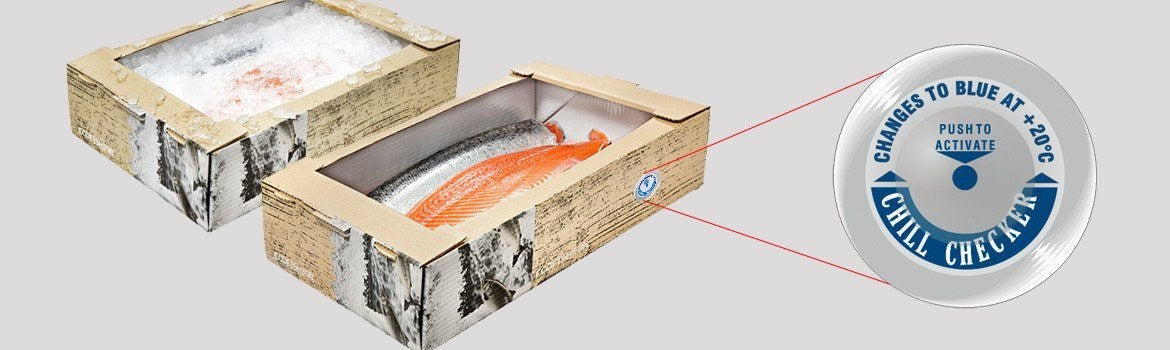
Cold thermometers detect and record a product's exposure to temperatures outside its safe range during transport or storage. Unlike electronic data loggers, they require no power supply, complex setup or calibration at the point of use, and they provide an immediate visual pass/fail reading, at the unit or package level.
The choice of indicator depends on what you need to monitor: whether it is enough to know that a deviation has occurred, how long it lasted, or what the current temperature is.
| Type | English terminology | What it monitors | Color change |
|---|---|---|---|
| Irreversible | Freeze / cold indicator | Whether a critical threshold has been crossed | Permanent |
| Time and temperature | Time-temperature indicator (TTI) | How long the threshold has been exceeded | Progressive and permanent |
| Reversible | Reversible LCD thermometer | The temperature at that moment | Reversible (rises and falls) |
The first two leave a record of a past event and act as a traceability record; the third allows real-time visual verification of how the cold room or vehicle is performing.
The irreversible indicator detects when a critical temperature is crossed and undergoes a permanent color change: once it has changed, it does not return to its original state even if the temperature returns to the correct range. This makes it possible to check afterward whether the cold chain was broken at any point during transit or storage, even with no staff present.
Temperature-drop indicators (freeze indicators) are especially relevant against a risk that is hard to spot with the naked eye: a product that has frozen and thawed may show no external sign of the incident. As a typical behavior reference, a drop below the threshold (e.g. < 2 °C) changes color completely after about 90 minutes of exposure; a rise above it (e.g. > 8 °C), after about 8 hours sustained.
Standard cold indicators cover working ranges between -3 °C and +5 °C, with versions dedicated only to temperature drops (FREEZESAFE type) or to combined monitoring above and below the range (Coldchain type). They comply with the REACH Regulation (EC) No 1907/2006 and the RoHS Directive 2011/65/EU.
Example · rise indicator, calibrated to +8 °C.
Dark environment, between 15 °C and 25 °C, relative humidity of 35% to 55%. Approximate shelf life: 1 year.
The time and temperature indicator records not only that a threshold has been exceeded, but for how long. The WarmMark model features several temperature points, each calibrated for a different period, which change color progressively as the exposure time out of range accumulates.
This is decisive for products whose degradation depends on the cumulative effect of temperature —vaccines, biologics, fresh foods— and not on an instantaneous spike. An exposure of a few minutes may be tolerable, whereas the same temperature for hours renders the product unusable. The TTI indicator makes that difference visible.
● Activated · cumulative color change ○ Pending
Example · 4-point model (WarmMark): the more hours out of range, the more points change color.
The reversible thermometer is made with heat-sensitive liquid crystal and works like a conventional thermometer: it shows the temperature at any given moment, changing color whether the temperature rises or falls. That is why it is reversible —it always reflects the current value—, unlike the two previous types.
There are two common configurations: the scale type, with points marked with specific temperatures that light up according to the actual value, and the window type, which changes color within a target range to confirm at a glance whether the temperature is correct. It is the right solution for routine visual verification of refrigerators, display cases and cold rooms.
Example · scale type: the segment next to the actual temperature lights up and turns off as the reading changes.
Tell us the temperature range you need to monitor and the type of product, and we'll confirm the right model —irreversible, TTI or reversible— and the delivery time.
The threshold that the indicator must monitor is determined by the product being transported. These are the most common reference ranges:
| Range | Typical application |
|---|---|
| +2 °C to +8 °C | Conventional vaccines, insulin, biologics, refrigerated medicines |
| +15 °C to +25 °C | Controlled room temperature (oral medicines, some biologics) |
| < 0 °C | Frozen foods |
| -20 °C | Varicella and zoster vaccines, frozen product |
| -60 °C to -90 °C | mRNA vaccines and ultra-frozen biologics |
Documented temperature monitoring is a regulatory requirement in the pharmaceutical and food sectors. In medicine distribution, Good Distribution Practice (GDP) and WHO guidelines apply; in food, the HACCP system requires the monitoring of critical control points, temperature during transport and storage among them. Cold indicators add to this monitoring a physical, low-cost record that is easy to file alongside the shipment documentation.
Cold thermometers are used whenever you need to guarantee that a sensitive product has stayed within its temperature range throughout the logistics chain.
Transport and storage of vaccines, refrigerated medicines, blood products and laboratory samples; monitoring in pharmacy and hospital refrigerators.
Cold chain for fresh and frozen products, refrigerated transport, monitoring in cold rooms and display cases.
Verification by pallet or by shipment, detection of isolated refrigeration failures in specific areas of the vehicle or cold room.
Products that lose stability or are damaged by freezing: emulsions, reagents, adhesives.
Because they are attached directly to the product or the pallet, they help pinpoint refrigeration problems that a single vehicle sensor would not detect, such as cold or hot spots in specific areas of the cold room.
The irreversible indicator changes color permanently when the critical temperature is crossed and never returns to its original state, so it serves as a record that the cold chain was broken at some point. The reversible one, made with liquid crystal, shows the current temperature and changes whether it rises or falls, so it is useful for real-time checking but leaves no record of a past event.
With an irreversible cold indicator (freeze indicator) placed on the product or the pallet. A thaw-and-refreeze cycle usually leaves no visible trace on the product itself, but the indicator permanently records the crossing of the temperature threshold. When you check it at the destination, a color change confirms that an excursion occurred even if the goods appear to arrive in good condition.
Standard cold indicators work in the range from -3 °C to +5 °C, suitable for refrigerated and frozen products. There are thresholds configured for the usual critical points of the cold chain, such as +2/+8 °C for refrigerated pharmaceutical products or 0 °C for products that must not freeze. For specific needs, Surisa's technical team advises on the right model and threshold.
Yes. They provide physical evidence of the temperature monitoring required by Good Distribution Practice (GDP) and WHO guidelines in the pharmaceutical sector, and by the HACCP system in food. Surisa's cold indicators also comply with the REACH Regulation (EC) No 1907/2006 and the RoHS Directive 2011/65/EU.
No. They are chemical or liquid-crystal labels that work without a battery or on-site setup, unlike electronic data loggers. They stick to a clean, dry surface as close as possible to the product and provide an immediate visual reading. They are stored in a dark environment, between 15 °C and 25 °C and 35–55% relative humidity, with an approximate shelf life of one year.
Tell us the temperature range you need to monitor, the product being transported and the type of indicator you need — we'll select the optimal model and reply with the right solution. Free engineering support, packs of 100 units with permanent stock.