


Carbon spring steel
General purpose, good formability; hardness up to ~64 HRC.
Flat strips of steel that work in bending — a controlled return force in a small space, tuned solely by the geometry of the strip.
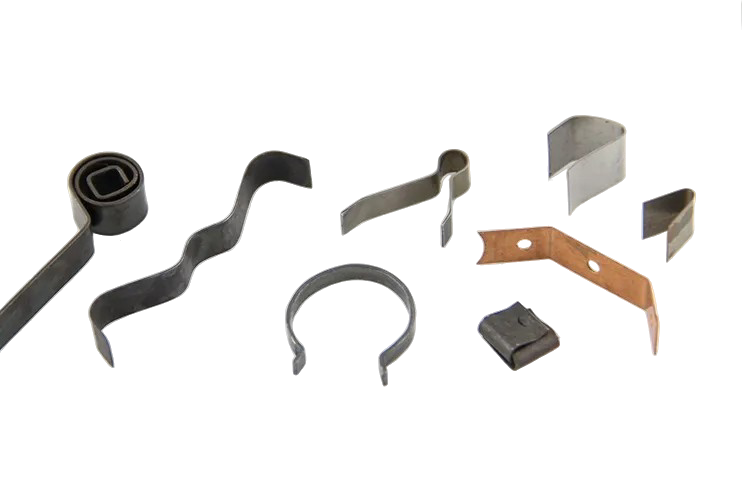
A flat spring —called a flat spring or strip spring in international technical terminology— is an elastic element made from flat or rolled steel strips that store and release energy as they flex under an external load. Unlike a helical spring, the entire elastic function lies in the formed strip itself, with no additional components.
When a load is applied, the strip flexes and stores energy; when it is removed, the strip recovers its shape, exerting a return force. Its simple geometry and low part count make it robust, compact and long-lasting.
They work in two basic beam configurations: cantilever, fixed at one end with the other free, like a diving board; or simply supported, resting on both ends with the load applied at an intermediate point.

Strip fixed at one end and free at the other, like a diving board. The load is applied at the free end. Contacts · switches · elastic tabs.

Strip resting on both ends with the load applied at an intermediate point. Scales · pressure sensors · measuring equipment.
The great advantage of the flat spring is that its spring rate is tuned solely by the geometry of the strip, without adding parts. Three parameters determine it.
| Parameter | Effect on stiffness |
|---|---|
| t · Thickness | ∝ t³ — the most influential factor: stiffness grows with the cube of the thickness. |
| b · Width | ∝ b — proportional: doubling the width doubles the stiffness. |
| L · Length | ∝ 1 / L³ — the longer the working length, the lower the stiffness. |
Cantilever · load at the free end: f = F·L³ / (3·E·I), where E is the material's modulus of elasticity and I = b·t³/12 the moment of inertia of the section. This makes it possible to obtain the exact return force by tuning thickness, width and length to the available space, with no additional components. Sizing is calculated using the beam-bending equations.

To reduce stress concentration and improve fatigue life, all corners and transitions should be rounded with a generous radius. The maximum stress concentrates at the clamped end (fixed end).
Flat springs are made from hardened and tempered or stainless spring strip, depending on the environment and the duty cycle.
Annealed strip lets you form the part before heat treatment; hardened and tempered strip provides the durability and fatigue resistance of the finished spring.
For electrical contacts, beryllium copper combines elasticity with conductivity. Discuss the material with engineering →
Tell us the force, travel and available space, and our engineering team will advise you on the optimal strip geometry.
Flat springs are used in any assembly that requires a repeated, controlled bending force in a small space.
Contacts and spring strips that ensure continuous, reliable contact pressure in connectors, relays and switches.
Retention springs, elastic tabs and clips that hold or release parts with a defined return force.
Latching tabs, ejectors and positioning elements inside tooling and stamping dies.
Elastic positioning with defined return, keeping the part in place between discrete positions.
Elastic guides, switches, relays and instrumentation where the return force must be reliable and repeatable.
The more specific the combination of force, travel and space, the greater the advantage of a custom-formed strip.

Cantilever strip that maintains continuous contact pressure against the terminal.

Tab with a detent that engages a notch and releases with a defined force.

Strip that lifts or positions a part with controlled elastic return.
The more specific the combination of force, travel and space, the greater the advantage of a custom-formed flat spring. Custom manufacturing can be explored with the technical team, adjusting thickness, width, length and forming geometry: bends, tabs and perforations.
To maximize fatigue life it is key to round all corners and transitions, since stress concentrates at the fixed end. Surisa's technical team, a specialized manufacturer since 1975, offers free engineering support for the sizing.
| Data for sizing |
|---|
| Required return force and deflection (mm) |
| Available space: length, width and height |
| Configuration: cantilever / simply supported |
| Forming geometry: bends, tabs |
| Service atmosphere (corrosion) and temperature |
| Load character: static / dynamic · cycles |

The maximum stress (σ max) concentrates at the fixed end. Rounding corners and transitions reduces stress peaks and extends fatigue life.
A flat spring is an elastic element made from a flat steel strip that works in bending: when a load is applied, the strip flexes and stores energy and, when it is removed, recovers its shape, exerting a return force. It works as a cantilever (fixed at one end) or simply supported between two supports. The entire elastic function lies in the formed strip itself, with no additional components, which makes it compact and robust.
Only through the geometry of the strip: thickness, width and working length. Thickness is the most influential factor (stiffness grows with the cube of the thickness), width increases stiffness proportionally, and the longer the span between supports the lower the stiffness. This makes it possible to obtain the exact spring rate without adding parts, simplifying design and assembly. Sizing is calculated using the beam-bending equations.
From carbon spring steel (SAE 1074/1075 per ASTM A684, or SAE 1095 for greater wear resistance), stainless steel (301, 17-7 PH) for corrosion and fatigue resistance, and special alloys such as Inconel (high temperature) or beryllium copper (electrical contacts). Annealed strip is formed before heat treatment; hardened and tempered strip provides the durability of the finished spring.
In a cantilever the strip is fixed at one end and free at the other, like a diving board; it is common in contacts, switches and tabs. Simply supported, the strip rests on both ends and the load is applied at an intermediate point; it offers greater stability and predictable deflection, common in scales, pressure sensors and measuring equipment. The choice depends on the mounting space and the point at which the load is applied.
Yes. Surisa manufactures fully custom flat springs, adjusting thickness, width, length and forming geometry (bends, tabs, perforations). To maximise fatigue life it is essential to round all corners and transitions, since stress concentrates at the clamped end. The engineering team offers free engineering support for sizing.
Send us the force, travel, available space and service environment — and we'll get back to you with the optimal flat spring geometry: thickness, width, length and forming. Free engineering support, manufacturer since 1975.