


— Type
Flat strip of pre-stressed steel, wound into a coil on itself or on a drum.
Flat strips of pre-stressed 301 stainless steel wound into a coil. As the strip extends, the material's tension resists continuously and exerts a nearly constant force over the entire travel, independent of deflection.
They are the solution for counterbalances, retraction and any mechanism that needs a uniform return force over long travels. Surisa builds them custom, with engineering support.
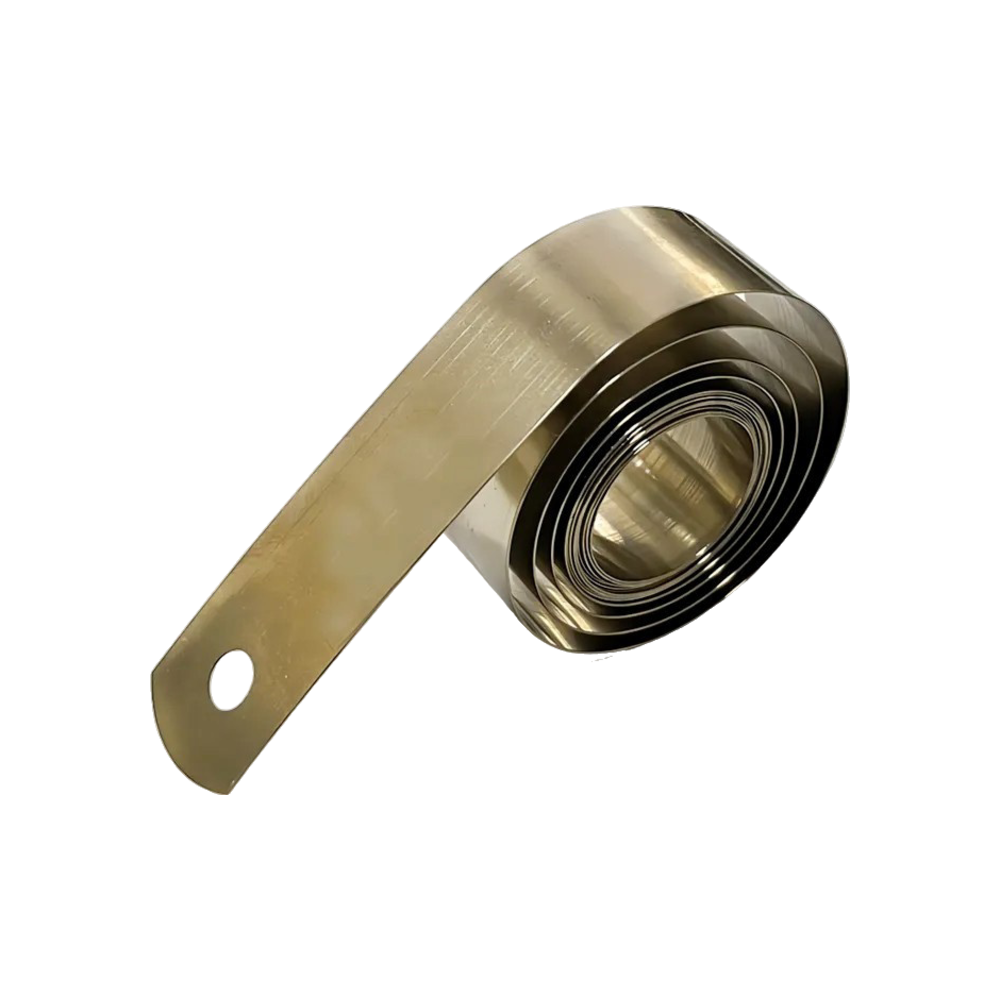
Constant force springs are flat strips of pre-stressed steel wound into coils of constant radius. Unlike a helical spring, they don't store energy by stretching: the force comes from the material's resistance to uncoiling and returning to its natural radius of curvature.
Their defining characteristic is that they exert a nearly constant force over the entire travel, regardless of how far the strip has been extended. This makes them ideal for counterbalances, retraction and any application requiring a uniform return force over long travels.
Surisa builds them custom, tuning force, strip width and number of turns, with engineering support for each application.
Flat strip of pre-stressed steel, wound into a coil on itself or on a drum.
Nearly constant force over the entire travel, independent of deflection.
The force comes from the material's resistance to uncoiling and returning to its natural radius.
F = (E · b · t³) / (26 · Rn²) — approximate.
Full load is reached when the strip extends ≈ 1.25 × its diameter; after that, a flat curve.
Pre-stressed type 301 stainless steel.
Typically from 2,500 to over 1,000,000 cycles depending on sizing.
Custom: adjustable force, strip width and number of turns.
The force is constant because the change in radius of curvature is constant as the strip uncoils. As long as the radius of the wound coils doesn't change significantly, the opposing force stays flat.
After a brief initial ramp —the strip reaches full load once extended around 1.25 times its diameter—, the force-displacement curve is essentially horizontal.
A helical extension spring follows F = k·x: the force increases in proportion to the stretch. If you need the force to grow with travel, the choice is an extension spring; if you need it to stay flat, a constant force spring.
The constant force spring curve (terracotta) stays flat after the initial ramp; the extension spring curve (dashed) grows linearly with displacement.
The output force depends on the strip geometry and the material. These four parameters, combined, define the force the spring exerts.
Fatigue life: depending on sizing, a constant force spring typically offers between 2,500 and over 1,000,000 cycles. It is one of the most predictable parameters of the component, which makes it easy to select for a target life.
| Parameter | Symbol | Influence on force |
|---|---|---|
| Strip thickness | t | The most influential factor: the force varies with the cube of the thickness (t³). |
| Strip width | b | Linear influence: doubling the width doubles the force. |
| Natural radius of curvature | Rn | Inverse square: the smaller the radius, the greater the force. |
| Modulus of elasticity | E | Material property (stainless steel, Inconel, Elgiloy…). |
F = (E · b · t³) / (26 · Rn²)
Where E is the modulus of elasticity, b the width, t the thickness and Rn the natural radius. Since the force depends on t³, the strip thickness is the most influential parameter.
The internal stress follows σ = E·t/(2·Rn): keeping it below ~60% of the material's yield strength is what ensures lives over a million cycles.
The dimensions that define the force: strip width (b), thickness (t) and natural radius of curvature (Rn) of the wound coils.
Tell us the required force, the travel, the available space and the service environment — and our engineering team will calculate the strip width, number of turns and material for the optimal constant force spring. Manufacturer since 1975.
Correct behaviour depends on proper mounting. The strip is wound onto a drum and the free end is fixed to the load point, following four basic rules.
Drum diameter
Should be 10%–20% larger than the spring's natural internal diameter, so as not to force the curvature.
Residual turns
At least 1.5 turns must remain wound on the drum at maximum extension, to guarantee integrity and continuity of the force.
Strip guiding
The strip becomes unstable at long extensions; it should be guided to prevent it from twisting or kinking as it retracts.
Idler pulleys
If used, their diameter must be larger than the natural one and they must never flex the strip against its curvature (back-bending).
The force differs depending on the direction of movement (strip extension or return), so the working direction must be specified when sizing the spring.
The spring is wound onto the drum (Ø 10-20% larger than the inner one) and leaves at least 1.5 residual turns; the strip exits towards the load.
Pre-stressed 301 stainless steel is the reference material for the vast majority of applications. For high-temperature or highly corrosive environments, Inconel or Elgiloy is used.
| Material | Designation | Characteristic |
|---|---|---|
| Type 301 stainless steel | pre-stressed | The most common: consistent quality and life, good stress retention, corrosion resistance and optimal cost (magnetic in the hardened state). |
| High carbon steel | high carbon | Better strength-to-cost ratio in dry environments. |
| Inconel | Ni-Cr alloy | High temperature and hostile environments. |
| Elgiloy | Co-Cr-Ni | Maximum fatigue and corrosion resistance. |
Constant force springs are chosen whenever a uniform restoring force or counterbalance over long travels is needed. To calculate the force, strip width and number of turns for your application, Surisa's technical team, a specialized manufacturer since 1975, offers free engineering support.
Uniform balancing of doors, lids, articulated arms and window sashes, holding any position with no effort from the user.
Automatic, constant reel-in of cables, hoses, belts and straps, with a uniform return force over the entire travel.
Drawers, linear guides, screens and blinds where a constant, predictable return force is required over long strokes.
Smooth, constant return mechanisms, where repeatability and reliability are critical.
Wound between two spools, they drive timers, retractors and constant-torque mechanisms, storing and returning energy in a controlled way.
When the force–travel–space combination isn't covered by any standard, a specific strip is sized by tuning force, width and number of turns.
It is a flat strip of pre-stressed steel, wound into a coil, that exerts a nearly constant force over its entire travel, regardless of how far it extends. Its fundamental difference from a helical extension spring is that the latter follows Hooke's law (the force grows linearly with the stretch), whereas the constant force spring keeps the force flat. If you need increasing force, use an extension spring; if you need it uniform, a constant force spring.
Because the force comes from the material's resistance to uncoiling and recovering its natural radius of curvature, and that change in radius is constant as the strip uncoils. As long as the radius doesn't change significantly, the force stays flat. There is only a brief initial ramp: full load is reached when the strip extends around 1.25 times its diameter, and from there on the force-displacement curve is horizontal.
The strip geometry and the material: the width has a linear influence (doubling the width doubles the force), the thickness a cubic one (it's the most influential factor) and the natural radius of curvature an inverse-square one (the smaller the radius, the greater the force). The approximate relationship is F = (E·b·t³)/(26·Rn²). For a long life, the internal stress must stay below approximately 60% of the material's yield strength.
It is wound onto a drum whose diameter should be 10-20% larger than the spring's natural internal diameter, and the free end is fixed to the load point. At maximum extension, at least 1.5 turns must remain wound on the drum to guarantee integrity and continuity of the force. The strip must be guided over long travels so it doesn't twist, and any pulley must be larger than the natural diameter without flexing the strip against its curvature.
The reference material is pre-stressed type 301 stainless steel, for its consistent quality, life and stress retention. For high-temperature or highly corrosive environments, Inconel or Elgiloy is used, and high carbon steel for dry environments with a better cost-to-strength ratio. Typical fatigue life ranges from 2,500 to over 1,000,000 cycles depending on sizing, making it one of the most predictable parameters of the component.
Tell us the required force, the travel, the available space and the environment — we'll calculate the strip width, number of turns and material, and specify the working direction. Free engineering support, manufacturer since 1975. Always custom.