


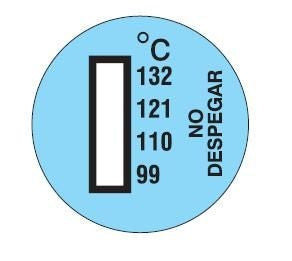
No power or electronics
It carries no batteries or wiring, so it never interferes with the engine's electrical parts or the vehicle's electrical system.
A 25 mm adhesive label that changes color permanently —from white to black— when the engine block reaches a critical temperature. No batteries or electronics, with 4 temperature points and resistance to water, steam, and oil.
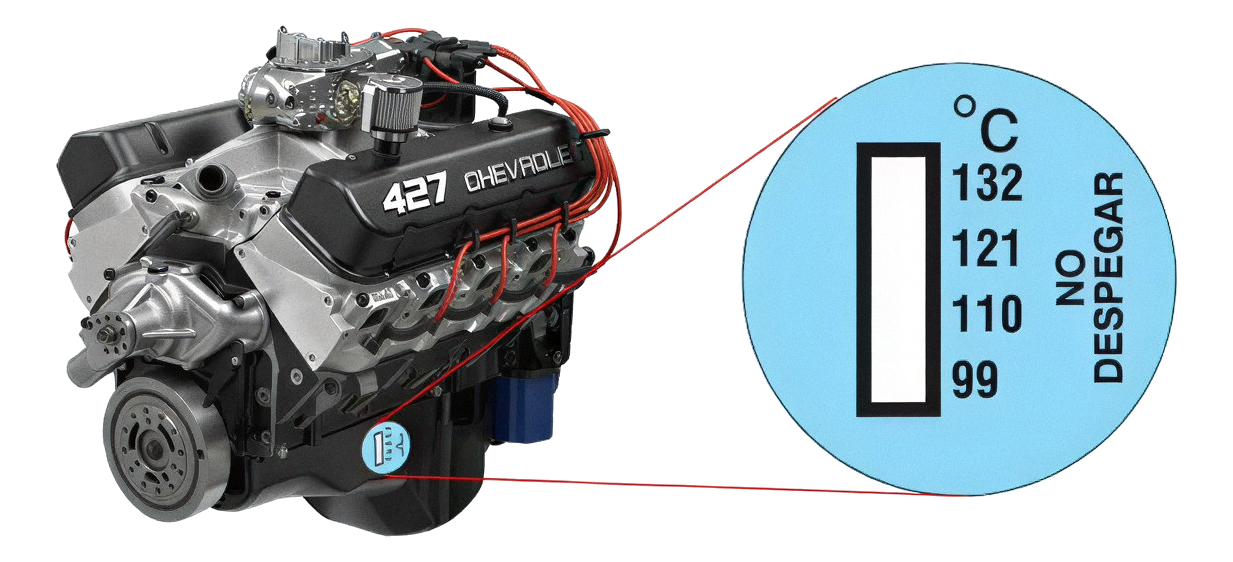
The indicator relies on the controlled melting point of a special wax. Each temperature point consists of an ultra-thin layer of white crystalline wax sitting on a black backing. As long as the surface temperature stays below the threshold, the wax remains opaque and the dot shows white. When the temperature printed next to the dot is reached, the wax melts and is absorbed into the backing, which becomes visible: the dot turns sharply and permanently from white to black.
The change is irreversible: once it has occurred, it does not revert even if the engine cools down. This makes the label a reliable record of thermal history, not just a momentary thermometer.
The label responds to the temperature of the surface it is applied to, not the surrounding air: good contact and a clean, dry surface are essential. The color change is virtually immediate once the threshold is exceeded, so it captures even brief overheating spikes.
A combustion engine normally runs with coolant between 90 and 105 °C. Above 105 °C it enters the risk zone: serious damage can occur, such as cylinder head warping, head gasket failure, or seizure. The oil, which runs between 90 and 120 °C, starts to degrade rapidly above 130 °C.
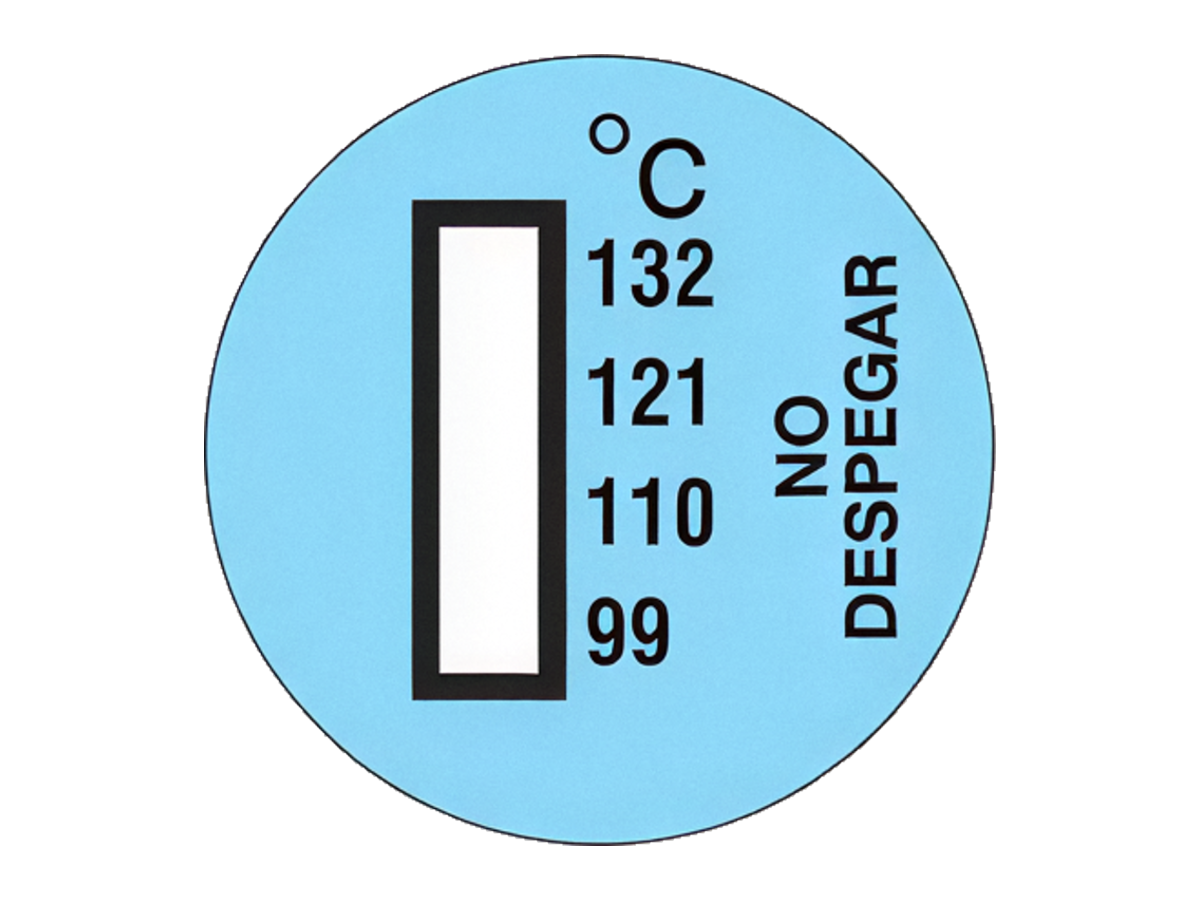
The sensor features 4 temperature points with stepped temperatures —99, 110, 121, and 132 °C— selected to cover that critical margin. Each dot has its color-change temperature printed next to it, so the label not only shows that overheating occurred, but how far it went: the more black dots, the higher the temperature reached.
For applications requiring thresholds other than those of the standard model, irreversible indicators with other temperature ranges are available.

Choose the warning threshold you need to monitor and buy the right reference online.
In stock · The price is for the supply format shown
| Parameter | Value |
|---|---|
| Format | Circular adhesive label |
| Diameter | 25 mm |
| Temperature points | 4 stepped points (99 · 110 · 121 · 132 °C) |
| Indication type | Irreversible (permanent change) |
| Color change | White → black |
| Response time | Virtually immediate once the threshold is exceeded |
| Power | None (no batteries or wiring) |
| Resistance | Water, steam, and oil |
| Application surface | Flat or curved |
| Reaction | To the temperature of the contact surface |
Tell us the component and the temperature you want to monitor, and our technical team will advise you, free of charge, on choosing the right indicator.
Compared with a thermocouple, an electronic probe, or simple visual estimation, the adhesive sensor offers a set of advantages specific to unattended warranty monitoring in repair shops and fleets.
Use is straightforward, but a few precautions ensure a reliable reading.
The engine temperature sensor is used whenever a permanent record of overheating is needed, without installing electronics.
Verification of whether an engine failure falls within warranty conditions or was caused by overheating.
Monitoring of parts supplied under warranty, to certify correct use by the end customer.
Passive monitoring of critical components in vans, trucks, and machinery where an operator is not always watching the dashboard.
Indicator of temperature spikes during testing or on components that are hard to access while running.
Any mechanical part —pumps, bearings, gearboxes— where detecting a one-off overheating event after the fact is of interest.
The irreversible sensor changes color permanently once a temperature is exceeded and does not revert, providing a record that overheating occurred even if the engine cools down afterward. A reversible thermometer, by contrast, shows the current temperature in real time and returns to its original state when the temperature drops. Use the irreversible type to verify warranties or record a thermal history; use the reversible type for instant readings.
Each of the 4 temperature points has a different color-change temperature, printed next to the dot on the label (99, 110, 121, and 132 °C on the standard model). The values are stepped to cover an engine's critical range, which starts to become problematic above 105 °C coolant temperature. The more dots that have turned black, the higher the maximum temperature reached by the component.
It measures the temperature of the surface it is applied to, not the surrounding air. That is why it is essential to apply it to a clean, dry surface with good contact. If it is poorly applied or applied over dirt, thermal contact is deficient and the reading may not be reliable.
No. The sensor is purely passive: it has no batteries, wiring, or electronic components, so it never interferes with the vehicle's electrical system. It works by the melting point of a wax, a principle entirely unrelated to the engine's electronics.
Yes, that is precisely its most common use in repair shops and scrapyards. Because the color change is irreversible and tamper-proof, the label objectively demonstrates whether the engine has suffered overheating due to misuse. This makes it possible to determine reliably whether the failure is covered by the warranty or was caused by factors outside it.
Tell us the component to monitor, the intended use —warranty, fleet, test bench— and the quantity, and we'll confirm the right model and the delivery time. Free technical support, permanent stock, manufacturer since 1975.