


Adhesive thermometers for
aquariums and terrariums
Self-adhesive thermochromic liquid crystal labels that indicate the temperature of the water or the habitat through a color change, with no probes or batteries. Reversible and reusable: they stick to any surface, even curved ones, and show the actual temperature at any given moment in green.

What a reversible liquid crystal thermometer is
These labels contain a series of elements with microencapsulated thermochromic liquid crystal (TLC) deposited on a black background. Each element is calibrated to “light up” at a specific temperature: below and above its range it stays black, and at its rated temperature it reflects the green of the visible spectrum, revealing the number printed underneath.
As the temperature changes, the green window moves along the scale through the color sequence brown/amber → green → blue. The window shown in green indicates the actual temperature; the adjacent ones shift slightly to amber (warmer) or blue (cooler).
Unlike irreversible indicators — which are single-use — reversible thermometers return to their previous state as they cool down and can be used indefinitely.
The window shifts through amber → green → blue as the temperature approaches or moves away from its rated value.
Available models
The number of levels determines the resolution of the scale: the more windows over the same range, the smaller the temperature step between them and the finer the reading. As a rule of thumb, the temperature can be read to within roughly half the interval between two adjacent windows.
| Model | Levels | Format | Packaging |
|---|---|---|---|
| Ambient LCD thermometer | 12 levels | Flexible adhesive | Pack of 10 |
| Horizontal LCD thermometer | 13 levels | Horizontal, reversible | Pack of 10 |
| Vertical LCD thermometer | 16 levels | Vertical, reversible | Pack of 10 |
Thermometers for aquariums and terrariums
Choose the range that covers your setup and buy the right one online.
-
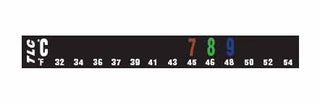 13 levels horizontal
- Size
- 15 x 132 mm
- Supply
- pack of 10 units
- Accuracy
- ±1 ºC
- References
- 2
-
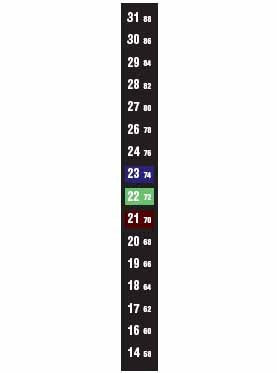 16 levels vertical
- Supply
- pack of 10 units
- Accuracy
- ±1 ºC
- References
- 4
In stock · The price is for the supply format shown
Why temperature control is critical
Fish and reptiles are ectothermic animals: their body temperature depends directly on that of their environment. Keeping the water or the habitat air within the right range is essential for their metabolism, digestion and immune system. A sustained deviation can weaken their defenses and encourage bacterial or fungal infections, as well as alter their behavior and appetite.
In terrariums, the usual practice is to work with a thermal gradient: a warmer basking zone and a cool zone, so the animal thermoregulates by moving between them. An adhesive thermometer in each zone lets you check both ends of the gradient at a glance.
Thermal gradient in a bearded dragon terrarium, with one adhesive thermometer in the basking zone and another in the cool zone.
Not sure which model to choose?
Tell us the species and the temperature range to monitor and we will confirm the right model and resolution (12, 13 or 16 levels) for your aquarium or terrarium.
Reference temperature ranges by species
The table below summarizes indicative ambient or water temperature ranges for the most common species. Use them to choose the thermometer with the right range for each habitat.
| Species / habitat | Reference range |
|---|---|
| Community tropical fish (tetras, guppies, mollies) | 24–27 °C |
| Discus and demanding tropical fish | 28–30 °C |
| Temperate fish (danios, White Cloud) | 18–23 °C |
| Cold-water fish (goldfish) | 15–24 °C |
| Bearded dragon (cool zone) | 24–29 °C |
| Leopard gecko (daytime) | 24–29 °C |
| Iguana (daytime) | 29–35 °C |
| Aquatic turtle (water) | 22–25 °C |
| Tortoise (daytime) | 21–29 °C |
The basking zones of many reptiles (bearded dragon, tortoise) require spot temperatures of 32–40 °C, so it is advisable to monitor the hot spot and the cool zone separately.
Installation and use
- Thoroughly clean and dry the surface where the label will be applied (the outside glass of the aquarium or the terrarium wall).
- Remove the protective liner and apply the label, pressing evenly and avoiding bubbles.
- Allow a few minutes for the liquid crystal to stabilize at the surface temperature before taking the first reading.
- Always read the window that appears in green: it is the one that marks the actual temperature at that instant.
Being reversible, these labels respond continuously to temperature variations and do not wear out with use. Keep them out of direct sunlight, which can distort the reading through local heating of the liquid crystal.
Example · scale from 24 to 32 °C; the window in green (28 °C) is the actual temperature of the aquarium at that instant.
Frequently asked questions about adhesive thermometers for aquariums and terrariums
01 How do you read a liquid crystal aquarium thermometer?
Read the window that appears in green: that is the actual temperature at that moment. The adjacent windows may show amber (indicating a slightly higher temperature) or blue (slightly lower), while those outside the range stay black. If no window is pure green, the temperature lies between the two closest colored windows.
02 Are they reversible or single-use?
They are reversible and reusable. The color change is produced by the reorientation of the thermochromic liquid crystals and reverts to its previous state on cooling, so the label works indefinitely for as long as the adhesive lasts. Irreversible thermometers, by contrast, permanently record the maximum temperature reached and are single-use.
03 How accurate are they compared with a digital thermometer?
They provide a reliable visual reading for monitoring trends, to within roughly half the interval between two adjacent windows (the more levels, the finer the reading). They are ideal for continuous habitat monitoring, although for laboratory measurements to within tenths of a degree a calibrated digital probe is recommended.
04 Can they be applied under water or only on the outside of the aquarium?
They are placed on the outside of the aquarium glass. The label reads the temperature of the glass surface, which is practically that of the water in contact with it. This avoids direct contact with the water and the animals, and makes replacement easier.
05 Do they work for both aquariums and reptile terrariums?
Yes. The same adhesive technology applies to fish tanks, aquariums, terrariums and turtle tanks. In terrariums with a thermal gradient, it is advisable to place one label in the basking zone and another in the cool zone to monitor both ends. It is important to choose a model whose scale range covers the target temperature of the species housed.
Need help choosing the right thermometer for your aquarium or terrarium?
Tell us the species or habitat, the temperature range to monitor and the format you need — horizontal, vertical or ambient — and we will get back to you with the optimal model. Free engineering support, packs of 10 units always in stock.