


Workplace safety
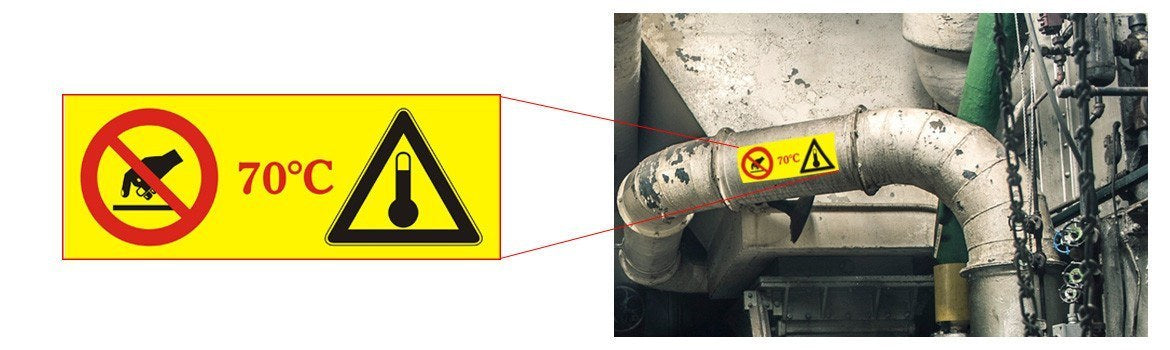
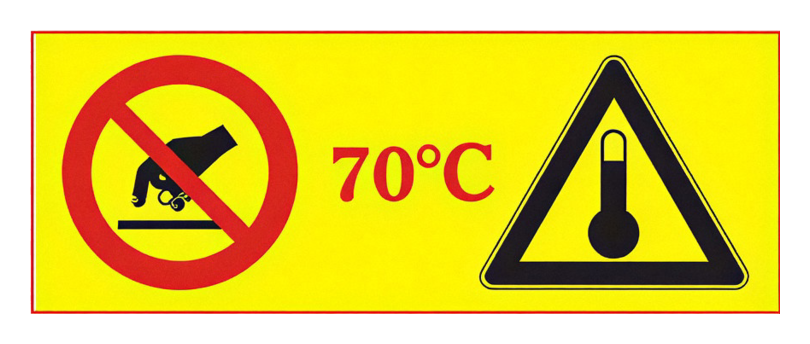
Marking of pipes, flanges, housings and contact areas in factories, warehouses and workshops, to prevent burns from accidental contact.
Adhesive reversible labels, printed with heat-sensitive inks, that warn when a surface exceeds a critical temperature: they change color or reveal a hidden message, and return to their initial state as they cool. Continuous overheating control and prevention of contact burns.
Labels printed with heat-sensitive inks remain unchanged below their switching temperature. Once the thermal switching point is reached, they respond in one of these two ways depending on the model, and in both cases the change is reversible: the label recovers its original appearance as the surface cools.
Color change: models such as the traffic light indicator or the Go/No-Go change color when the threshold is exceeded. In liquid crystal indicators (thermochromic liquid crystal, TLC), the color evolves continuously across the spectrum, reflecting the current temperature with a typical tolerance of ±1 °C.
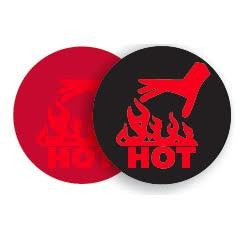
Hidden message: models such as Tempsafe or Hand Hot incorporate a printed graphic message that only becomes visible when the temperature exceeds the critical control point. At that moment the warning appears, alerting to the hot-surface risk.
This reversibility sets them apart from irreversible indicators, which permanently record the maximum temperature reached and are used as a single-use indicator.
Each model covers a different need, depending on whether you want to read an approximate value or receive a clear “safe / not safe” warning:
| Model | Mechanism | Behavior | Main use |
|---|---|---|---|
| LCD traffic light indicator | Liquid crystal (TLC) | Several windows change color showing the current temperature | Continuous visual temperature monitoring |
| Go / No-Go | Two-state color change | Turns from green to red at 43 °C | Binary hot-surface warning |
| Tempsafe | Hidden message | Reveals a warning text when heated | Burn prevention in occupational risk areas |
| Hand Hot | Hidden message | Displays the “hot” warning on contact | Marking of manual contact areas |
Liquid crystal models report the temperature in a graduated way; two-state and hidden-message models are designed to give an unmistakable warning the instant the safety threshold is crossed.
Choose the surface threshold you need to monitor and buy the right one online.
 Go / No-Go
 Hand Hot
 Semáforo
 Tempsafe
In stock · The price is for the supply format shown
Reversible heat-sensitive labels share a set of common technical characteristics worth bearing in mind when selecting a model:
| Parameter | Value / range |
|---|---|
| Indication type | Reversible (recovers its state on cooling) |
| Typical working range | Approx. −30 °C to +120 °C depending on model |
| Tolerance (liquid crystal) | ±1 °C of the nominal temperature |
| Go/No-Go warning threshold | 43 °C (green → red) |
| Attachment | Permanent adhesive on a clean, dry surface |
| Supply format | Packs of 10 units |
Liquid crystal indicators degrade permanently above ~120 °C; for processes that continuously exceed that value, an irreversible indicator must be used.
Prolonged exposure to UV light (direct sunlight) and to strong solvents deteriorates the heat-sensitive pigment.
The application surface must be clean, dry and degreased to ensure good adhesion and a reliable temperature reading.
Tell us the surface to monitor, the temperature threshold and the type of warning you need — our engineering team will help you choose the optimal model.
The reason many of these indicators switch at 43 °C is that this is the safety threshold for prolonged contact with a surface. The EN ISO 13732-1 standard (ergonomics of the thermal environment — contact with hot surfaces) establishes the temperature thresholds above which unprotected skin suffers burns. For prolonged contact, the threshold converges around 43 °C regardless of the material; for brief contact (≈1 s) it depends on the surface material.
| Surface material | Indicative threshold (≈1 s) |
|---|---|
| Bare metal | ~65–70 °C |
| Ceramic, glass, stone | ~80–85 °C |
| Plastics | ~85–93 °C |
| Wood | >110 °C |
43 °C · prolonged contact, regardless of the material.
65–93 °C · brief contact (≈1 s), depending on the surface material.
Placing a label that warns before these values are reached makes it possible to signal the burn risk on machines, pipes and housings without resorting to electronic instrumentation, and complements the workplace safety measures required wherever accidental human contact with hot surfaces can occur.
High-temperature thermometers are used wherever a surface can heat up without warning and that heating poses a risk of burns or equipment failure.
Marking of pipes, flanges, housings and contact areas in factories, warehouses and workshops, to prevent burns from accidental contact.
Overheating control in motors of scooters and small electric mobility vehicles, pumps and gearboxes, where poor cooling or continuous use can damage the equipment.
Visual monitoring of rolling bearings, plain bearings and friction points to detect excess temperature before it leads to failure.
Monitoring of cabinets, heat sinks and power components that can malfunction above a certain temperature.
Quick verification that a work surface stays within the correct range without the need for a contact thermometer.
A reversible indicator recovers its initial state when the surface cools, so it can be used to monitor the temperature continuously and warn again every time the threshold is exceeded. An irreversible indicator permanently records the maximum temperature reached and works as a single-use indicator. The high-temperature thermometers in this range are reversible; to keep a permanent record of a one-off overheating event, an irreversible model is the right choice.
It depends on the model. The Go/No-Go indicator changes from green to red at 43 °C, which is the safety threshold for prolonged contact with a surface according to the EN ISO 13732-1 standard. LCD traffic light indicators show the current temperature in a graduated way within their range, while Tempsafe and Hand Hot reveal a warning message when their critical point is exceeded. Different thresholds are available depending on the application.
Yes. They adhere to the clean, dry, degreased surface and indicate the temperature of that surface. It is one of their most common applications: signaling overheating on motor housings, pipes or bearings. Bear in mind the indicator's upper limit: liquid crystal models degrade above about 120 °C, so for surfaces that continuously exceed that value an irreversible indicator is recommended.
Because that is the threshold above which, in prolonged contact, unprotected skin can suffer burns regardless of the surface material, according to the EN ISO 13732-1 standard. For very brief contact the threshold is higher and depends on the material (around 65–70 °C for bare metal), but 43 °C is the conservative reference for signaling the risk of burns from sustained contact.
Reversible indicators can be reused indefinitely as long as they are kept protected from direct UV light, from temperatures above their range and from strong solvents. They are supplied in packs of 10 units. For higher-volume orders or specific temperature thresholds, conditions and availability can be checked with the technical team.
Tell us the surface to monitor, the temperature threshold and the type of warning you need — we select the optimal model and get back to you with the right solution. Free engineering support, standard models permanently in stock.