


The most compact
Marked in °C and °F. Ideal when a rough indication of the temperature level in a tight space is all you need.
Adhesive labels that show the current temperature of a surface through a color change, with no batteries, wires or glass that can break. Reversible and reusable indefinitely: as they cool down they return to their previous state.
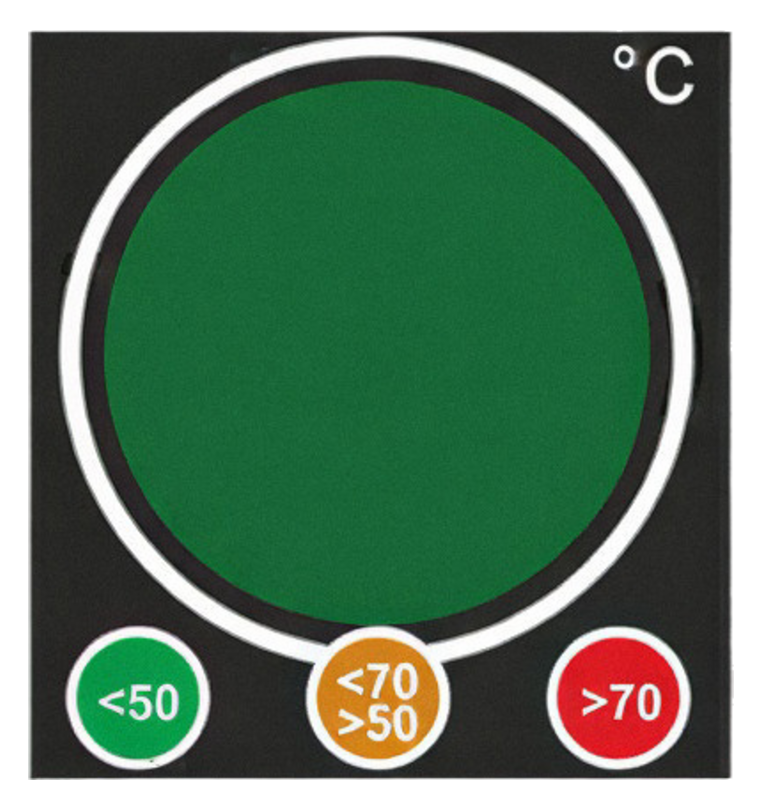
A reversible LCD thermometer consists of a series of temperature-sensitive dots or windows, each one with microencapsulated thermochromic liquid crystal —a non-toxic blend of liquid crystal esters— printed on a black-background adhesive base and laminated with a transparent polyester film that protects it.
Each dot is calibrated for a specific temperature. When it is reached, the liquid crystal molecules change their orientation and selectively reflect the wavelength corresponding to green, while absorbing the rest of the spectrum. As a result, at any given moment only one dot appears green, and that dot indicates the actual temperature of the surface.
Unlike an irreversible thermometer —which keeps a permanent record of whether a temperature has been exceeded—, the reversible one always shows the current temperature and returns to its previous state as it cools down, so it can be reused indefinitely. Simply stick the label onto the surface to monitor —even a curved one, such as a glass container or a pipe— for an immediate visual reading.
Because it contains no electronics or batteries, the label does not interfere with the equipment it is stuck onto and it complies with the applicable environmental and public health regulations (RoHS 3, WEEE and REACH). All models are manufactured under an ISO 9001 quality system.
The color change of each dot happens in three successive stages: blue when the temperature is slightly below the marked value, green when it matches it —this is the correct reading— and brown or red when it slightly exceeds it.
When no dot is fully green, the actual temperature lies halfway between the adjacent blue and brown/red windows. That is why the effective resolution equals half the step between dots: a model with 5 °C steps reads to a resolution of ~2.5 °C, while one with consecutive 1 °C dots lets you read down to ~0.5 °C. The calibration tolerance of each dot is ±1 °C across all models.
Selection criteria: more dots and a smaller step = more accuracy; fewer dots and a larger step = more range covered on a smaller label.
Example with a strip of dots at 20–40 °C: only the dot at the actual temperature appears green; the lower ones look blue and the higher ones brown or red.
The four standard models cover different combinations of format, number of dots, step between temperatures and range. All are supplied in packs of 10 units and with an accuracy of ±1 °C.
| Model | Format | Dots | Step | Available ranges (°C) | Dimensions | Resolution |
|---|---|---|---|---|---|---|
| 7 levels | Horizontal | 7 | 5 °C | 0–30 · 30–60 · 60–90 | 12.5 × 45 mm | ~2.5 °C |
| 11 levels | Vertical | 11 | 5 °C | 0–50 · 50–100 | 18 × 51 mm | ~2.5 °C |
| 13 levels | Horizontal | 13 | 1 °C | 0–12 · 12–24 | 15 × 132 mm | ~0.5 °C |
| 16 levels | Vertical | 16 | 2–5 °C | 14–31 · 32–49 · 10–40 · 25–100 | 117–132 × 19 mm | ~1–2.5 °C |
Choose the model by its number of temperature levels and buy online the reference that suits you.
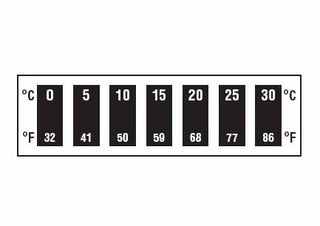 7 levels
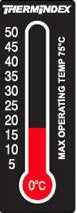 11 levels
In stock · The price is for the supply format shown
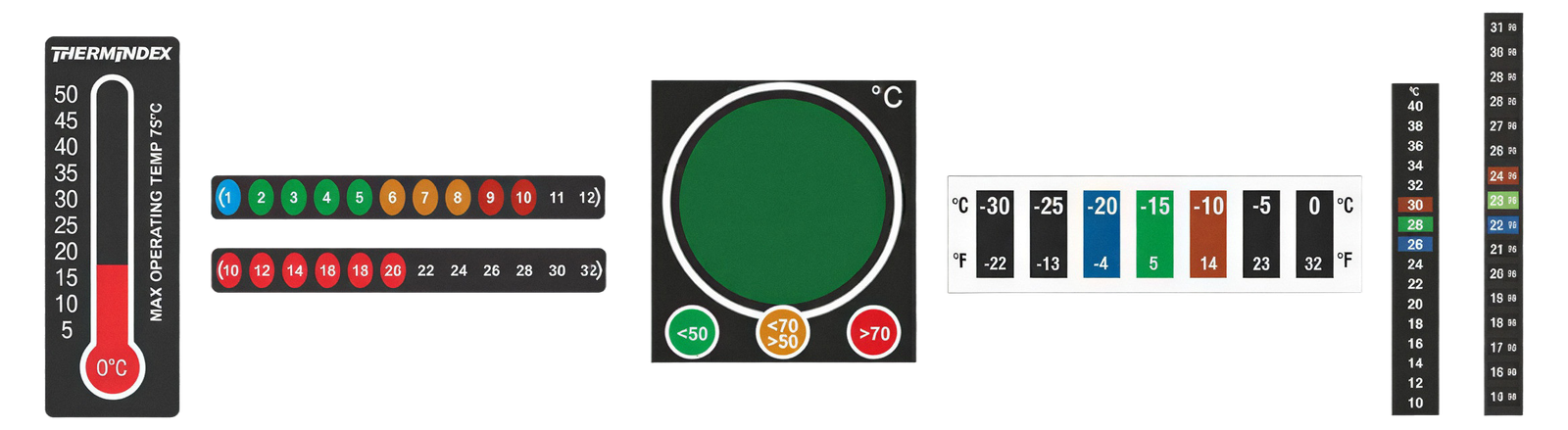
Notes per model:
In addition to the four standard models in stock, window and scale formats are manufactured and, on request, models with dots calibrated between −30 °C and +120 °C, with custom sizes, formats and number of dots.
Tell us the temperature band to monitor, the number of dots and the format, and we'll confirm the right standard model or a custom development between −30 °C and +120 °C.
| Parameter | Value |
|---|---|
| Technology | Microencapsulated thermochromic liquid crystal (LCD) |
| Type of indication | Reversible (reusable indefinitely) |
| Accuracy | ±1 °C per dot |
| Base | Self-adhesive, flexible (suitable for curved surfaces) |
| Laminate | Transparent protective polyester |
| Composition | Liquid crystal esters, non-toxic |
| Power | None (no batteries or electronics) |
| Supply | Packs of 10 units |
| Standards | ISO 9001 · RoHS 3 (UE 2015/863) · WEEE · REACH |
| Exclusions | Not listed in California Proposition 65 or the SVHC list |
Usage limitations: continuous exposure to direct sunlight or UV rays is not recommended, as they degrade the liquid crystal. Except for the 11-level model, standard thermometers are not designed to work submerged in water or other liquids; for that requirement there are specific models in the range with reinforced protection.
Reversible LCD thermometers are a simple, economical temperature-monitoring solution with immediate reading, applicable across virtually any sector.
Temperature monitoring in chambers, refrigerators and storage surfaces; quick visual verification at points along the cold chain.
Monitoring of medicine and vaccine refrigerators, incubators and laboratory equipment, where the absence of electronics prevents interference.
Reading the temperature of test tubes, flasks and vials by sticking the label onto the outside of the glass container, without introducing anything inside it. The vertical formats (11 and 16 levels) adapt well to the cylindrical shape.
Thermal warning on machinery, motors, panels or heating installations prone to overheating. Visible at a glance, they let any operator spot an anomaly without knowing the instrument.
Any application where permanent visual monitoring of a surface's temperature is needed without resorting to a traditional thermometer.
A reversible LCD thermometer always shows the current temperature of the surface and returns to its original state as it cools down, so it is reused indefinitely. An irreversible thermometer keeps a permanent record of whether a given temperature has been reached or exceeded, with no going back: it serves as proof that a threshold has been passed. To monitor temperature in real time you use the reversible one; to leave evidence of a past thermal event, the irreversible one.
The window that appears green indicates the actual temperature. The windows below that temperature look blue and those above it brown or red. If no window is fully green, the temperature lies halfway between the last blue window and the first brown/red one. The smaller the step between dots, the more accurate the reading.
The 13-level model, with consecutive dots every 1 °C, is the most accurate in the standard range and allows a reading resolution of approximately ±0.5 °C. The 7- and 11-level models, with 5 °C steps, offer a rough reading of ~2.5 °C but cover a wider range in a more compact format. The calibration tolerance of each dot is ±1 °C in all cases.
Yes on curved surfaces: the label is flexible and sticks to glass containers, pipes or tanks without any problem. As for moisture, only the 11-level model withstands immersion (up to 3 hours in still water at room temperature); the rest of the standard models should not be submerged. For applications with continuous contact with liquids, the range includes models with specific protection.
Across the four standard models, the ranges go from 0 °C to 100 °C. Outside that interval, it is possible to manufacture on request models with dots calibrated between −30 °C and +120 °C, as well as custom sizes, formats and number of dots. For requirements outside the catalog, it is best to consult the technical team.
Tell us the temperature range to monitor, the surface it will be attached to and the accuracy you need — we'll select the optimal model and range and get back to you with the appropriate solution. Free engineering support, specialized manufacturer since 1975.