


Ambient thermometer
For monitoring the temperature of rooms, offices, warehouses, laboratories or stores. It covers the ambient temperature band with 12 color points.
Adhesive liquid crystal labels that show the temperature through a color change, point by point, with no batteries or electronic components. Reusable, readable at a glance, and requiring no calibration or maintenance.
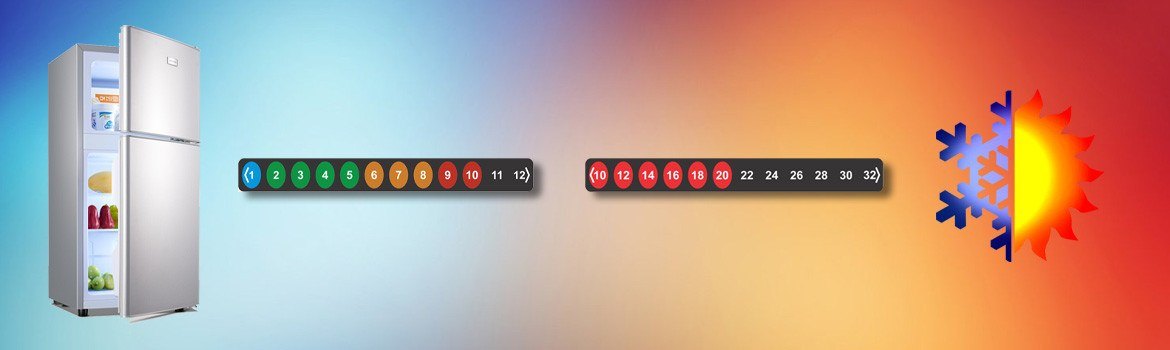
A reversible thermometer is a label that can be used indefinitely: the color points activate when they reach their temperature and return to their previous state when the temperature drops, indicating the actual value at every moment. This sets it apart from an irreversible thermometer, which permanently records whether a given temperature has been exceeded (useful for detecting excursions, not for monitoring the current value). In international technical terminology these products are known as reversible liquid crystal thermometers or thermochromic LCD temperature labels.
The technology is Easy Read LCD (Liquid Crystal Display): a non-toxic mixture of microencapsulated liquid crystal esters, printed on an adhesive label and laminated with a transparent polyester protection. When the assigned temperature is reached, the liquid crystal molecules reorient their structure and reflect a different wavelength of light, producing the color change. Below and above its range, the point stays dark; within the range, it runs through the color sequence, passing through green at the calibration point.
Since it contains no batteries, liquids or electronic components, the label is unbreakable, cannot contaminate refrigerated products and generates no hazardous waste.
On the refrigerator thermometer, the 12 points do more than indicate the exact degree: they are grouped by color to show immediately whether the temperature is right or not. This traffic-light system lets any operator spot an anomaly without having to interpret figures. On single-indicator models (cold chain) the logic is the same: the green point shows that refrigeration is within the margin.
The temperature points carry a special, thicker lamination that delays the effect of the color change. That way, when the refrigerator is opened, the momentary inflow of warm air does not alter the reading and the indicator keeps showing the actual interior temperature.
The lit point shows the temperature at that moment; its color indicates at once whether the value is within (green) or outside the margin.
Choose the temperature range you need to read and buy online the reference that suits you.
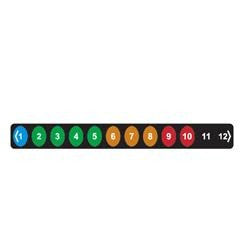 Refrigerator 12 levels
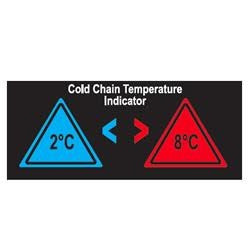 Cadena de frío
 Ambient 12 levels
In stock · The price is for the supply format shown
| Parameter | Value |
|---|---|
| Technology | Microencapsulated liquid crystal (Easy Read LCD) |
| Type | Reversible / reusable |
| Accuracy | ±1 °C |
| Resolution | One point per °C (refrigerator: 1–12 °C) |
| Reading | Color change per point; green = calibration temperature |
| Format | Flexible adhesive label, laminated in transparent polyester |
| Dimensions (refrigerator) | 10 × 90 mm, horizontal format |
| Power | None — no batteries or electronics |
| Water resistance | Withstands 3 h submerged in water at ambient temperature |
| Composition | Non-toxic; no substances hazardous to health or the environment |
| Standards | ISO 9001 · RoHS 3 (EU 2015/863) · REACH · WEEE |
| Supply | Packs of 10 units |
| Limitation | Avoid prolonged exposure to UV rays |
The chemical components are not listed under California Proposition 65 or SVHC, which makes them easier to use in food and healthcare environments with material traceability requirements.
Tell us the temperature band to monitor and the number of points, and we will confirm the right standard model or a custom development between −30 °C and +120 °C.
The choice of thermometer depends on the temperature band you want to monitor:
For freezers (usual reference: −18 °C) or any other band outside the standard catalog, the technology allows custom labels to be manufactured in ranges between −30 °C and +120 °C, with the number of points and the format (horizontal or vertical) the application requires.
Reversible LCD thermometers are used wherever visual, economical, maintenance-free temperature control is needed, complementing the equipment's own sensors.
Monitoring of cold rooms and display cases. Placing several labels in different zones of a cold room helps detect spots the refrigeration does not reach, even when the central sensor reads the correct value.
Refrigerated medicines, and especially vaccines and injectables, must be stored between 2 and 8 °C without freezing. A miscalibrated sensor or a box blocking the cooling duct can go unnoticed; the label makes it visible at once.
Checking reagent and sample refrigerators, and the ambient temperature of rooms with stability requirements.
Service refrigerators, display cabinets and chest freezers, where color-based reading speeds up daily HACCP checks.
Quick check of the interior of vehicles and containers during loading and unloading.
The point showing green indicates the current temperature. If no point is green, the temperature is halfway between the last point lit in a warm tone (orange/red) and the next one in a cold tone (blue). On the refrigerator model, the colors also group the points by range: green between 2 and 5 °C means the temperature is correct, while orange or red warn that the recommended margin has been exceeded.
The reversible type is reusable: it shows the temperature at that moment and its points change again as the temperature rises or falls, so it is used for continuous monitoring. The irreversible type changes color permanently once a specific temperature is exceeded, so it is used to record whether a thermal excursion has occurred, not to read the current value. To monitor a refrigerator or a room, use the reversible type.
Refrigerated medicines and vaccines must be stored between 2 and 8 °C, with a target value around 5 °C, and must never freeze. The 12-level refrigerator thermometer covers this margin: the green band (2–5 °C) confirms the temperature is correct, and the orange and red points warn if it rises above the recommended level.
Accuracy is ±1 °C relative to the temperature marked on each point, sufficient for visual monitoring of refrigerators, cold rooms and rooms. They require no calibration or maintenance because they contain no electronics. The only precaution is to avoid prolonged exposure to UV rays, which can degrade the liquid crystal over time.
Yes. In addition to the standard ambient and refrigerator (1–12 °C) models, custom labels are manufactured in any band between −30 °C and +120 °C, with the number of points, the resolution and the format (horizontal or vertical) the application needs — including freezing ranges. They are supplied in packs of 10 units, with volume discounts from 20 units.
Tell us the temperature band to monitor, the format and the volume — we'll confirm the right standard model or a custom development. Free engineering support, specialized manufacturer since 1975.