


Case 01
Safety and control valves with repetitive opening/closing
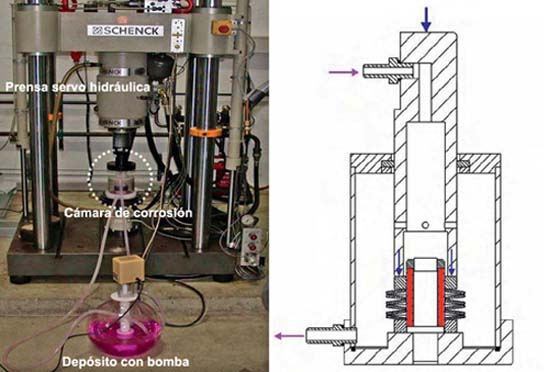
Test on submerged 6×1 stacks subjected to dynamic compression cycles in a servo-hydraulic press (63 kN, 100 mm). Two series: demanding cycles at 20–80% and moderate cycles at 20–60% of travel. It measures service life as the number of cycles to fracture. It reflects the real-world scenario of springs in dynamic applications — valves, clutches, dampers.
Safety and control valves with repetitive opening/closing
Clutches and friction systems
Dampers and anti-vibration systems
Springs in dynamic applications with moisture or corrosive agents
Assembly: 6×1 stacks (six springs in series per DIN 2093) on an internal shaft guide, with no lubrication between parts. The stack is partially submerged to avoid hydrostatic pressures that would generate additional forces on the parts.
Three equipment components: a servo-hydraulic press (maximum force 63 kN, travel 100 mm), a sealed corrosion chamber with a feed-through for the ram, and a reservoir with a recirculation pump that ensures the medium in contact with the parts is continuously renewed.
The test is run at room temperature in all cases. Service life is counted as the number of cycles until one of the parts in the stack fractures.
| Parameter | Value |
|---|---|
| Stack | 6 × 1 · internal shaft guide · opposed per DIN 2093 |
| Lubrication | No lubrication between parts |
| Press | Servo-hydraulic · 63 kN · 100 mm travel |
| Frequency | Constant · room temperature |
| Chamber | Sealed · medium in constant circulation |
| End criterion | Fracture of one part in the stack |
Two fatigue regimes
Springs working with a large deflection amplitude. The most severe condition — stack cycled from 20% to 80% of maximum travel.
Springs under less demand. It allows comparing the effect of the fatigue regime on service life for the same material/coating combination.
Selected media (4 media · no 40% MgCl₂)
Neutral reference medium — it isolates the mechanical effect of the regime from the chemical influence of the medium.
Chlorides typical in automotive and de-icing salts. It replaces MgCl₂ with sufficient representativeness.
Alkaline — characteristic of CIP cleaning in the pharmaceutical and food industries.
Citric acid — food environment and acidic cleaning. The most aggressive medium for zinc coatings.
40% MgCl₂ was ruled out of the fatigue tests for being excessively aggressive — it would cause fractures in time frames too short to provide useful information about the fatigue regime. The 3% NaCl solution covers the chloride family with sufficient representativeness.
Service life to fracture · number of cycles · demanding regime
| Spring · Material · Finish | Deionized water neutral reference medium | NaCl 3% chlorides · automotive | NaOH 0,1N CIP cleaning · alkaline | C₈H₈O₇ 0,1M citric acid · food |
|---|---|---|---|---|
| — Uncoated stainless steels | ||||
| C-63 · 1.4310 · Stamped · Ground | 14.171 | 17.952 | 37.767 | 22.280 |
| C-63 · 1.4310 · Shot peened | 18.255 | 20.300 | 38.033 | 25.389 |
| C-63 · 1.4568 · Stamped · Ground | 12.924 | 17.207 | 32.747 | 19.520 |
| C-63 · 1.4568 · Shot peened | 20.480 | 24.823 | 34.555 | 20.090 |
| C-63 · 1.4568 · Shot peened · Kolsterised | 11.339 | 22.199 | 32.533 | 30.883 |
| — 51CrV4 steel with coatings | ||||
| 51CrV4 · Yellow zinc plated | 26.839 | 25.510 | 26.477 | 14.058 |
| 51CrV4 · Clear zinc plated | 7.841 | 11.323 | 14.509 | 4.318 |
| 51CrV4 · Dacromet | 5.676 | 4.944 | 6.033 | 4.849 |
| 51CrV4 · Geomet | 5.428 | 6.159 | 4.517 | 4.031 |
| 51CrV4 · Delta Tone + Delta Seal | 24.795 | 10.355 | 10.127 | 5.563 |
| 51CrV4 · Nickel plating | 7.083 | 6.461 | 12.058 | 6.414 |
| 51CrV4 · Water-thinned paint | 22.138 | 13.469 | 9.902 | 4.195 |
| 51CrV4 · Oiled | 13.956 | 5.493 | 19.606 | 5.178 |
Conditions: room temperature · cycles between 20% and 80% of travel · no lubrication · corrosive medium in circulation.
Moderate regime · springs under less mechanical demand
| Spring · Material · Finish | Deionized water neutral reference medium | NaCl 3% chlorides · automotive | NaOH 0,1N CIP cleaning · alkaline | C₈H₈O₇ 0,1M citric acid · food |
|---|---|---|---|---|
| — Uncoated stainless steels | ||||
| C-63 · 1.4310 · Stamped · Ground | 19.552 | 21.858 | 30.037 | — |
| C-63 · 1.4310 · Shot peened | 33.236 | 40.005 | 51.965 | 47.338 |
| C-63 · 1.4568 · Stamped · Ground | 12.357 | 17.383 | 34.692 | — |
| C-63 · 1.4568 · Shot peened | 21.845 | 27.974 | 41.433 | — |
| C-63 · 1.4568 · Shot peened · Kolsterised | 32.933 | 34.000 | 40.250 | — |
| — 51CrV4 steel with coatings | ||||
| 51CrV4 · Yellow zinc plated | 103.618 | 292.537 | — | 73.386 |
| 51CrV4 · Clear zinc plated | 153.506 | 295.742 | 1.702.463 | 49.507 |
| 51CrV4 · Dacromet | 129.507 | 46.388 | — | 28.192 |
| 51CrV4 · Geomet | 141.642 | 59.555 | — | 24.128 |
| 51CrV4 · Delta Tone + Delta Seal | 167.443 | 240.707 | — | 22.578 |
| 51CrV4 · Nickel plating | 47.429 | 27.854 | — | 19.208 |
| 51CrV4 · Water-thinned paint | 94.033 | 91.741 | — | 15.703 |
| 51CrV4 · Oiled | 106.702 | 32.806 | 1.443.281 | 28.078 |
Conditions: room temperature · cycles between 20% and 60% of travel · no lubrication · medium in circulation.
— = not tested
Tell us about your use case and our team of engineers will advise you on choosing the optimal solution.
Service-life ratio when reducing the fatigue regime (20–80% → 20–60%)
| Material / Coating | 20% – 80% | 20% – 60% | Ratio |
|---|---|---|---|
| 1.4310 standard | 17,952 | 21,858 | ×1.2 |
| 1.4310 shot peened | 20,300 | 40,005 | ×2.0 |
| 1.4568 shot peened | 24,823 | 27,974 | ×1.1 |
| Yellow zinc plated | 25,510 | 292,537 | ×11.5 |
| Clear zinc plated | 11,323 | 295,742 | ×26.1 |
| Dacromet | 4,944 | 46,388 | ×9.4 |
| Water-thinned paint | 13,469 | 91,741 | ×6.8 |
The bottleneck is electrochemical corrosion accelerated by the loss of the passive layer, not pure fatigue.
51CrV4 has a very large fatigue margin; the limiting factor is the durability of the coating.
Zinc plating and Delta Tone can be more cost-effective than stainless steel, as long as the cycle does not involve acids.
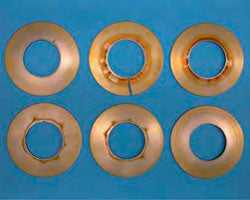
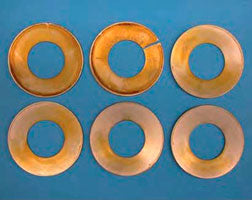
In the following images we can see the result of corrosion with fatigue in the 3% NaCl sodium chloride solution. The parts correspond to stacks of disc springs in 1.4310 stainless steel with shot peening treatment.
The photographs were taken at the end of the fatigue test, once one of the parts in the stack had fractured.
Material · Finish · Medium · Regime: 1.4310 · Shot peened · 3% NaCl · 20–80% of travel
Disc springs in dynamic applications with corrosive media present are common across very diverse sectors. For any of these applications, the choice of material/coating must cross-reference the results of all three test blocks (without stress, with stress, and with fatigue) and not rely on just one.
The fatigue condition can rule out combinations that look optimal in free immersion, and vice versa.
It is a phenomenon specific to corrosion-fatigue in stainless steels. The friction between parts during the cycles forms slip bands on the spring surface, which mechanically destroy the passive oxide layer (Cr₂O₃) that protects the steel. Once the area of fresh metal is exposed, accelerated electrochemical corrosion is triggered, even in a seemingly inert medium. Under static conditions this does not happen because the passive layer remains intact and regenerates. This is why shot peening markedly improves results: it introduces residual compressive stresses that delay the nucleation of slip bands.
Dacromet and Geomet are thin, rigid coatings — zinc/aluminum flakes oriented in an inorganic matrix — optimized to resist chemical attack under static conditions. Under compression cycles, the coating suffers microfractures and local delamination in the contact zones between disc springs, where the pressure is highest. Those cracks expose the 51CrV4 substrate to the medium, accelerating corrosion right where fatigue concentrates stresses. In the without-stress test (block 01) these coatings score B in most media; under fatigue they remain at modest values (4,000–6,000 cycles), confirming that their best application is static or low-dynamic protection.
It depends on the regime. In the demanding 20–80% regime (wide cycles), shot peened stainless steel 1.4310 or 1.4568 offers the best combination of service life + stability — between 20,000 and 25,000 cycles. In the moderate 20–60% regime, yellow zinc plating on 51CrV4 outperforms stainless steel (292,537 vs 27,974 cycles in 1.4568 shot peened) at a clearly lower cost. For industrial production where the load cycle is predictable and moderate, zinc plating can be the most cost-effective option. If the cycle is demanding or unpredictable, shot peened stainless steel offers a greater safety margin.
3% NaCl accurately reproduces the chloride-ion concentration of seawater (≈30 g/L), and chloride ions are the dominant corrosive agent in marine and saline environments. Standardized artificial seawater solutions (ASTM D1141) add sulfates, bicarbonates, magnesium, and other minor salts that can introduce variability into the test without providing key information about the corrosion-fatigue mechanism. To validate results against specific marine standards (offshore, naval), a complementary test in a chamber with artificial seawater would be required — write to us if your application requires it.
Yes — but only under the specific conditions of the test (0.1N NaOH, moderate 20–60% regime, room temperature). NaOH is the most benign of the four media tested for zinc coatings: the zinc reacts with the NaOH to form a passive layer of zinc hydroxide that protects the substrate without dissolving quickly. Add to this the moderate regime, which limits the mechanical stresses on the coating. Extrapolating to real applications must account for: (1) temperature — at 80 °C the ratio changes drastically; (2) the simultaneous presence of chlorides or acids, which neutralize the protective effect of NaOH; (3) the frequency and amplitude of the real cycle. In CIP cleaning applications with springs under moderate load, this result is a good indicator, but it is advisable to validate it with a test at the service temperature.
Tell us about your use case and our team of engineers will advise you on choosing the optimal solution.