


Case 01
Flange gaskets with preload springs (oil & gas, chemical, food)
Immersion test in five corrosive media on 6×1 stacks compressed to 80% of travel, at 80 °C and 40 °C. It measures service life to fracture, expressed in hours (limit 2,500 h). It reflects the real-world scenario of springs under permanent preload — flange gaskets, valves, clutches.
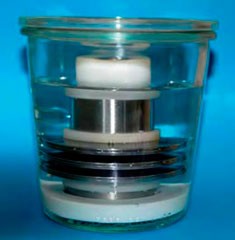
Flange gaskets with preload springs (oil & gas, chemical, food)
Valves with disc-spring closure
Pretensioned assemblies that stay under load throughout their service life
Any disc spring working as a static force spring
Assembly of the parts: 6×1 stacks (six disc springs in series, stacked face-to-face per DIN 2093) with initial compression to 80% of travel via an internal guide. Each stack is placed in a sealed glass container vessel. The vessel is filled with the corrosive solution, fully immersing the stack.
Chambers and temperatures: first test at 80 °C — the most severe condition, which accelerates the corrosion process. Second test at 40 °C — repeated only for the combinations that fractured at 80 °C, since at a lower temperature the corrosion rate decreases and the results can only be equal or better.
Procedure: daily visual inspection, solution renewed every 2 weeks. The test is considered complete when a part of the stack fractures or upon reaching 2,500 h without fracture. Each combination is repeated several times; the worst time is taken as the result.
Service life to fracture · 80% compression · limit 2,500 h
| Spring · Material · Finish | SeawaterDIN 50905 | MgCl₂ 40%magnesium chloride | NaCl 3%sodium chloride | NaOH 0,1Nsodium hydroxide | C₈H₈O₇ 0,1Mcitric acid |
|---|---|---|---|---|---|
| — Stainless steels without coating | |||||
| C-63 · 1.4310 · Stamped · Ground | >2500 | 356 h | >2500 | >2500 | >2500 |
| C-63 · 1.4310 · Shot peened | >2500 | 429 h | >2500 | >2500 | >2500 |
| B-80 · 1.4310 · Stamped · Ground | >2500 | 1968 h | >2500 | >2500 | >2500 |
| C-63 · 1.4568 · Stamped · Ground | >2500 | 140 h | >2500 | >2500 | >2500 |
| C-63 · 1.4568 · Shot peened | >2500 | 140 h | >2500 | >2500 | >2500 |
| C-63 · 1.4568 · Shot peened · Kolsterised | 284 h | 2177 h | >2500 | >2500 | >2500 |
| — 51CrV4 steel with coatings | |||||
| 51CrV4 · Yellow zinc plating | 912 h | >2500 | >2500 | >2500 | 68 h |
| 51CrV4 · Clear zinc plating | 1129 h | >2500 | >2500 | >2500 | 68 h |
| 51CrV4 · Dacromet | >2500 | >2500 | >2500 | >2500 | 891 h |
| 51CrV4 · Geomet | >2500 | >2500 | >2500 | >2500 | 891 h |
| 51CrV4 · Delta Tone + Delta Seal | 620 h | >2500 | 738 h | >2500 | 526 h |
| 51CrV4 · Water-thinned paint | 1057 h | 837 h | 45 h | >2500 | 380 h |
| 51CrV4 · Oiled | 837 h | >2500 | 360 h | >2500 | 262 h |
All stacks exceed 2,500 h without fracture, even those whose coating dissolved completely (the water-thinned paint dissolved in 2 days, but the part did not fracture). In media with pH > 10, a protective oxide/hydroxide layer forms.
A critical medium for stainless steels. The 1.4310 fractures between 356 h and 1,968 h; the 1.4568 without Kolsterising, at 140 h. The Kolsterised version holds up to 2,177 h, but offsets this by performing worse in seawater (284 h).
Most stainless steels hold up > 2,500 h, except the 1.4568 Kolsterised. Zinc-based coatings (zinc plating, Delta Tone, oiled) and paint begin to show failures.
A benign medium under load for stainless steels (> 2,500 h in all cases). Some coatings fail: paint (45 h), oiled (360 h), Delta Tone (738 h).
Catastrophic for zinc coatings. Zinc-plated parts fracture in 68 h. Dacromet and Geomet hold up to 891 h. Stainless steels exceed 2,500 h without problems.
Only combinations that fractured at 80 °C · the rest assumed > 2,500 h
To assess the effect of temperature on stress corrosion cracking, the test is repeated at 40 °C only on the combinations that fractured at 80 °C. The rest are assumed to be > 2,500 h as well, since at a lower temperature the corrosion rate can only decrease.
| Spring · Material · Finish | SeawaterDIN 50905 | MgCl₂ 40%magnesium chloride | NaCl 3%sodium chloride | NaOH 0,1Nsodium hydroxide | C₈H₈O₇ 0,1Mcitric acid |
|---|---|---|---|---|---|
| — Stainless steels without coating | |||||
| C-63 · 1.4310 · Stamped · Ground | >2500 | ||||
| C-63 · 1.4310 · Shot peened | >2500 | ||||
| B-80 · 1.4310 · Stamped · Ground | >2500 | ||||
| C-63 · 1.4568 · Stamped · Ground | >2500 | ||||
| C-63 · 1.4568 · Shot peened | >2500 | ||||
| C-63 · 1.4568 · Shot peened · Kolsterised | >2500 | >2500 | |||
| — 51CrV4 steel with coatings | |||||
| 51CrV4 · Yellow zinc plating | >2500 | 45 h | |||
| 51CrV4 · Clear zinc plating | >2500 | 284 h | |||
| 51CrV4 · Dacromet | >2500 | ||||
| 51CrV4 · Geomet | >2500 | ||||
| 51CrV4 · Delta Tone + Delta Seal | >2500 | >2500 | >2500 | ||
| 51CrV4 · Water-thinned paint | 834 h | 694 h | 116 h | 1917 h | |
| 51CrV4 · Oiled | >2500 | >2500 | 356 h | ||
· Empty cells: not tested at 40 °C because it already exceeded 2,500 h at 80 °C.
At 40 °C, many materials that failed at 80 °C now exceed 2,500 h. Temperature is one of the most decisive factors in stress corrosion cracking.
The oiled parts, which gave the worst result in free immersion, offer reasonable resistance at 40 °C: they only fracture in citric acid (356 h). The oil layer limits direct contact with the medium for as long as the part is under load, delaying crack propagation — even though it does not prevent visual corrosion.
Water-thinned paint remains unreliable under load even at 40 °C: fractures at 694 h in MgCl₂ and 116 h in NaCl.
Dacromet and Geomet improve their behavior in citric acid from 891 h (at 80 °C) to > 2,500 h (at 40 °C). Temperature is a critical factor for these coatings in acidic media.
Tell us about your use case and our engineering team will advise you on choosing the optimal solution.
Hours are converted to the same B / M / P / MP scale for direct comparison
To directly compare the under-load test results with those of the no-load test, the hours are converted to the same qualitative visual scale. The rating considers both fracture and the visual condition of the part — one that held > 2,500 h but ended up with severe corrosion is not considered fit for continued service.
| Material / Coating | MgCl₂ 40% | NaCl 3% | NaOH 0,1N | Citric acid | ||||
|---|---|---|---|---|---|---|---|---|
| s/t | c/t | s/t | c/t | s/t | c/t | s/t | c/t | |
| C-63 · 1.4310 | ||||||||
| C-63 · 1.4310 · Shot peened | ||||||||
| B-80 · 1.4310 | ||||||||
| C-63 · 1.4568 | ||||||||
| C-63 · 1.4568 · Shot peened | ||||||||
| C-63 · 1.4568 · Shot peened · Kolsterised | ||||||||
| Yellow zinc plating | ||||||||
| Clear zinc plating | ||||||||
| Dacromet | ||||||||
| Geomet | ||||||||
| Delta Tone + Delta Seal | ||||||||
| Nickel plating | ||||||||
| Water-thinned paint | ||||||||
| Oiled | ||||||||
s/t = no load · c/t = under load at 80 °C
1.4310 drops from M to P; 1.4568 drops from M to MP. Stress corrosion cracking shows up clearly.
It is the only medium where most combinations keep their rating when moving from free immersion to immersion under load.
Delta Tone and oiled drop in quality. Zinc coatings are sensitive to the acid + stress combination.
They keep a B rating in three media under load. They only fail in citric acid — expected given their zinc base.
The visual appearance of the part after the test is as informative as the hours-to-fracture figure. A part that held the 2,500 h but shows an advanced state of corrosion should not remain in service in the real application: any change in conditions would drastically reduce its service life.
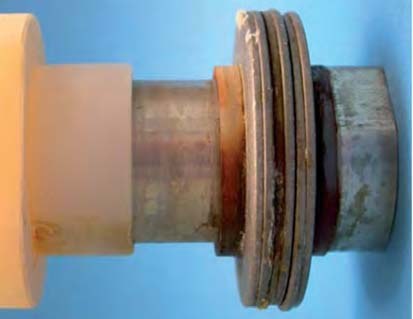
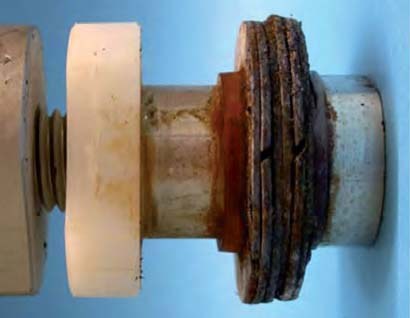
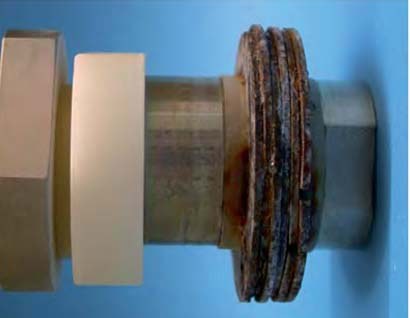
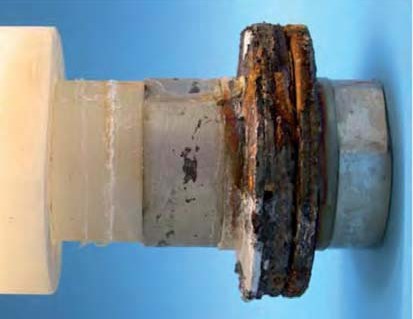
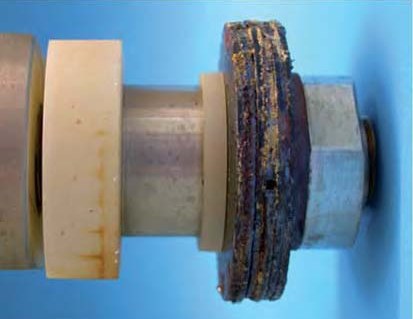
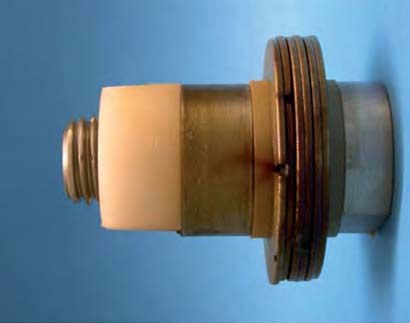
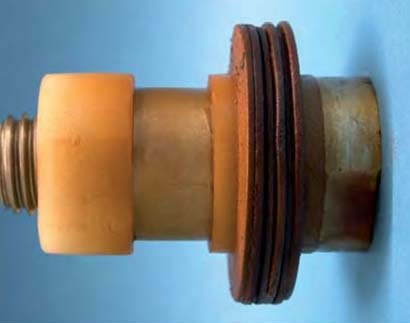
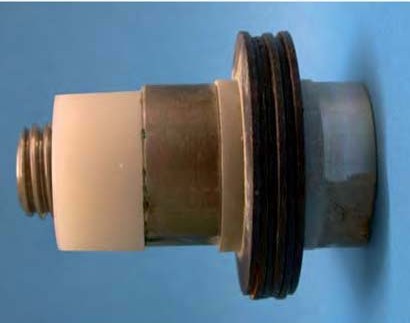
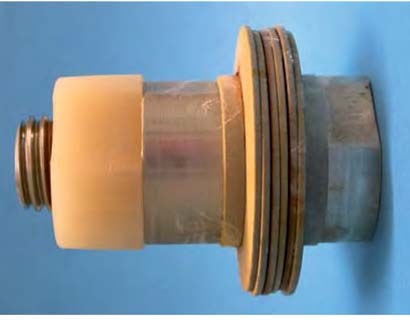
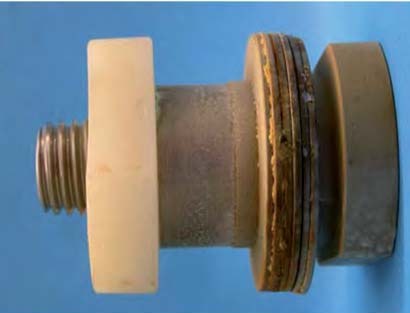
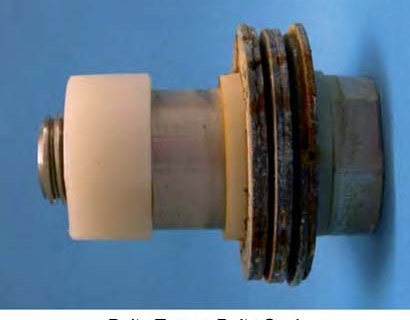
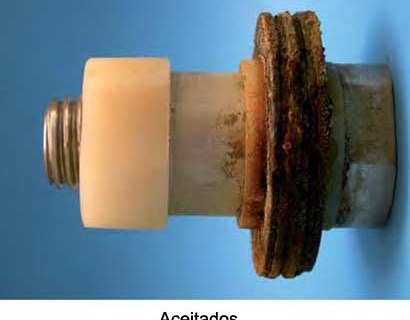
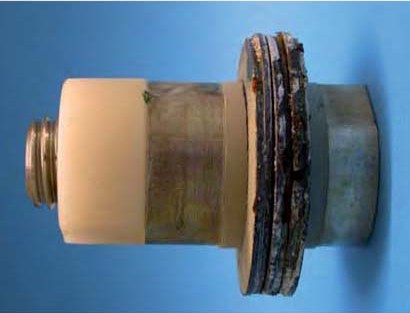
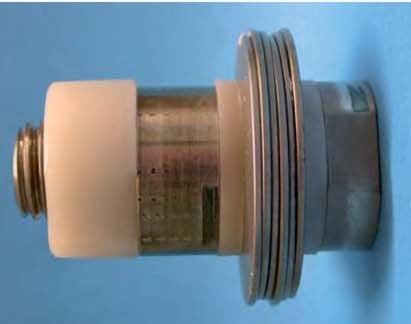
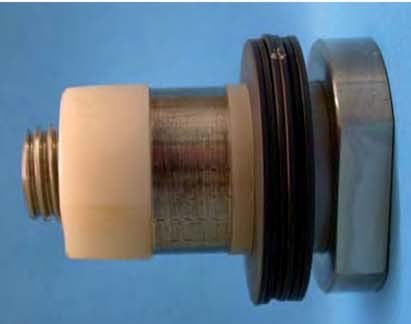
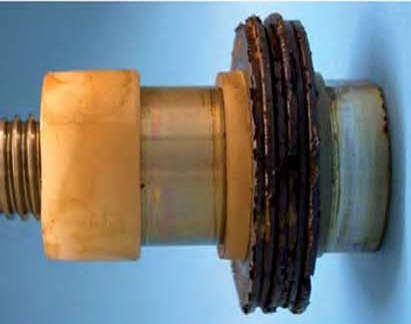
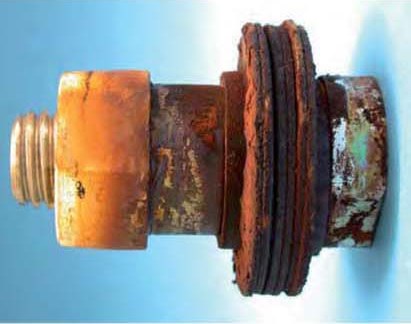
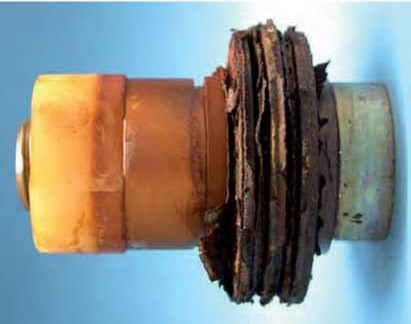
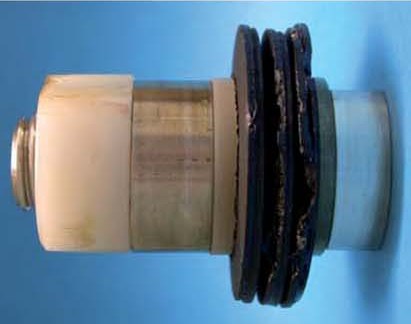
This is the phenomenon of stress corrosion cracking (SCC), specifically the sensitivity of austenitic stainless steels to chlorides. In the no-load test, chloride ions create surface pitting but the material holds. Under 80% compression, that pitting acts as a stress concentrator where transgranular cracks nucleate and propagate until complete fracture. This is why the MgCl₂ 40% solution is the international standard medium for evaluating SCC in stainless steels — its aggressiveness under load is disproportionately high compared with free immersion.
Because at 80 °C the corrosion rate increases significantly and the test is accelerated, making it possible to discriminate differences between materials within reasonable timeframes (weeks instead of months). Once the critical combinations are identified at 80 °C, they are repeated at 40 °C to assess whether the real service temperature is low enough to maintain the integrity of the part. If a combination fails at 80 °C but exceeds 2,500 h at 40 °C, it is viable in applications at room or moderate temperature.
For seawater under permanent load, the stainless steels 1.4310 (Stamped or Shot peened) and B-80 · 1.4310 are safe: they exceed 2,500 h at 80 °C without fracture, which implies indefinite life at room temperature. The 1.4568 Kolsterised is the exception to avoid — it fractures at 284 h at 80 °C. Among the coatings, Dacromet and Geomet on 51CrV4 also exceed 2,500 h in seawater under load. Zinc platings, Delta Tone, paint and oiling can be lower-cost options if the spring is not critical.
The travel of a disc spring is the difference between its free height and its flat height (fully compressed). Compression to 80% of travel means the part is deformed to 80% of its maximum deflection capacity, generating approximately 80% of its nominal load. This condition simulates the realistic worst case of a spring working as a permanent force element — compressed near the operating limit, but still without entering the material's plastic yield zone.
The oil layer is not a chemical barrier like a zinc coating or a chromate — it is a hydrophobic film that limits direct contact between the aqueous medium and the steel surface for a time. Under prolonged free immersion the oil eventually washes off and the substrate is exposed, which is why it gives poor results. However, in the under-load test the service life to fracture is usually short (days or weeks), and the oil holds up during that limited time window. It is not a long-term protection, but it delays the propagation of SCC cracks long enough for many real applications to remain functional.
Tell us about your use case and our engineering team will advise you on choosing the optimal solution.