


Hardened carbon steel
Standard · general joints
Conical spring washers for bolted joints: Belleville-style components designed to maintain bolt preload and prevent loosening caused by vibration or thermal expansion.
Unlike the DIN 2093 standard—which covers disc springs for static and dynamic loads—DIN 6796 washers are intended exclusively for static loads in bolted joints and are sized so that their maximum force corresponds to 70–90% of the clamping force of class 8.8 and 10.9 bolts.
The standard sets out the complete table of dimensions by bolt size (M3–M36), the dimensional tolerances, the minimum force developed when flattened, and the permitted materials and heat treatments.

DIN 6796 governs conical washers intended to provide residual elastic capacity to a bolted joint. Their function is not to exert a calibrated axial force (as DIN 2093 disc springs do), but to compensate for the small relative movements between the joined parts.
By maintaining an elastic reserve between the bolt head (or nut) and the joined part, the DIN 6796 washer ensures that the preload does not fall below the critical threshold even if some movement occurs due to these effects.
The standard clearly specifies that these washers are not designed to withstand dynamic loads: for applications with repeated load-and-unload cycles, DIN 2093 / DIN EN 16983 disc springs should be used.
The standard sets the proportions between thickness (t), free height (H), and outside diameter (De) for each bolt size. The nominal force Fc corresponds to the fully flattened state, calibrated to match 70–90% of the clamping force of a class 8.8 bolt installed at the recommended torque.
| Bolt size | Di (mm) | De (mm) | t (mm) | H (mm) | Force Fc (N) |
|---|---|---|---|---|---|
| M3 | 3,2 | 7 | 0,6 | 0,8 | 2.250 |
| M4 | 4,3 | 9 | 0,8 | 1,05 | 3.700 |
| M5 | 5,3 | 11 | 1 | 1,3 | 5.900 |
| M6 | 6,4 | 14 | 1,5 | 1,8 | 11.000 |
| M8 | 8,4 | 18 | 2 | 2,35 | 17.300 |
| M10 | 10,5 | 23 | 2,5 | 2,9 | 26.200 |
| M12 | 13 | 29 | 3,5 | 3,75 | 47.000 |
| M14 | 15 | 35 | 4 | 4,4 | 60.000 |
| M16 | 17 | 39 | 5 | 5,25 | 81.000 |
| M18 | 19 | 42 | 5 | 5,4 | 87.000 |
| M20 | 21 | 45 | 6 | 6,4 | 110.000 |
| M22 | 23 | 49 | 6 | 6,55 | 120.000 |
| M24 | 25 | 56 | 6 | 6,75 | 130.000 |
| M27 | 28 | 60 | 6 | 6,9 | 140.000 |
| M30 | 31 | 70 | 7 | 7,9 | 175.000 |
| M33 | 34 | 76 | 7 | 8,1 | 185.000 |
| M36 | 37 | 85 | 8 | 9,2 | 235.000 |
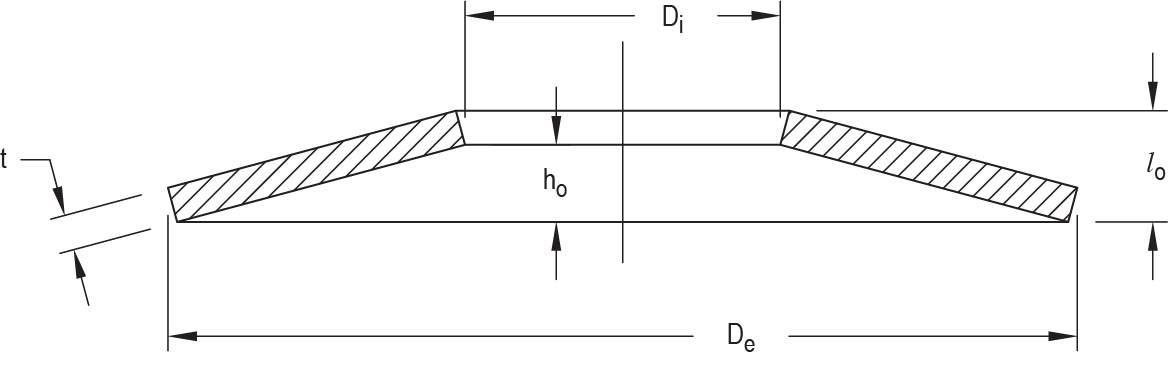
The height H is measured with the washer in its free state. Once Fc is reached, the washer behaves functionally like a flat washer.
The standard permits three main families: hardened carbon steel (standard), stainless steels (austenitic and martensitic), and nickel alloys (on request). C60 steel hardened to 420–510 HV covers most general applications.
Tell us about your use case and our team of engineers will advise you on choosing the optimal solution.
After forming and heat treatment, carbon steel washers are supplied with one of the following coatings to improve corrosion resistance and surface appearance.
| Coating | Corrosion resistance | Typical use |
|---|---|---|
| Black oxide | Decorative · very limited rust protection | Dry indoor · display parts |
| Electrolytic zinc plating (blue/yellow passivation) | Indoor use · dry environments | Most common catalog standard |
| Zinc-nickel | Salt-spray resistance ~500 h with no red rust | Industrial · automotive |
| Zinc flake (Dacromet® / Geomet®) | Salt-spray resistance ~720–1,000 h | Severe corrosion · Cr-VI free |
| Hot-dip galvanizing (HDG) | Thick coating · long outdoor service life | Steel structures · civil works |
DIN 6796 refers to other DIN standards to set the dimensional tolerances. The quality control required for the critical dimensions (De, Di, t, H) is AQL 1.5, which guarantees a statistical quality level compatible with series production and with use in critical bolted joints.
Compared with other types of washers used in bolted joints, DIN 6796 is the only one in the spring washer family that offers significant elastic capacity comparable to that of a disc spring. For this reason it has become the standard solution for critical bolted joints.
| Standard | Type | Elastic capacity | Dynamic load | Main application |
|---|---|---|---|---|
| DIN 6796 | Conical spring | High | No | Critical joints with vibration or thermal loads |
| DIN 127 | Split lock washer (helical) | Low | Limited | General joints — not recommended today |
| DIN 128 | Curved (wave) | Low | No | Where surface damage must be avoided |
| DIN 6797 | Toothed (int. / ext.) | Very low | No | Anti-rotation by biting |
| DIN 2093 / EN 16983 | Disc spring | Calibrated | Yes | Static and dynamic technical applications |
DIN 6796 washers are used wherever a bolted joint must maintain its preload throughout its service life without the need for periodic re-tightening.
Electric and combustion engines, compressors, pumps, industrial fans. The constant residual force prevents loosening throughout the service life.
Structural anchors, frame joints, and critical fastenings in towers and cranes subject to wind and dynamic loads.
Joints under continuous vibration (car body, bogie, onboard electrical equipment), chassis fasteners with extended maintenance intervals.
Industrial flanges subject to thermal cycling, inspection covers, and pipe connections with recurring thermal expansion.
Fastenings in turbines, generators, transformers, and high-voltage equipment where periodic re-tightening is not feasible.
Pretensioned anchors, seismic-resistant joints, and fastenings under wind loads and thermal movements of the building.
Although both are conical spring washers, their purpose is different. DIN 6796 is a spring washer for bolted joints under static load: its nominal force is sized to match 70–90% of the clamping force of a class 8.8 or 10.9 bolt. DIN 2093 / DIN EN 16983 defines disc springs for technical use, suitable for static and dynamic loads, with a calculable load-deflection curve, dimensions standardized in three series (A/B/C), and the option to stack them. Rule of thumb: if the joint is a bolt and there is vibration or thermal cycling, use DIN 6796; if you are designing a system with a disc spring whose force and travel are calculated, use DIN 2093.
The standard sizes the nominal force Fc of each washer to match 70–90% of the clamping force of a class 8.8 or 10.9 bolt of the same size. This covers the vast majority of standard industrial joints. For class 12.9 bolts—with a significantly higher clamping force—DIN 6796 is still valid as an elastic element, but its force Fc represents a smaller percentage of the total clamping force; in critical joints with class 12.9, it is advisable to verify the sizing case by case.
Yes, and it is a recommended replacement in critical joints. The DIN 127 split lock washer offers very limited elastic capacity and its anti-loosening effectiveness is questionable in modern industrial practice—several technical manuals consider it obsolete for new joints. DIN 6796 provides a significantly greater elastic reserve with the same geometric footprint, making it the correct technical choice when designing a new joint or replacing a split lock washer that has shown loosening problems.
No. DIN 6796 is designed as a single piece per joint: one washer between the bolt head (or nut) and the joined part. It is not sized for stacking in series or in parallel. If the application requires greater force or greater elastic travel through controlled stacking, a DIN 2093 / DIN EN 16983 disc spring should be used, as its geometry and tolerances are designed to stack predictably.
For demanding corrosive environments, zinc flake (Dacromet® / Geomet®) offers the best protection with no risk of hydrogen embrittlement: 720–1,000 h in salt spray and Cr-VI free. Zinc-nickel is the alternative when an electrolytic finish is required (~500 h with no red rust). For civil works and exposed outdoor use, hot-dip galvanizing (HDG) offers the longest service life thanks to its coating thickness. For critical automotive and energy applications, Geomet 321 is the reference. If the washer will operate in continuous immersion or in chemical environments, it is advisable to reconsider the base material toward stainless 1.4310 / 1.4568.
Tell us about your use case and our team of engineers will advise you on choosing the optimal solution.