Knowing about cleanrooms and their regulations is important to meet the conditions inside these rooms. There are various aspects at play, with temperature, air quality, design and any contamination that may affect the place being some of the most important. These types of enclosures are common in the pharmaceutical, nuclear, microelectronics and also food industries.
Their main function is to guarantee a safe environment in terms of contamination, microorganisms and particles, allowing operations or procedures to be carried out with products while avoiding their contamination. Environmental quality requirements have progressively evolved: the control of air quality, as well as environmental factors. For this reason, factors such as temperature, pressure or humidity become very important within the regulations. Below, we detail what these current standards are and we will see how adhesive thermometers can solve temperature control inside cleanrooms.
ISO 14644 standard for cleanrooms
A cleanroom is specially built to maintain low levels of contamination. For this reason it is key to respect very strict environmental parameters, because the processes or operations with food or pharmaceutical products, for example, carried out inside must be performed safely. The ISO 14644 standard establishes twelve basic points to achieve this.
Cleanliness, testing and construction
The first classifies air cleanliness according to particle concentration, in addition to setting out the monitoring that must be followed to control those set parameters. Then, the second and third deal with both establishing the specifications for carrying out tests and the methods for them. The fourth point focuses on aspects as essential as the design, construction and commissioning of the cleanroom, always bearing in mind its final objective.
Operation, separation and contamination
Regarding correct operation, point five stipulates how it should be in each case, while six covers terminology. The devices for separating elements inside the room appear in point seven, and from point eight onwards we find the requirements on the trickiest topics. We are referring to molecular contamination of the environment and surface chemistry, as well as the classifications regarding cleaning and nanoparticle concentration.
Summary and application of cleanrooms
Fundamentally, the ISO 14644 standard defines the limits and procedures to achieve microbial limitation and exclusion, particle limitation and exclusion, and to eliminate external contamination, as well as internal contamination, which would be that produced between products.
This type of installation is used in countless sectors, such as pharmaceutical, healthcare, aerospace and microtechnology, as well as in research laboratories and universities. However, some of the most common are operating theatres and cleanrooms in the food industry, of vital importance for health.
Labels to control temperatures in cleanrooms
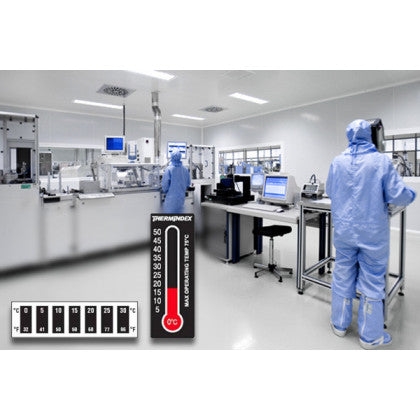
Within cleanrooms in the food sector it is essential that temperatures are ideal so that the food production process is completed successfully and without alterations to its components. They must be free of microbial contamination to avoid public health problems. The same happens with medicines and antibiotics, which must be kept at certain temperatures so that they do not lose potency or to prevent them from becoming unfit for humans. One of the most effective methods of controlling those parameters is adhesive temperature labels, which measure like a thermometer. These indicators have different levels and formats. Their operation is simple: just stick them on the area to be monitored and they will visually show the temperature. It is a convenient and economical solution. In addition, these temperature indicators contain no problematic materials such as mercury, nor batteries or liquids, so their use in this type of installation poses no problem.
In some applications within cleanrooms it may be necessary to guarantee that a certain temperature is not exceeded. In these cases, irreversible temperature labels for the cold chain offer a simple solution to the problem. These labels, by making a permanent change, serve as proof to ensure the conditions that have occurred in the enclosure. This is especially useful for food or pharmaceutical products. In short, this is how cleanrooms and regulations work so that everything inside them takes place in perfect conditions. All industries are advised not to skimp on costs to meet these necessary requirements.