Temperature control for
industrial dishwashers

Single-use adhesive label that is applied directly to the dishware and verifies, through a permanent color change, that the surface has reached the disinfection temperature. Documentary proof for the HACCP plan in industrial kitchens, catering and hospitals.

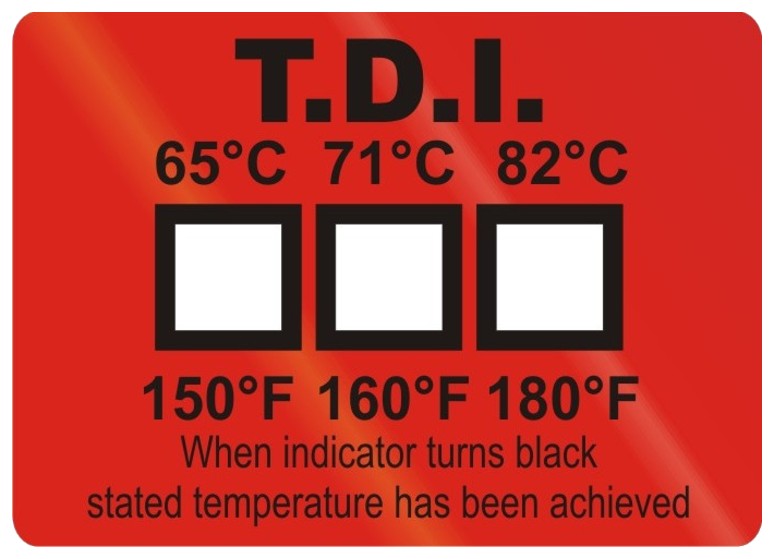
FIG · TDI label, not activated
Three-point TDI irreversible label (65, 71 and 82 °C) before activation, with the three white windows before the wash cycle.
Temperature points
3 levels · 65 / 71 / 82 °C
Critical threshold
71 °C on the surface
Format
Box of 1,000 units
01

What it measures: surface temperature, not chamber temperature

The key distinction in hygiene control is that the machine display shows the temperature of the water or the chamber, not the temperature each piece actually reaches. Food safety regulations require verifying the temperature on the surface of the utensil, and that is where irreversible indicators come in.

The rinse water in a high-temperature industrial dishwasher typically circulates between 80 and 85 °C (wash phase at 60–65 °C, per the DIN 10534 reference for commercial dishwashers). That rinse must transfer enough thermal energy for the dishware surface to reach at least 71 °C, the threshold associated with a 5-log microbial reduction (99.999%).

Load density, the orientation of the pieces, spray shadows and stacked racks can leave specific areas short of the threshold even when the machine shows the correct temperature. The irreversible indicator solves precisely that blind spot: it records whether that piece, in that position, in that cycle, reached the disinfection temperature.

FIG · rinse water vs. surface
Temperature scale of the wash cycle Vertical scale with the wash phase at 60–65 °C, the rinse at 80–85 °C, the ~90 °C ceiling and the critical point of 71 °C minimum that the dishware surface must reach. 60–65 °C · wash 80–85 °C · rinse ~90 °C max. 71 °C minimum on the surface

The rinse water transfers heat to the dishware, but only part of it reaches the surface of the piece: the TDI label confirms whether that point reached the 71 °C minimum. It is best not to exceed ~90 °C, since beyond that the water starts to vaporize and transfers heat less effectively.

02

The three-point TDI label

The reference model for this application is the TDI label, an irreversible indicator with three temperature points made specifically for monitoring disinfection in industrial dishwashers. It features the most widely accepted critical point of 71 °C in the center, plus one point below and one above, so the result is not a simple yes/no but a reading of the cycle's actual thermal margin:

  • Only the lower point activates → the cycle fell short; the surface did not reach 71 °C.
  • The center point (71 °C) activates → correct disinfection.
  • The upper point also activates → wide thermal margin.

At the end of the cycle, the label peels off easily thanks to its outer laminate and its specific adhesive, and can be filed as documentary proof in the HACCP records.

FIG · reading the TDI label according to the cycle result

Three cards with the 65, 71 and 82 °C points: only 65 activated (short cycle), 65 and 71 activated (correct disinfection), and all three activated (wide margin).

Short cycle
71 °C was not reached — repeat the cycle
Correct disinfection
surface sanitized to the reference threshold
Wide margin
surface temperature well above the threshold
reading the TDI label according to the cycle result
Note

Models with other temperature points are also available for different applications — engine monitoring, cold chain, thermal processes — on technical request.

Buy online

Labels for industrial dishwashers

Choose the label format and buy online the reference you need for your sanitization plan.

Prices excl. VATShips from our Barcelona warehouse1 model · 3 references

In stock · The price is for the supply format shown

03

Technical specifications

Technical specifications of the TDI irreversible label for industrial dishwashers: type, temperature points, backing, reaction, use and supply format.
ParameterValue / Range
Indicator typeIrreversible (permanent color change)
Temperature points3 points · 65 / 71 / 82 °C (150 / 160 / 180 °F)
Reference disinfection threshold71 °C on the utensil surface
BackingLaminated self-adhesive paper
ReactionWhite → black as each point is reached
UseSingle cycle (disposable)
ApplicationDirectly on dishware or metal utensils
RemovalPeels off after the cycle, can be filed as proof
Supply formatBoxes of 1,000 units

Need to document the disinfection of your dishware?

Tell us the type of installation —industrial kitchen, catering, hospital— and the monitoring frequency you need, and we'll confirm the right model and the delivery time. Free technical support, permanent stock, manufacturer since 1975.

04

How to use it correctly

A few precautions ensure that the label reading is representative of the actual cycle.

  1. Apply to a clean metal piece — a plate, tray or piece of cutlery. Metal transfers heat in a more representative way. Never on the rack or the interior of the machine: that does not confirm the dishware is being sanitized.
  2. Do not measure on the first cycle of the day — run 2–3 cycles first so the water and the machine's metal parts reach their normal operating condition.
  3. Use several indicators if the load is dense, in different positions (top, bottom, center, edges). If the upper one activates and the lower one does not, there is an uneven heating pattern that the machine display would not show.
  4. Peel off while hot and attach the indicator to the report if it is required as a quality record — the laminate allows it to be removed without damage.
  5. Repeat at a reasonable frequency — in the absence of guidance from the local health authority, a weekly check is a common reference.
05

Regulatory framework

The use of an irreversible indicator is based on the same criterion found in the main food hygiene references.

— 01

HACCP

In the EU, Regulation (EC) No 852/2004 requires food business operators to implement procedures based on hazard analysis and critical control points. Dishware sanitization is usually a critical control point (CCP) that must be verified and documented.

— 02

71 °C surface threshold

It matches the criterion of the FDA Food Code (section 4-703.11 B), which requires verifying 71 °C on the utensil surface using an irreversible registering temperature indicator.

— 03

DIN 10534 / NSF·ANSI 3

Hygiene references for commercial and industrial dishwashers, with rinse water at around 80–85 °C.

Note

The rinse should not exceed ~90 °C, since above that point the water starts to vaporize and transfers heat to the surface less effectively.

06

Industrial applications

The indicator for industrial dishwashers is used wherever dishware sanitization is an auditable critical point.

— 01

Airline catering

Monitoring of trays and tableware with documentary traceability for on-board food safety audits.

— 02

Hospitals and nursing homes

Verification of dishware disinfection in kitchens serving vulnerable populations.

— 03

Foodservice: restaurants, bars, institutional catering

Compliance with the HACCP plan and health inspections.

— 04

School cafeterias and institutional catering

Sanitization records in high-volume services.

07

Frequently asked questions about temperature control in industrial dishwashers

01 What temperature must dishware reach to be considered sanitized?

The dishware surface must reach at least 71 °C, the threshold associated with a 99.999% reduction of microorganisms. To achieve this, the rinse water in an industrial dishwasher typically circulates between 80 and 85 °C, since part of that energy is lost in the transfer to the utensil. The irreversible indicator confirms that the temperature was reached on the piece, not just in the chamber.

02 Why isn't the temperature shown on the machine enough?

Because the display shows the temperature of the water or the chamber, not the temperature each piece receives. Load density, dishware orientation and areas with little spray coverage can leave utensils below the threshold even when the machine shows the correct value. The surface indicator measures exactly what the regulations require you to verify.

03 Does it work as a record for the HACCP plan?

Yes. Its color change is permanent and irreversible, so the peeled-off label remains as physical, datable proof that the cycle reached the disinfection temperature. It can be filed with the HACCP plan records and presented in audits or health inspections.

04 Where should the indicator be applied?

On a clean metal piece in the load (a plate, tray or piece of cutlery), never on the rack or the interior of the machine. Metal gives the most representative reading. In dense loads it is advisable to place several indicators in different positions to detect areas of uneven heating.

05 How often should the verification be done?

It depends on the guidance of the local health authority or each facility's internal protocol. If there is no specific requirement, a weekly check is a common reference. It is recommended not to verify on the first cycle of the day and to run 2–3 cycles beforehand so the machine is at its normal operating temperature.

Need to document the disinfection of your dishware?

Tell us the type of installation —industrial kitchen, catering, hospital— and the monitoring frequency you need, and we'll confirm the right model and the delivery time. Free technical support, permanent stock, manufacturer since 1975.