Corrosion Test
Without Applied Stress

Free-immersion test over 4 weeks at room temperature on stainless steel disc springs (1.4310, 1.4568, with and without shot peening, with and without Kolsterising) and on standard 51CrV4 steel parts with eight anti-corrosion coatings. Four media: 40% MgCl₂, 3% NaCl, 0.1N NaOH and 0.1M citric acid. Results expressed on a qualitative visual scale (Good / Moderate / Poor / Very Poor). Reference data for selecting material and coating subjected to corrosion without applied load.

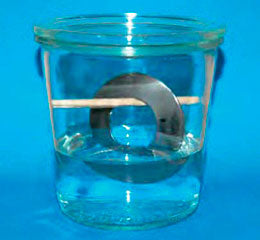
FIG · Test setup
C-63 disc spring specimen in 1.4310 stainless steel, freely immersed in a corrosive solution with no preload applied.
C-63 · 1.4310 — Specimen
Duration
4 weeks
Test temp.
20–25 °C
Load
Unstressed
Metric
B / M / P / MP
01

Test conditions

Operating parameters of the free-immersion test — 7 technical conditions.
Parameter Value
Type of exposure Full immersion in the corrosive solution
Duration 4 weeks
Temperature Ambient (20–25 °C)
Aeration No air introduced into the medium
Mechanical state of the parts Load-free · no preload applied
Solution renewal None during the test
Sample geometry C-63 (DIN 2093) and B-80 (DIN 2093)
02

Results of the unstressed immersion test

Qualitative visual scale after 4 weeks of immersion

Scale B Good M Moderate P Poor MP Very Poor
Qualitative Good / Moderate / Poor / Very Poor results by material and corrosive medium after 4 weeks of free immersion — 6 stainless steels and 8 coatings on 51CrV4 against 4 solutions.
Spring · Material · Finish40% MgCl₂magnesium chloride3% NaClsodium chloride0,1N NaOHsodium hydroxide0,1M C₈H₈O₇citric acid
— Uncoated stainless steels
C-63 · 1.4310 · Stamped · Ground M B B B
C-63 · 1.4310 · Stamped · Ground · Shot peened M B B B
B-80 · 1.4310 · Stamped · Ground M B B B
C-63 · 1.4568 · Stamped · Ground M B B B
C-63 · 1.4568 · Stamped · Ground · Shot peened P M B B
C-63 · 1.4568 · Stamped · Ground · Shot peened · Kolsterised MP P B B
— 51CrV4 steel with anti-corrosion coatings
51CrV4 · Yellow zinc plating B P B MP
51CrV4 · Clear zinc plating B M B MP
51CrV4 · Dacromet B B B MP
51CrV4 · Geomet B B B MP
51CrV4 · Delta Tone + Delta Seal B M B P
51CrV4 · Nickel plating P P B P
51CrV4 · Water-thinned paint B B M P
51CrV4 · Oiled MP MP B MP
— Designations
  • C-63 63 × 31 × 1.8 mm (DIN 2093)
  • B-80 80 × 41 × 3.0 mm (DIN 2093)
  • 1.4310 X10CrNi18-8 / AISI 301
  • 1.4568 X7CrNiAl17-7 / 17-7 PH / AISI 631
  • Kolsterised carbon diffusion into austenitic stainless steel
— Corrosive solutions
  • 40% MgCl₂ highly concentrated magnesium chloride
  • 3% NaCl sodium chloride (de-icing salts)
  • 0.1N NaOH sodium hydroxide (CIP cleaning)
  • 0.1M C₈H₈O₇ citric acid (food industry)
03

Conclusions by corrosive medium

The test results vary radically depending on the corrosive medium. Below are four readings — one for each solution tested — covering the behavior of the stainless steels and the coatings.

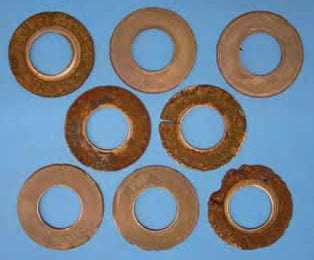
Under the same time and temperature conditions, the parts range from a surface patina to thick layers of rust or dissolution of the coating. The photograph shows the combined effect of material + medium on the final appearance of the part.

— magnesium chloride · extreme concentration

MgCl₂ 40%

The stainless steels show low resistance. The 1.4310 achieves a moderate result (M); the 1.4568 worsens notably with shot peening (P) and even more with Kolsterising (MP). On the 1.4310, shot peening improves slightly; on the 1.4568 it worsens — peening introduces roughness without offsetting the chemical effect.

The coatings perform better than the stainless steels here. Zinc platings, Dacromet, Geomet, Delta Tone + Delta Seal and water-thinned paint achieve G. Exceptions: electroless nickel and oiling.
— sodium chloride · de-icing salts

NaCl 3%

The stainless steels behave well (G or M in every case). Most coatings, by contrast, clearly drop in resistance. Dacromet, Geomet and water-thinned paint are the exceptions — they maintain good behavior. Zinc plating, nickel plating and oiling degrade.

— sodium hydroxide · CIP cleaning

NaOH 0,1N

This is the mildest medium in the test. Both the stainless steels and most coatings achieve G. The only protection affected is water-thinned paint — the NaOH dissolves the organic layer.

— C₈H₈O₇ · food / cleaning

Citric Acid 0.1M

This medium demonstrates the need to use stainless steel in the presence of organic acids. The stainless steels achieve G; the zinc-based coatings (zinc platings, Dacromet, Geomet) fail (MP) — the zinc reacts directly with the acid and dissolves.

Delta Tone + Delta Seal, nickel plating and paint achieve P; oiling, MP.

Shall we talk about your project?

Tell us about your use case and our engineering team will advise you on choosing the optimal solution.

04

Cross-reading · counterintuitive combinations

— Shot peened

Shot peening does not always improve unstressed corrosion resistance

On the 1.4310 it is neutral; on the 1.4568 it worsens slightly in 40% MgCl₂. It improves fatigue (see section 03) but is not an anti-corrosion protection in itself.

— Kolsterised

Kolsterising worsens unstressed corrosion resistance on 1.4568

This treatment improves wear resistance but does not protect against MgCl₂ or NaCl. For chloride environments without wear, it is not the best option.

— Dacromet · Geomet

The most versatile protections in chloride media

G in 40% MgCl₂, G in 3% NaCl, G in 0.1N NaOH. Their only weak point is citric acid, common to all zinc-based coatings.

— Oiled

Oiling is not a real anti-corrosion protection

Just a temporary preservation method for storage. It fails in three of the four media — it only holds up in 0.1N NaOH.

05

Limitations of the unstressed test

The results of this test cannot be directly extrapolated to applications where the spring works under load. Under compression, additional phenomena appear that invalidate combinations that were optimal in free immersion:

  • 01
    Stress corrosion cracking (SCC)

    Chloride ions penetrate microcracks and, in the presence of stress, propagate cracks that lead to spring fracture.

  • 02
    Acceleration by temperature

    At 80 °C, the corrosion rate multiplies compared with room temperature.

  • 03
    Loss of passive layer through friction

    In dynamic applications, friction between parts locally destroys the protective oxide layer of the stainless steel.

06

Frequently asked questions

01 Exactly how long did the exposure last, and why 4 weeks?

The immersion ran for 4 continuous weeks at room temperature, without renewing the solution or introducing air. This period is long enough for the slow electrochemical processes (pitting corrosion, attack of zinc by citric acid, dissolution of organic layers) to show visually, and at the same time short enough to avoid artifacts from solution depletion. Free-immersion tests do not have a single standard; they were designed as a complement to the cyclic VDA test for situations where the spring is not under load.

02 Why does oiling get Very Poor in almost every medium?

Oiling is not a real anti-corrosion layer, but a film of mineral oil whose only function is to slow atmospheric oxidation during storage. Under immersion the film displaces or emulsifies within a few hours and leaves the substrate (51CrV4 steel) directly exposed to the medium. That is why it fails in MgCl₂, NaCl and citric acid — it only holds up in 0.1N NaOH, where the substrate itself resists reasonably well. For real anti-corrosion protection, it is best to choose electrochemical coatings (zinc plating), conversion coatings (Dacromet, Geomet) or organic layers (Delta Tone + Delta Seal, paint).

03 Why does Kolsterising, a sophisticated treatment, worsen the results?

Kolsterising is a low-temperature carbon diffusion on austenitic stainless steels that increases surface hardness and wear resistance without forming carbides that would compromise the passive layer. It works well against wear and fatigue, but it introduces residual surface stresses and slightly modifies the chemical structure of the active chromium. In the presence of highly concentrated chlorides (40% MgCl₂) the effect is counterproductive: the treated layer is attacked before the base stainless steel. For applications subject to chloride corrosion without a wear component, it is best to use the material in its standard finish.

04 If my spring is going to work in 3% NaCl without applied load, which material do I choose?

For immersion in 3% NaCl without load, the recommended options — all rated G in this test — are: (1) stainless steel 1.4310 or 1.4568 with no additional treatments; (2) Dacromet or Geomet conversion coatings on 51CrV4 if cost is critical; (3) water-thinned paint, valid for cosmetic applications. Avoid conventional zinc plating, electroless nickel and oiling in this medium. If the application adds load, temperature > 40 °C or fatigue, the results of this section do not apply — consult sections 02 and 03 before deciding.

05 Are tests available in artificial seawater or salt spray?

This test covers 4 standardized media (MgCl₂, NaCl, NaOH, citric acid) chosen to span the most common types in industrial springs. It does not include salt spray (ISO 9227) or artificial seawater (ASTM D1141) — these are cyclic or spray tests with different dynamics and are carried out in a climatic chamber, not in free immersion. If your application requires it (marine, outdoor, automotive), Surisa can coordinate the test with an accredited external laboratory or refer you to already-published salt spray data for the coatings in question — write to us specifying the required standard.

Shall we talk about your project?

Tell us about your use case and our engineering team will advise you on choosing the optimal solution.