Irreversible antifreeze
thermometer

Adhesive indicator that changes color permanently when the temperature drops below a critical level, leaving a record that the product was exposed to freezing even if the temperature recovers afterward. No batteries or electronics.

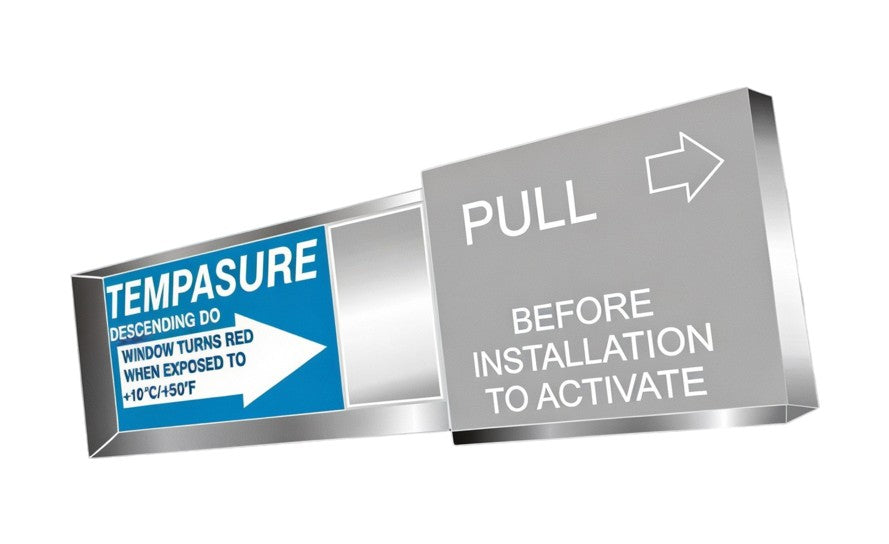
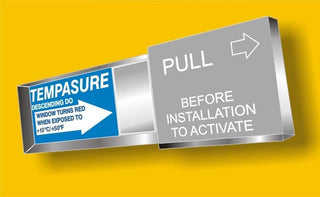
FIG · Tempasure sensor, window not activated
Tempasure adhesive antifreeze sensor with the indicator window not yet activated and the PULL activation tab before installation.
Standard range
-10 °C to +10 °C
Record
Permanent and irreversible
Format
Sensors/labels · 100 units min.
01

How an antifreeze indicator works

The indicator is stuck onto the surface of the product or packaging to be monitored. It contains a heat-sensitive chemistry calibrated to a specific switching temperature. When the temperature drops below that critical point for long enough, a permanent and irreversible color change takes place.

This makes it possible to distinguish two scenarios that a simple spot reading cannot detect: if the product always stays within range, the indicator keeps its original color; if it suffered a cold excursion at some point during transport or storage, the indicator will have changed color, even if the temperature is back within range at the time of reading.

Since it is a single-use device, once activated it must be replaced with a new unit — unlike reversible LCD thermometers, which show the instantaneous temperature but leave no trace of past events.

FIG · Window states
States of the antifreeze indicator window Two-state diagram: the intact window in its base color on the left and, after dropping below the calibrated threshold, the activated window with a permanent color change on the right. Before · Intact Drops below the calibrated threshold After · Activated

The window changes color permanently when crossing the threshold downward; it does not revert even if the temperature rises again.

02

Available models

Surisa distributes three antifreeze solutions that cover everything from spot control of a single threshold to complete cold chain monitoring at both ends. Tempasure and FREEZESAFE watch a single lower limit; Coldchain complete XS adds control of the upper end, the usual approach for products that must stay within a band, such as the classic pharmaceutical 2–8 °C.

Available antifreeze models by type of control and supply format.
ModelType of controlSupply format
TempasureDrop below a thresholdAdhesive sensor · min. 100 units
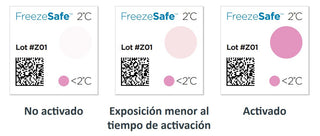
FREEZESAFEDrop below a thresholdAdhesive label · packs of 100 units
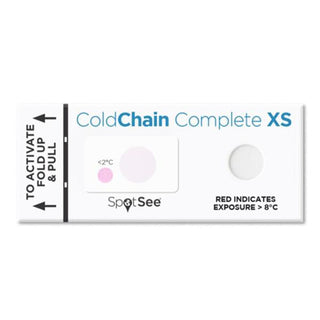
Coldchain complete XSCold and hot limitsAdhesive label · packs of 100 units
FIG · Single vs. dual threshold
Single threshold versus dual threshold Comparison of two control schemes: Tempasure and FREEZESAFE activate when dropping below a single lower limit; Coldchain complete XS monitors a lower and an upper limit at the same time.Tempasure · FREEZESAFE Min. Coldchain complete XS Min. Max.

Tempasure and FREEZESAFE activate when dropping below a single lower threshold; Coldchain complete XS watches both the cold and hot limits at once.

Buy online

Antifreeze thermometers

Choose the model based on the cold thresholds you need to monitor and buy the right one online.

Prices excl. VATShips from our Barcelona warehouse3 models · 10 references

In stock · The price is for the supply format shown

03

Temperature ranges

Tempasure antifreeze indicators are available as standard with thresholds between -10 °C and +10 °C, covering most cold chain needs. For specific requirements, special thresholds between -20 °C and +40 °C can be manufactured on request.

The switching temperature is chosen according to the point at which the monitored material starts to deteriorate — what we call the critical freezing temperature. That value is not universal: it depends on the product and the sector. A pharmaceutical preparation, a waterborne paint or a chemical reagent each have different damage thresholds, and the indicator must be selected accordingly.

FIG · Scale of available ranges
Scale of available temperature ranges Temperature scale from -20 °C to +40 °C with the standard -10/+10 °C band highlighted, the special made-to-order -20/+40 °C band shown dashed, and an example of a threshold calibrated at -5 °C.Special on request · -20 / +40 °C Standard · -10 / +10 °C Example · threshold at -5 °C -20 -10 0 °C 10 20 30 40Water freezing point
Technical parameters of the antifreeze indicators: ranges, signal type, reusability and format.
ParameterValue
Standard range (Tempasure)-10 °C to +10 °C
Special range on request-20 °C to +40 °C
Signal typeIrreversible color change
ReusableNo (single use)
FormatAdhesive sensors / labels · 100 units min.

What critical temperature do you need to monitor?

Tell us the product you need to protect and the point at which it starts to deteriorate — we will confirm the right model and threshold. Free engineering support, permanent stock.

04

Why freezing causes irreversible damage

Understanding what happens to the product when it freezes explains why a permanent indicator is essential instead of a simple spot check. In all of these cases the damage is real but invisible after thawing.

— 01

Waterborne paints and adhesives

They are emulsions — polymer and pigment particles dispersed in water. Below 0 °C the water crystallizes and expels those particles from the suspension, causing irreversible coagulation ("emulsion breaking"). After thawing, the product is left lumpy and separated, never recovering its flow or adhesion. Stability is evaluated with tests such as ASTM D2243; antifreeze additives (glycols, urea) only shift the freezing point slightly — they do not prevent the damage.

— 02

Vaccines and biologics

Many vaccines permanently lose potency if they freeze, without the vial showing any visible changes. The usual vial monitors (VVM) detect exposure to heat, not cold — the antifreeze indicator covers precisely that blind spot in the pharmaceutical cold chain.

— 03

Reagents, emulsions and chemical products

Many aqueous formulations — dispersions, resins, diagnostic reagents — destabilize when frozen, with phase separation or precipitation that renders them unusable.

Note

The antifreeze indicator provides the traceability needed to make an informed decision on whether a batch should be used or discarded.

05

Industrial applications

Antifreeze indicators are used in any logistics flow where a cold-sensitive product is transported or stored outside continuous temperature control. The more critical the product, the more value a permanent indicator adds by documenting any thermal excursion that occurred anywhere along the chain.

— 01

Pharmaceutical and healthcare industry

Vaccines, blood products, biological medicines and diagnostic reagents. Provides documentary evidence aligned with good distribution practices (GDP) for the transport and storage of medicines.

— 02

Paints, coatings and adhesives

Control during winter transport of waterborne emulsions that coagulate irreversibly below 0 °C.

— 03

Chemicals and specialties

Aqueous dispersions, resins, additives and reagents that degrade upon freezing.

— 04

Logistics and refrigerated transport

Cold chain verification in international transit, especially with transshipments or uncontrolled intermediate storage.

— 05

Food

Control of products where accidental freezing alters texture or properties; with the Coldchain complete XS model, simultaneous monitoring of the upper limit of the cold chain.

06

Frequently asked questions about antifreeze thermometers

01 What is the difference between an irreversible antifreeze indicator and a reversible thermometer?

The antifreeze indicator is irreversible: when the temperature drops below the critical threshold, it changes color permanently and never returns to its original state. It serves as evidence that freezing occurred at some point, even if the temperature later returns to normal. A reversible thermometer (for example, liquid crystal) shows the current temperature but leaves no record of past events. To verify cold chain integrity, the irreversible model is required.

02 At what temperature does the indicator activate?

The threshold is chosen when selecting the product. Standard Tempasure indicators cover from -10 °C to +10 °C, and thresholds between -20 °C and +40 °C can be manufactured on request. The right temperature is the one at which the monitored material starts to deteriorate (its critical freezing temperature), which varies by sector and formulation.

03 Can the same indicator detect cold and heat at the same time?

It depends on the model. Tempasure and FREEZESAFE only watch the drop below a threshold. To control the cold and hot limits simultaneously — the typical approach for a 2–8 °C band — there is the Coldchain complete XS, which alerts if the product goes out of range at either end.

04 Why do I need a freeze indicator if vaccines already carry a vial monitor?

Vial monitors (VVM) detect cumulative heat exposure, but not freezing. Freezing is one of the most frequent causes of loss of potency in sensitive vaccines and leaves no visible signs on the vial. The antifreeze indicator covers that blind spot, providing evidence of whether the product ever froze.

05 Can an indicator be reused once activated?

No. They are single-use devices: once the color has changed, they must be replaced with a new unit. They are supplied in formats of 100 units (Tempasure with a minimum quantity of 100 units; FREEZESAFE and Coldchain complete XS in packs of 100).

Do you need to protect a freeze-sensitive product?

Tell us the product you need to protect, the critical temperature and whether you also need to watch the hot limit — we will select the optimal model and range and get back to you with the right solution. Free engineering support, permanent stock.