


Autoclave sterilization temperature and time
TL;DR: Steam sterilization in an autoclave works by combining temperature and exposure time with saturated steam: the reference cycles are 121 °C for 15 minutes and 134 °C for 3 minutes, with the load already at temperature. Irreversible temperature labels make it easy to check the maximum temperature reached at a specific point of the load during the cycle. Surisa stocks irreversible labels with points from 116 to 154 °C, covering both the 121 °C and 134 °C cycles, and advises on choosing the right range.
An autoclave is a thick-walled, airtight vessel that works above atmospheric pressure so that water vapor reaches temperatures above 100 °C. At those temperatures, saturated steam denatures the proteins of bacteria, viruses, fungi and spores, and inactivates them. The principle is the same in a laboratory autoclave, in a hospital central sterilization department or in an industrial autoclave: what sterilizes is the combination of temperature, time and direct contact between the steam and the surface.
Buy online
How steam sterilization works
In international technical terminology, this process is called steam sterilization or moist heat sterilization, and the adhesive indicators that record the cycle temperature are known as autoclave temperature indicators or irreversible temperature labels.
Steam is the most widely used sterilization method because it is non-toxic, inexpensive and fast-acting. Its effectiveness depends on three conditions:
- Saturated steam: the steam must be in equilibrium with liquid water. Superheated steam, or steam with excess moisture, transfers heat less effectively.
- Absence of air: air pockets in the chamber or inside the packs stop the steam from reaching the surface and create cold spots. This is why pre-vacuum autoclaves remove the air before the sterilization phase.
- Time at temperature: the sterilization time starts counting when the entire load has reached the setpoint temperature, not when the cycle starts.
Pressure does not sterilize by itself: it is the means by which the steam reaches the required temperature. With saturated steam, 121 °C corresponds to about 1.05 bar gauge pressure and 134 °C to about 2.05 bar.
The European regulatory framework is set mainly by EN 285 (large steam sterilizers), EN 13060 (small steam sterilizers) and ISO 17665 (validation and routine control of moist heat sterilization).
Autoclave sterilization times and temperatures
For metal items sterilized with saturated steam, the reference combinations of temperature and exposure time are:
| Temperature | Minimum exposure time | Typical use |
|---|---|---|
| 115 °C | 30 min | Gentle cycles for heat-sensitive materials |
| 121 °C | 15 min | Standard laboratory cycle and unwrapped items |
| 126 °C | 10 min | Intermediate cycle |
| 134 °C | 3–5 min | Fast cycle for surgical instruments |
These are exposure times with the load at temperature. The full cycle is longer, because it includes air removal, heat-up, the sterilization phase, pressure release and drying.
It is not advisable to mix very different materials in the same cycle: porosity, mass and the type of wrapping change how long each item takes to reach the setpoint temperature.
Indicative examples by type of material
- Wrapped surgical instruments: between 20 and 30 minutes at 121 °C, or the 134 °C cycle validated for that load.
- Laboratory glassware (flasks, bottles): about 20 minutes at 121 °C.
- Textiles and cotton garments: about 30 minutes at 121 °C, as steam penetrates them with more difficulty.
- Culture media and liquids: the time depends on the volume; large containers need longer for the liquid to reach 121 °C inside.
In every case, the instructions of the autoclave and material manufacturers, and the validated cycle of each installation, take precedence.
Temperature labels for verifying the autoclave cycle
Temperature labels are adhesive indicators with one or more heat-sensitive points. There are two types:
- Reversible: they show the current temperature and return to their initial state as they cool down. They are useful for instant readings, not for recording a cycle.
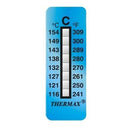
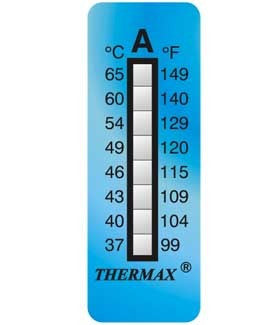
- Irreversible: each point turns permanently black once the printed temperature is exceeded. After the cycle, the label shows the maximum temperature reached at that point.
In an autoclave, irreversible labels are used to:
- Check that a specific area of the load (the center of a basket, a dense pack, the lower part of the chamber) has reached the setpoint temperature.
- Detect cold spots when commissioning a new autoclave or after a change in the load configuration.
- Leave a visual record of the result in a logbook or on the batch itself.
A temperature label records the maximum temperature, not the exposure time or the presence of saturated steam. It therefore complements, but does not replace, chemical sterilization indicators to ISO 11140-1, biological indicators to ISO 11138 or the autoclave's own temperature and pressure record.
How to choose the label range
What matters is that the label has points below and above the setpoint temperature: that way you can see whether the load fell short or overshot.
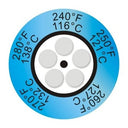
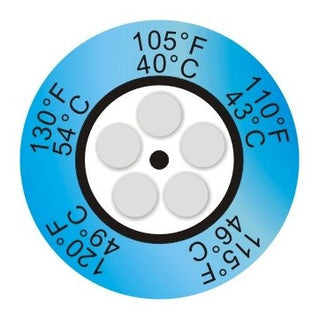
- For both cycles (121 °C and 134 °C): 8-level label with a 116–154 °C range, or clock-face label with 5 levels and a 116–138 °C range.
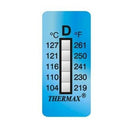
- 121 °C cycle only: 5-level label with a 104–127 °C range, or 6-level mini label with a 99–127 °C range.
- 134 °C cycle only: 5-level label with a 132–154 °C range, or 6-level mini label with a 132–160 °C range.
- A single threshold: 1-level label at 121 °C.
Autoclave applications by sector
- Hospitals and clinics: sterilization of surgical instruments, dental items and textiles in the central sterilization department.
- Laboratories: sterilization of glassware and culture media, and decontamination of biological waste before disposal.
- Veterinary and beauty clinics: sterilization of reusable instruments in benchtop autoclaves.
- Food industry: sterilization of canned goods in autoclaves or retorts, where controlling the temperature at the center of the container is critical.
- Composites and tires: curing of carbon fiber parts and rubber vulcanization in industrial autoclaves, with controlled temperature and pressure cycles.
- Wood and textiles: heat and steam treatments in autoclaves for stabilization or impregnation.
Frequently asked questions about autoclave sterilization temperature
What temperature and how much time does an autoclave need to sterilize?
The reference cycles with saturated steam are 121 °C for 15 minutes and 134 °C for 3 minutes, counted from the moment the entire load has reached temperature. There are intermediate cycles (126 °C for 10 minutes) and gentle cycles (115 °C for 30 minutes). Wrapped, porous or bulky loads need longer, so the cycle validated for each load always takes precedence.
What is the difference between the 121 °C cycle and the 134 °C cycle?
Both achieve sterilization; what changes is the relationship between temperature and time. The 134 °C cycle is much shorter and is used for metal instruments that tolerate heat. The 121 °C cycle is slower but gentler, and is the usual choice for liquids, culture media, heat-resistant plastics and laboratory work in general.
Does an irreversible temperature label prove that the material is sterile?
Not on its own. The label confirms the maximum temperature reached at the point where it was placed, but it does not measure the exposure time or the presence of saturated steam. It is a verification tool that complements chemical indicators (ISO 11140-1), biological indicators (ISO 11138) and the autoclave's own record.
Where should the temperature label be placed inside the autoclave?
At the point that is hardest to heat: the center of the load, inside or on top of the densest pack, or in the area of the chamber closest to the drain, which is usually the coldest. To map the chamber, several labels are placed in different positions and the results are compared after the cycle.
What pressure does a steam autoclave reach?
With saturated steam, at 121 °C the gauge pressure is approximately 1.05 bar (about 2 bar absolute), and at 134 °C approximately 2.05 bar (about 3 bar absolute). Pressure is a consequence of the saturated steam temperature: what guarantees sterilization is the temperature held for the necessary time.
Recommended products
Temperature indicators selected for this application. Buy the reference you need online.

Shall we talk about your project?
Tell us about your use case and our engineering team will advise you on choosing the best solution.