


Sterilization of surgical and laboratory equipment
TL;DR: The most widely used sterilization methods are steam in an autoclave (121–134 °C), dry heat (160–180 °C) and low-temperature methods (ethylene oxide, hydrogen peroxide), below 60 °C. In all of them, temperature is a critical variable. Irreversible temperature labels make it possible to check the maximum temperature reached at a point of the load. Surisa stocks labels with points from 37 to 199 °C, covering all of these processes.
Sterilization eliminates every form of microbial life, spores included. It is mandatory for surgical instruments that come into contact with sterile tissue and for much laboratory equipment. It should not be confused with disinfection, which reduces microorganisms but does not guarantee the elimination of spores.
The method is chosen according to the material: whatever tolerates heat is sterilized with steam or dry heat, and whatever does not, with low-temperature methods.
Buy online
Sterilization methods for surgical instruments
In international technical terminology, these are referred to as sterilization methods for surgical instruments, and as steam, dry heat and low-temperature sterilization.
| Method | Temperature | Indicative time | Typical material |
|---|---|---|---|
| Steam in an autoclave | 121 °C / 134 °C | 15 min / 3 min exposure | Metal instruments, textiles, glass |
| Dry heat | 160 °C / 170 °C / 180 °C | 120 min / 60 min / 30 min | Glass, metal, powders and oils |
| Ethylene oxide | Approx. 37–55 °C | Several hours, plus aeration | Heat-sensitive material |
| Hydrogen peroxide (plasma or vapor) | Approx. 45–55 °C | Less than 1 hour | Material sensitive to heat and moisture |
Steam in an autoclave
This is the reference method for instruments that tolerate heat and moisture, because it is fast, effective and non-toxic. Most hospital autoclaves work with a pre-vacuum: they remove the air, introduce saturated steam at 121 or 134 °C, hold the exposure and dry the load. We explain the cycles in detail in autoclave sterilization temperature and time.
Dry heat
This is carried out in hot air ovens, known as Poupinel ovens. It needs higher temperatures and longer times than steam, because dry air transfers heat less effectively. It is useful for materials that steam does not penetrate or that moisture damages, such as powders, oils and glass. Its main drawbacks are wear on the instruments and the cooling time.
Low-temperature methods
Ethylene oxide and hydrogen peroxide, as plasma or vapor, are used for material that cannot withstand heat, such as endoscopes, plastics or electronic components. They work in sealed chambers with cycles controlled by the equipment. Ethylene oxide also requires an aeration phase to remove residues.
Radiation
Gamma radiation or electron beam is used on an industrial scale to sterilize single-use items such as syringes, gloves or Petri dishes. It is not a hospital method.
Sterilization and decontamination in the laboratory
In a microbiology laboratory, several methods are combined according to the material:
- Autoclave: culture media, reusable items and decontamination of biological waste before disposal.
- Dry heat: clean, dry glassware such as pipettes, dishes or flasks.
- Filtration: solutions that do not tolerate heat, such as some antibiotics or media supplements.
- Flame or incineration: inoculation loops and small metal instruments.
Chemical disinfectants (alcohols, aldehydes, phenols) are used for surfaces and non-critical items, but they are not sterilization methods.
Washer-disinfectors
Washer-disinfectors clean and disinfect instruments before sterilization. Thermal disinfection is based on holding the water at temperatures around 90–93 °C for a defined time, in accordance with ISO 15883. It is a step prior to sterilization, not a substitute for it.
How to verify the temperature with irreversible labels
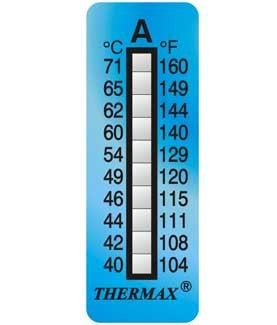
Irreversible temperature labels have one or more points that turn permanently black once the printed temperature is exceeded. After the cycle, they show the maximum temperature reached at the point where they were placed.
Surisa labels carry a clear polyester layer that protects them from water, steam and oil. Their accuracy is ±1 °C up to 100 °C and ±1 % above 100 °C.
In sterilization and disinfection processes they are used to:
- Check that the center of the load or the densest pack reached the setpoint temperature.
- Detect cold zones in a dry heat oven or in an autoclave.
- Verify the temperature reached in a washer-disinfector.
- Attach the label to the batch record as visual evidence.
A temperature label records the maximum temperature, not the exposure time or other process conditions. It complements, but does not replace, chemical (ISO 11140-1) and biological (ISO 11138) indicators.
Which range to choose for each process
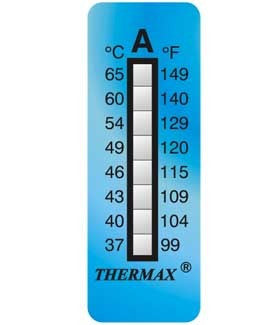
- Ethylene oxide or hydrogen peroxide: 8-level label with a 37–65 °C range.
- Washer-disinfector: 8-level label with a 71–110 °C range.
- Steam autoclave: 8-level label with a 116–154 °C range.
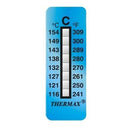
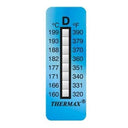
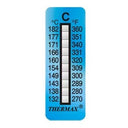
- Dry heat at 160–180 °C: 8-level label with a 160–199 °C range, or 10-level label with a 132–182 °C range.
Frequently asked questions about surgical instrument sterilization
What is the most widely used method for sterilizing surgical instruments?
Steam in an autoclave, at 121 °C for 15 minutes or at 134 °C for 3 minutes of exposure. It is fast, effective, inexpensive and leaves no toxic residues. Dry heat is reserved for materials that moisture damages, and low-temperature methods for heat-sensitive material.
At what temperature does dry heat sterilize?
The reference combinations are 160 °C for 120 minutes, 170 °C for 60 minutes and 180 °C for 30 minutes, counted from the moment the load reaches temperature. Dry heat needs more temperature and more time than steam because air transfers heat less effectively.
What is the difference between sterilizing and disinfecting?
Sterilization eliminates all microorganisms, spores included. Disinfection reduces microorganisms to a safe level, but does not guarantee the elimination of spores. Washer-disinfectors and chemical disinfectants disinfect; the autoclave and the dry heat oven sterilize.
How do you sterilize material that cannot withstand heat?
With low-temperature methods: ethylene oxide or hydrogen peroxide as plasma or vapor, which work below about 60 °C. They are used for endoscopes, plastics and devices with electronic components. In the laboratory, heat-sensitive solutions are sterilized by filtration.
Which temperature label should I use for a dry heat oven?
An irreversible label with points below and above the working temperature. For a cycle from 160 to 180 °C, an 8-level label with a 160–199 °C range will do. If the point for the setpoint temperature has not turned black at the end of the cycle, that zone of the oven did not reach it.
Recommended products
Temperature indicators selected for this application. Buy the reference you need online.
Shall we talk about your project?
Tell us about your use case and our engineering team will advise you on choosing the best solution.