


Food cold chain and storage
TL;DR: The cold chain keeps food chilled (generally below 4–7 °C, depending on the product) and frozen (at −18 °C or below) from production to the consumer. The most critical moment is transport, with loading and unloading. Surisa's adhesive indicators make it possible to read the temperature of a cold room at a glance and to leave a permanent record of whether a product was exposed to out-of-range temperatures, and for how long.
Cold does not eliminate microorganisms: it slows down their growth and the action of the enzymes that spoil food. That is why the cold chain only works if it is not interrupted. A break, even if the temperature is recovered afterwards, shortens the product's shelf life and can compromise its safety.
Food storage temperatures
In international technical terminology, this is referred to as food cold chain monitoring, chilled and frozen food storage temperatures and temperature abuse when a product leaves its range.
| Product | Reference maximum temperature |
|---|---|
| Frozen and quick-frozen food | −18 °C or below |
| Ground meat | 2 °C |
| Offal | 3 °C |
| Poultry meat and meat preparations | 4 °C |
| Fresh meat from ungulates (beef, pork, lamb) | 7 °C |
| Fresh fish | Close to that of melting ice |
The meat and fish values come from Regulation (EC) 853/2004 on the hygiene of food of animal origin. For each product, the final reference is the one stated on its label or in its food safety plan.
Between about 5 and 60 °C lies what is known as the danger zone, in which bacteria multiply fastest. The aim of the cold chain is for food to spend no time in that range.
Cold chain regulations
- Regulation (EC) 852/2004, on the hygiene of foodstuffs: it requires the cold chain not to be interrupted and a food safety plan to be applied based on HACCP principles (Hazard Analysis and Critical Control Points), in which temperature is usually a critical control point.
- Regulation (EC) 853/2004: it sets the maximum temperatures for products of animal origin.
- ATP Agreement: it governs insulated, refrigerated and mechanically refrigerated vehicles for the international carriage of perishable foodstuffs.
- Quick-frozen food: it must be kept at −18 °C or below, with small brief tolerances during transport and distribution.
Transport of chilled and frozen food
Transport concentrates the greatest risks: doors opening at every delivery, waits at loading docks and temperature differences between zones of the same compartment. Part of the load may be at 4 °C and another part, near the door, at 10 °C.
That is why it helps for temperature monitoring to travel on the product or the pallet itself, and not only in the vehicle's refrigeration unit. An indicator stuck to the box tells the recipient, at the moment of unloading, what that particular consignment went through.
During loading and unloading it is advisable to work at refrigerated docks or to keep the time out of refrigeration to a minimum.
Storage in cold rooms and warehouses
In cold rooms and display cabinets, the unit's sensor measures the air temperature at a specific point, which does not always match that of the product. Air changes quickly when the door is opened, whereas food, because of its mass, changes temperature more slowly.
Common good practice:
- Placing indicators in the most critical zones of the cold room (near the door, on high shelves).
- Recording the temperature as often as the food safety plan requires.
- Not overloading the cold room, so that cold air can circulate.
- Not refreezing a thawed product: ice crystals damage its structure and the microbial load is still present.
Adhesive indicators for the cold chain
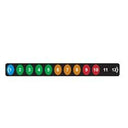
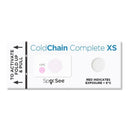
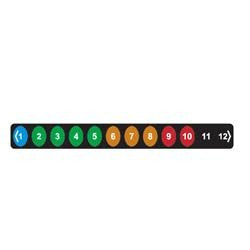
- Reversible: they show the current temperature. The LCD refrigerator thermometer covers 1 to 12 °C with a color code, and the cold chain indicator shows whether the temperature is below 2 °C, between 2 and 8 °C or above 8 °C.
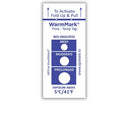
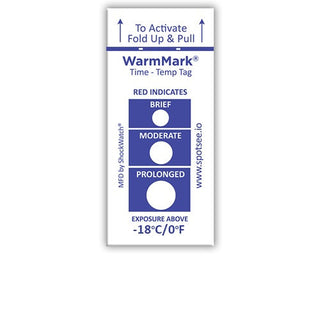
- Time and temperature: they change color progressively when a temperature is exceeded for a period. WarmMark is available for −18 °C (points at 1, 3 and 12 hours), 0 °C, 5 °C, 8 °C and 10 °C, among others.
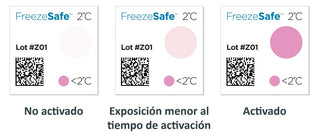
- Temperature drop: they warn if a product that must not freeze, such as fresh fruit and vegetables, fell below 0, 2 or 5 °C (FreezeSafe).
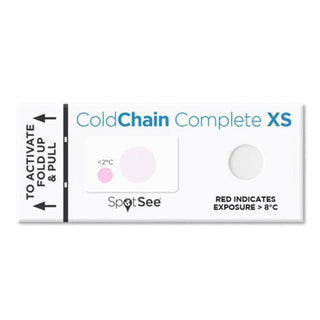
- Combined: Coldchain Complete XS detects both drops below 2 °C and rises above 8 °C on a single label.
Adhesive indicators complement electronic temperature data loggers: they do not give a history with data, but they show anyone, without instruments, whether there was a deviation.
Frequently asked questions about the food cold chain
At what temperature should frozen food be kept?
At −18 °C or below, throughout storage and transport. Quick-frozen food regulations allow small brief rises during transport and distribution, but the product must return to −18 °C. A time and temperature indicator at −18 °C leaves a record of how long it was above that.
At what temperature should chilled food be kept?
It depends on the product. Under Regulation (EC) 853/2004, ground meat must not exceed 2 °C, offal 3 °C, poultry meat 4 °C and fresh beef, pork or lamb 7 °C. For all other food, the label and each company's food safety plan prevail.
What happens if the cold chain is broken?
Microorganisms start multiplying again as the temperature rises, and that growth is not reversed by cooling the product down again. The food loses shelf life and, depending on the time and the temperature reached, may no longer be safe. With frozen food, partial thawing also damages the texture.
How do I know whether the cold chain was broken during transport?
With a temperature data logger or with an irreversible indicator stuck to the box or the pallet. A time and temperature indicator changes color progressively if its temperature was exceeded, so the recipient sees on unloading whether there was an exposure and roughly how long it lasted.
Where should the temperature indicator be placed in a cold room or a truck?
On the product or the pallet, and in the most exposed zones: near the door, at the top of the load and away from the evaporator. That way the indicator reflects what the food experiences and not just the air temperature next to the unit's sensor.
Recommended products
Temperature indicators selected for this application. Buy the reference you need online.
Shall we talk about your project?
Tell us about your use case and our engineering team will advise you on choosing the best solution.