


Bread baking temperature and oven control
TL;DR: The crumb of a loaf is baked when its interior reaches around 93–99 °C, while the oven usually works between 200 and 250 °C for lean dough breads and somewhat lower for enriched doughs. Checking that the oven reaches and holds its temperature is key to even baking. Surisa's irreversible labels, with points up to 260 °C, make it possible to check the maximum temperature reached on the tray or in different zones of the oven.
In a bakery, temperature comes into play throughout the process: in dough fermentation, in baking and in cooling. An oven that does not reach its temperature, or that heats unevenly, produces loaves with an underbaked crumb, a pale crust or color differences between trays.
Buy online
What happens to bread during baking
In international technical terminology, this is referred to as bread baking temperature, internal temperature of bread and oven temperature profiling.
| Temperature inside the loaf | What happens |
|---|---|
| Up to around 55–60 °C | The yeast is still active and the loaf rises in the oven |
| Around 60–70 °C | The starch gelatinizes and the crumb starts to form |
| From around 70 °C | The gluten proteins coagulate and set the structure |
| Around 93–99 °C | The crumb is baked |
The crust reaches much higher temperatures than the interior. Above around 140–150 °C the Maillard reaction and caramelization take place, giving bread its golden color and much of its aroma.
Oven temperature by type of bread
- Lean dough breads (baguette, ciabatta, round loaves): ovens at around 220–250 °C. Many are baked with the oven higher at the start and the temperature lowered afterwards.
- Enriched doughs (sandwich loaf, brioche, pastries): lower temperatures, usually between 170 and 200 °C, because sugar and fat brown sooner.
- Large pieces: longer at a somewhat lower temperature, so that the interior bakes before the crust darkens too much.
In every case, the exact temperature and time depend on the recipe, the size of the piece and the type of oven (deck, convection or rotary rack).
Why monitor the oven temperature
The oven's own gauge measures the temperature at a specific point. The trays, by contrast, may sit in hotter or cooler zones, especially in large or multi-deck ovens. The usual consequences of a poorly adjusted oven are:
- Underbaked crumb in the center of the pieces.
- A crust that is too dark or too pale.
- Differences in color and baking between trays from the same batch.
- More energy consumption than necessary.
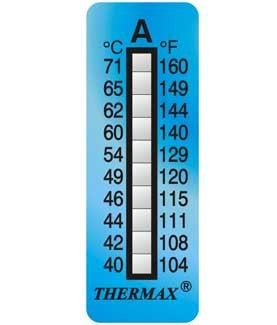
An irreversible temperature label stuck to the tray or at different positions in the oven shows, once baking is over, the maximum temperature reached at each point. It serves to check the oven without standing in front of it, compare trays and detect zones that do not reach temperature.
The labels record the temperature of the surface they are stuck to, not that of the inside of the loaf. For crumb temperature, a probe thermometer is used.
Which label to choose
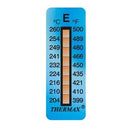
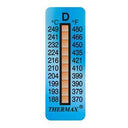
- Lean dough bread ovens (220–250 °C): 8-level label with a 204–260 °C range, or 10-level label with a 188–249 °C range.
- Enriched doughs and pastries (170–200 °C): 8-level label with a 160–199 °C range.
Surisa labels have an accuracy of ±1 % above 100 °C and a polyester layer that protects them from water, steam and grease.
Frequently asked questions about bread baking temperature
At what temperature is bread baked?
Most lean dough breads are baked with the oven between 220 and 250 °C, and enriched doughs, such as sandwich loaf or brioche, between 170 and 200 °C. The exact temperature depends on the recipe, the size of the piece and the type of oven.
What temperature should the inside of the bread reach?
Around 93–99 °C. At that temperature the starch has already gelatinized, the proteins have coagulated and the crumb has its final structure. It is measured with a probe thermometer inserted into the center of the piece.
Why does bread come out raw inside and burnt outside?
Usually because the oven is too hot for the size of the piece: the crust browns before the heat reaches the center. The solution is normally to lower the temperature and extend the baking time. It is also worth checking that the oven heats evenly.
How do I check whether my bakery oven heats evenly?
By sticking irreversible temperature labels on different trays or positions in the oven and comparing which points have turned black after a bake. If some zones read a lower temperature than others, the oven has cold spots that should be looked into.
Which temperature label withstands the temperature of a bread oven?
High-temperature irreversible labels. For ovens from 220 to 250 °C, an 8-level label with a 204–260 °C range or a 10-level label with a 188–249 °C range will do. They are stuck to a clean, dry surface, such as the edge of the tray.
Recommended products
Temperature indicators selected for this application. Buy the reference you need online.
Shall we talk about your project?
Tell us about your use case and our engineering team will advise you on choosing the best solution.