


Industrial oven temperature control
TL;DR: In an industrial oven, what matters is the temperature the part reaches, not just that of the air next to the oven's sensor. Irreversible temperature labels are stuck onto the part and show the maximum temperature reached, up to 290 °C. Above that value, or on very small parts, temperature indicating crayons are used, which Surisa stocks for 120, 245 and 600 °C.
Many manufacturing processes go through an oven: powder coating curing, drying, heat treatment of metal parts, rubber vulcanization or the lamination of photovoltaic modules. In all of them, a temperature difference between zones of the oven translates into defective parts, rework or unnecessary energy consumption.
Why measure the temperature on the part
In international technical terminology, this is referred to as industrial oven temperature monitoring, part temperature verification and oven temperature uniformity.
The oven controller regulates the air temperature at the point where its sensor sits. But the temperature of the part depends on its mass, its position in the load and the exposure time. The most common causes of deviation are:
- Hot and cold spots inside the chamber, due to poor air circulation or failing heating elements.
- Very dense loads, in which the parts at the center take longer to heat up.
- Parts of different mass in the same load, which do not reach the setpoint temperature at the same time.
- Leaks at doors or seals, which cool specific zones.
Measuring directly on the part makes it possible to detect these problems, adjust the process and avoid using more energy than necessary.
Irreversible labels: up to 290 °C
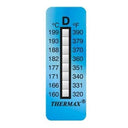
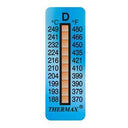
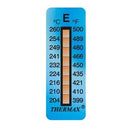
Irreversible temperature labels have one or more points that turn permanently black once the printed temperature is exceeded. They are the simplest and most economical option when the process does not exceed 290 °C.
How they are used:
- Choose a clean, dry area of the part.
- Stick the label on before the part goes into the oven.
- When the process is over, read which points have turned black: they indicate the maximum temperature reached.
- If needed, peel the label off and attach it to the batch quality record.
Surisa labels have an accuracy of ±1 % above 100 °C and a polyester layer that protects them from water, steam and oil.
Temperature indicating crayons: up to 600 °C
When the temperature exceeds 290 °C, or when the part is too small for a label to be stuck on, temperature indicating crayons are used. They are wax crayons with a dye that changes color on reaching its temperature.
It is enough to make a mark on the part before the process. If the part is going to be sold, the mark is removed afterwards by sanding the area. Another option is to mark a control part of the same material that travels with the load.
Which indicator to choose for each process
| Process temperature | Recommended indicator |
|---|---|
| 160–199 °C (for example, powder coating curing) | 8-level label, 160–199 °C range |
| 188–249 °C | 10-level label, 188–249 °C range |
| 204–260 °C | 8-level label, 204–260 °C range |
| Up to 290 °C, a single threshold | 1-level label (from 29 to 290 °C depending on the reference) |
| 120, 245 or 600 °C, or small parts | Temperature indicating crayon |
Labels and crayons are a simple, visual check. For temperature uniformity surveys with a continuous record, thermocouples and data loggers are used; adhesive indicators complement them in the routine control of each load.
Frequently asked questions about industrial oven temperature
How do I know what temperature a part reached inside the oven?
By sticking an irreversible temperature label onto the part before loading it. On leaving the oven, the blackened points indicate the maximum temperature reached on that part, regardless of what the oven controller reads.
What do I do if the process exceeds 290 °C?
Use a temperature indicating crayon. A mark is made on the part that changes color on reaching the crayon's temperature. Surisa stocks crayons for 120, 245 and 600 °C.
How do I detect cold spots in an industrial oven?
By placing temperature labels on parts at different positions in the load: front and back, top and bottom, center and edges. When the labels are compared after the process, the zones reading a lower temperature are the oven's cold spots.
Can the label be kept as a quality record?
Yes. The irreversible label can be peeled off after the process and attached to the batch report, as visual evidence of the temperature reached. The color change is permanent.
How accurate are temperature labels?
Surisa's irreversible labels have an accuracy of ±1 °C up to 100 °C and ±1 % above 100 °C. At 200 °C, that is equivalent to ±2 °C.
Recommended products
Temperature indicators selected for this application. Buy the reference you need online.
-
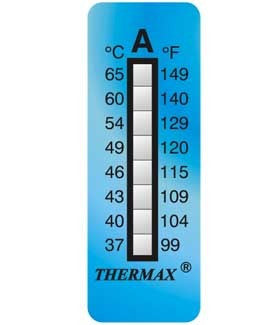 8 levels
- Size
- 51 x 18 mm
- Accuracy
- ±1 ºC (<100 ºC) · ±1 % (>100 ºC)
- References
- 5
-
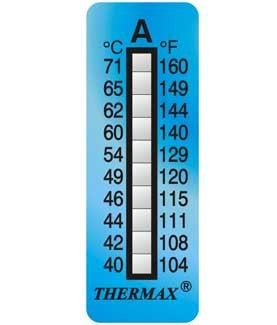 10 levels
- Size
- 51 x 18 mm
- Accuracy
- ±1 ºC (<100 ºC) · ±1 % (>100 ºC)
- References
- 4
-
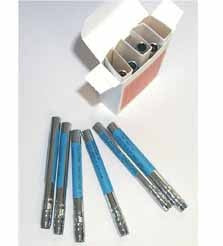 Lápiz termosensible
- Size
- 7,5 cm
- Accuracy
- ±5 ºC
- References
- 3
-
 1 level
- Size
- 12 x 13 mm
- Accuracy
- ±1 ºC (<100 ºC) · ±1 % (>100 ºC)
- References
- 49

Shall we talk about your project?
Tell us about your use case and our engineering team will advise you on choosing the best solution.