


Temperature control in industrial processes
TL;DR: In many industrial processes, what decides quality is the temperature the part receives, not the one shown by the oven or the machine. Surisa's irreversible labels are stuck onto the part and record the maximum temperature reached, from 29 to 290 °C; above that, temperature indicating crayons go up to 600 °C. There are also labels that warn of hot surfaces to prevent burns.
The sensors of an oven or a machine measure the temperature at the point where they are installed. With wear on heating elements and sensors, or with poorly distributed loads, the actual temperature of the part may be different. An adhesive indicator stuck onto the part gives a direct reading, with no cables or batteries, and can later be attached to the batch quality record.
In international technical terminology, this is referred to as industrial temperature indicators, irreversible temperature labels and temperature indicating crayons.
Buy online
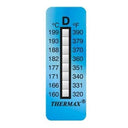
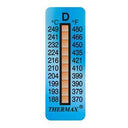
Applications in industry
- Industrial oven temperature control: how to verify the actual temperature of the part, cold spots and which indicator to choose for each process.
View irreversible thermometers →
Aluminum powder coating and painting
Powder coating of aluminum has two critical thermal stages:
- Drying after pretreatment, in ovens at around 120 °C.
- Curing of the coating, with the part between about 180 and 200 °C for the time specified by the coating manufacturer.
If the profile does not reach the curing temperature, the coating does not develop its hardness or its weather resistance. An 8-level label with a 160–199 °C range stuck to the profile shows, as it leaves the oven, the temperature it reached.
Vulcanization and tire manufacturing
In the manufacture of tires and rubber parts, temperature is critical in compound mixing. The first mixing stage works at around 160–170 °C, while the final stage, in which the curing agents are added, must stay below about 100–110 °C so that the compound does not start vulcanizing prematurely. Subsequent curing also requires the mold temperature to be controlled.
Heat treatment of metal parts
In tempering, which is applied after quenching to relieve internal stresses, the temperature depends on the properties sought: between about 150 and 250 °C for parts that must retain high hardness, such as tools, and much higher temperatures, in the order of 450–650 °C, when more toughness is wanted.
- Up to 290 °C: irreversible labels stuck onto the part.
- Above 290 °C: 600 °C temperature indicating crayons.
Can and photovoltaic module manufacturing
- Food and beverage cans: lacquers and coatings are cured in high-temperature ovens. A label stuck to a control can confirms the maximum temperature reached on the line.
- Photovoltaic modules: laminating the encapsulant to the glass requires reaching the temperature specified by its manufacturer to guarantee the module's seal. A single-point label takes up very little space and does not interfere with the electrical components.
Fusing of thermoadhesive interlinings
In garment making, thermoadhesive interlinings are bonded to the fabric with an exact combination of temperature, pressure and time. The press temperature must be checked daily across the whole pressing surface, before production starts. Control strips are placed between the fabric and the interlining, and measure the temperature right at the bond.
Engines: overheating control
The Temperature Recorder indicator is a 4-point irreversible label designed to monitor overheating in engine parts. It is used in warranty control: if the part overheated, the label records it permanently.
Workplace safety: hot surfaces
Pipes, radiators, machines and process equipment can reach temperatures that cause contact burns. The risk is greater when the surface alternates between cold and hot, because it is easier to let your guard down.
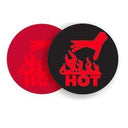
Tempsafe and Hand Hot safety labels change color when the surface heats up and display a visible warning. They are useful both in factories and in offices and shops, where whoever approaches the surface has no safety training.
Frequently asked questions about industrial temperature control
Why measure the temperature on the part and not in the oven?
Because the oven sensor measures the air at a specific point, and the part may be cooler because of its mass, its position in the load or poor air circulation. A label stuck onto the part records the temperature it actually received.
Up to what temperature do temperature labels work?
Surisa's irreversible labels cover 29 to 290 °C, depending on the reference. Above that temperature, or on very small parts, temperature indicating crayons are used, available for 120, 245 and 600 °C.
At what temperature does powder coating on aluminum cure?
Usually with the part between about 180 and 200 °C, for the time specified by the coating manufacturer. What matters is the temperature of the profile, not that of the oven air, which is why it is verified with a label stuck onto the part.
How do you mark a hot surface to prevent burns?
With safety labels that change color as the surface heats up and display a warning message. Being reversible, they warn only while the surface is hot, and they are stuck directly onto the pipe, the radiator or the machine.
Can the labels be used as a quality record?
Yes. Irreversible labels can be peeled off after the process and attached to the batch report as visual evidence of the temperature reached. The color change is permanent.
Recommended products
Temperature indicators selected for this application. Buy the reference you need online.
-
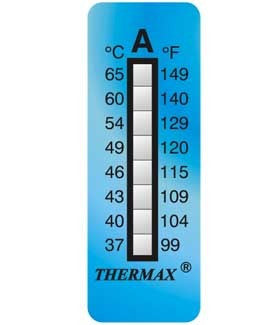 8 levels
- Size
- 51 x 18 mm
- Accuracy
- ±1 ºC (<100 ºC) · ±1 % (>100 ºC)
- References
- 5
-
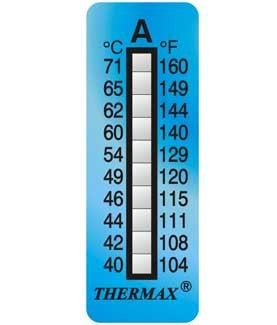 10 levels
- Size
- 51 x 18 mm
- Accuracy
- ±1 ºC (<100 ºC) · ±1 % (>100 ºC)
- References
- 4
-
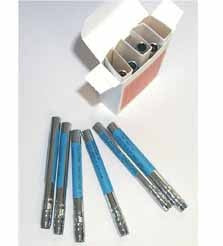 Lápiz termosensible
- Size
- 7,5 cm
- Accuracy
- ±5 ºC
- References
- 3
-
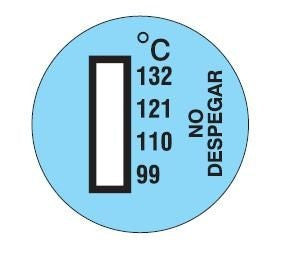 Temperature Recorder
- Size
- 25 mm
- Accuracy
- ±1 %
- References
- 4
-
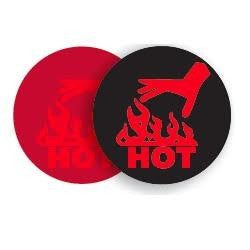 Hand Hot
- Size
- 37 mm
- Accuracy
- ±1 ºC
- References
- 1 (single)
Shall we talk about your project?
Tell us about your use case and our engineering team will advise you on choosing the best solution.