


Incubator temperature control
TL;DR: An incubator must hold a stable temperature close to its setpoint, usually between 35 and 38 °C depending on the application: around 37 °C for cell culture, between 36.5 and 37.5 °C body temperature for newborns, and around 37.5 °C for egg incubation. Adhesive thermometers allow a quick visual check: reversible ones show the current temperature and irreversible ones leave a record of whether a threshold has been exceeded. Surisa stocks labels with ranges covering 29 to 65 °C.
An incubator is an enclosed unit that holds temperature, and often humidity, at a controlled value for hours or days. Small deviations are enough to ruin a culture, compromise the development of an embryo or affect a newborn. That is why every incubator has electronic sensors, and why it also helps to have an independent check that can be read at a glance.
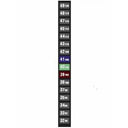
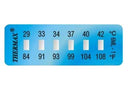
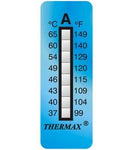
Reference temperatures by type of incubator
In international technical terminology, this is referred to as incubator temperature monitoring and, for the adhesive labels, as temperature indicator labels or, for the reversible ones, liquid crystal thermometers.
| Type of incubator | Typical temperature | What is at stake |
|---|---|---|
| Laboratory, cell culture | 37 °C | Cell viability and growth |
| Laboratory, microbiology | 30–37 °C, depending on the microorganism | Validity of the test and the count |
| Neonatal | Adjusted to keep the baby between 36.5 and 37.5 °C | Thermal stability of the newborn |
| Eggs (poultry farming) | Around 37.5 °C | Hatch rate and chick quality |
In every case, the exact setpoint is defined by the laboratory protocol, by clinical judgment or by the equipment manufacturer. What they have in common is that an error of one or two degrees, sustained over time, already has consequences.
Laboratory incubators
In microbiology, cell biology and pharmacy laboratories, the incubator is in continuous use. The most common causes of deviation are frequent door opening, overloaded shelves that restrict air circulation, and controller or sensor failures.
An adhesive label stuck inside lets anyone check the temperature when they open the unit, without relying on the display. An irreversible label also leaves a record of whether the working temperature was exceeded at any point, for example overnight or over a weekend.
Neonatal incubators
In a neonatal incubator, air temperature, humidity and the baby's body temperature are all monitored. Premature babies lose heat easily, so the aim is to keep their body temperature stable, between 36.5 and 37.5 °C.
Incubators work in two common modes:
- Air control: the unit regulates the air temperature inside the compartment according to the setpoint.
- Skin servo control: a sensor on the baby's abdomen measures their temperature and the unit adjusts the air to maintain it.
Adhesive thermometers are a visual aid for staff: they make it possible to check the temperature at the point where they are placed at a glance. They do not replace the unit's own sensors, alarms or clinical monitoring.
Egg incubators
In hen egg incubation, the working temperature is around 37.5 °C. Both too much and too little heat reduce the hatch rate and affect chick quality. Humidity is the other critical parameter and is usually raised over the final days, during the hatching phase.
Temperature deviations usually come from:
- Lack of fan maintenance, which creates warmer and cooler zones.
- An increase in the egg load without adjusting the unit.
- Water pooling in the base, which alters humidity and temperature.
- Problems with the ventilation dampers.
Spreading several labels across different trays helps detect zones with temperature differences within the same incubator.
Which adhesive thermometer to use in an incubator
Adhesive thermometers stick to any smooth surface and are read without instruments. There are two types, and in an incubator it is common to combine them:
- Reversible (LCD): they show the current temperature through a color change and return to their initial state when the temperature changes. They are for day-to-day reading.
- Irreversible: each point changes color permanently once the printed temperature is exceeded. They tell you whether a threshold was exceeded even if nobody was watching at the time.
Ranges available for incubators
- Reading the current temperature: vertical LCD thermometer with 16 levels and a 32–49 °C range, or LCD thermometer with 11 levels and a 0–50 °C range.
- Detecting overheating from 29 °C: irreversible mini thermometer with 6 levels and a 29–42 °C range.
- Detecting overheating from 37 °C: irreversible thermometer with 8 levels and a 37–65 °C range.
Frequently asked questions about incubator temperature
What temperature should an incubator be at?
It depends on the application. Cell culture incubators work at 37 °C, microbiology incubators between 30 and 37 °C depending on the microorganism, hen egg incubators at around 37.5 °C, and neonatal incubators are adjusted to keep the baby's body temperature between 36.5 and 37.5 °C. The exact setpoint is defined by the protocol or by the equipment manufacturer.
How can I check that the incubator temperature is correct?
Besides the unit's own reading, you can stick an adhesive thermometer inside. A reversible LCD thermometer shows the current temperature through a color change, with no batteries or instruments. If the label reading does not match the unit's, it is worth checking the sensor or the controller.
What is the difference between a reversible and an irreversible adhesive thermometer?
The reversible one shows the temperature at that moment and changes as the temperature rises or falls, so it can be read as many times as you like. The irreversible one changes color permanently once the printed temperature is exceeded: it does not show the current temperature, but whether that value was exceeded at some point.
How do I detect whether my incubator overheated overnight?
With an irreversible thermometer whose range starts just above the working temperature. For an incubator at 37 °C, for example, an 8-level label with a 37–65 °C range will do: if a point has changed color by the next day, the temperature exceeded that value at some point.
Do adhesive thermometers replace the incubator sensor?
No. The unit's sensors and alarms are the primary control system. Adhesive thermometers are an independent, visual check: they help detect sensor faults, zones at a different temperature within the unit, or overheating episodes.
Recommended products
Temperature indicators selected for this application. Buy the reference you need online.
-
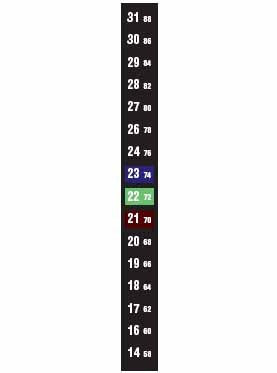 16 levels vertical
- Accuracy
- ±1 ºC
- References
- 4
-
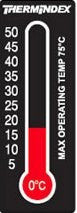 11 levels
- Size
- 18 x 51 mm
- Accuracy
- ±1 ºC
- References
- 2
-
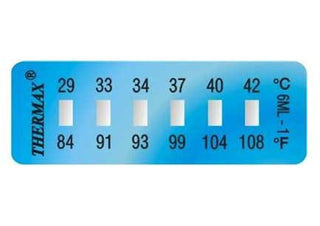 6 levels mini
- Size
- 12 x 32 mm
- Accuracy
- ±1 ºC (<100 ºC) · ±1 % (>100 ºC)
- References
- 8
-
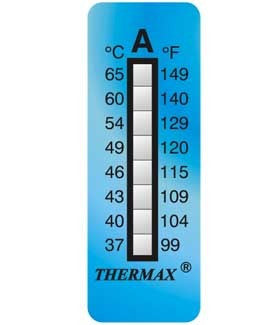 8 levels
- Size
- 51 x 18 mm
- Accuracy
- ±1 ºC (<100 ºC) · ±1 % (>100 ºC)
- References
- 5
Shall we talk about your project?
Tell us about your use case and our engineering team will advise you on choosing the best solution.